Write in the proposed local coordinates. The multivariable chain rule givesConsequentlyAway from the origin the Jacobian determinant is , so the inverse function theorem justifies these local coordinates. Therefore and the local general solution isSubstitution verifies the result: and , whose weighted sum vanishes.
There is a global qualification. The coordinate map is two-to-one, and a level set of has separate characteristic curve branches. A single profile on the entire plane does not follow without a branch-identification assumption. For example, take on the wedge , , and zero elsewhere. This is smooth, satisfies the equation, and has different values at and despite equal . The characteristic components of a hyperbolic first-order equation explain this obstruction. At the origin the coordinate map is singular and the original equation reads ; the boxed answer is the intended local form on a regular branch, or a global form under an additional identification of branches.
The first partial derivatives factor asIf either coordinate vanishes, the other equation forces the other coordinate to vanish as well. If both are nonzero, subtracting the two bracket equations gives , and then . Thus the complete list of stationary points is and the four points .
The Hessian matrix isAt the origin it is , which is a positive-definite matrix. At the four other points its eigenvalues are and , independently of the signs. The second-derivative test therefore givesThere are no local maxima. The minimum at the origin is not global, since as .
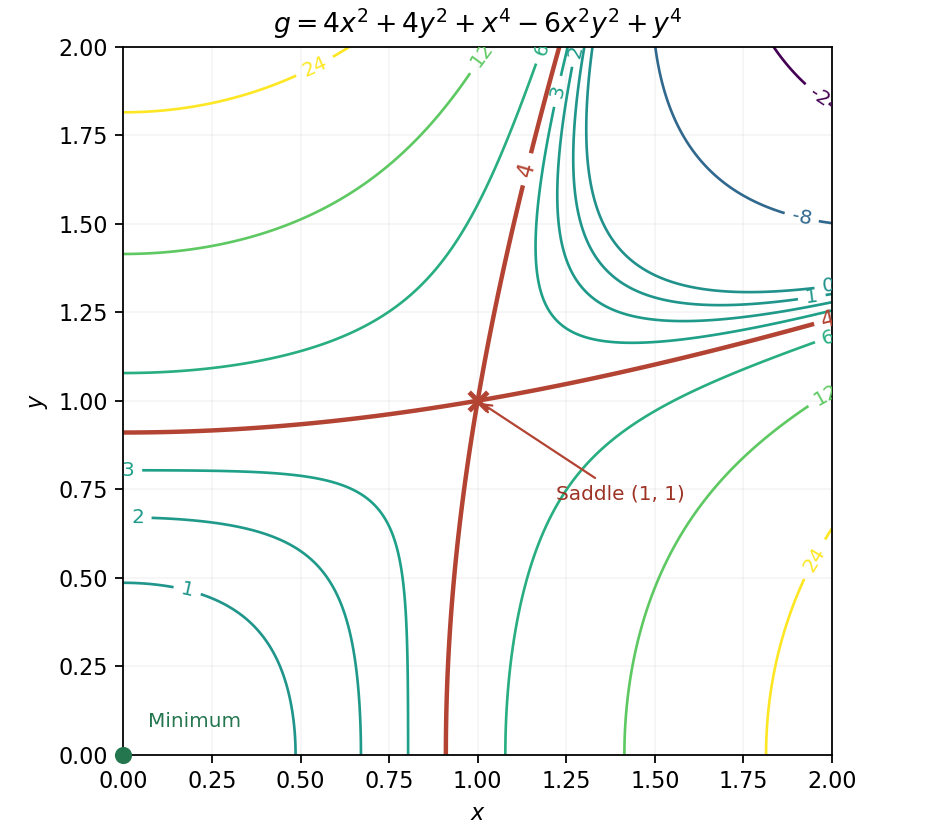
Within the requested first-quadrant square, the stationary points visible in the contour plot are the corner minimum and the saddle . Near the origin, , so the low positive contours look like quarter-circles. Along either coordinate axis, rises monotonically. Along the diagonal, rises to at , returns to zero at , then becomes negative.
The saddle contour crosses at and separates the central positive contours from the outer diagonal region. Negative contours occur toward , where , while the axis corners and have . These checks determine both the contour ordering and the change of connectivity at the saddle; the figure shows these level sets.

Articles by others on the same topic
There are currently no matching articles.