Take for the sketch; changing its sign rotates the picture by . The parametric curve passes through at and through at . As it returns towards the origin, since and . The positive- branch makes a loop in the first quadrant, leaving the origin tangent to the positive axis and returning tangent to the positive axis.
For a more precise sketch, differentiation givesThe loop has its largest at and largest at . Their coordinates are and its reflection in .
The parameter value is excluded. Cancelling the common factor in the sum givesThus the asymptote is . As , and ; as , and . The branch approaches the origin from the fourth quadrant as , while connects the other infinite branch to the origin through the second quadrant.
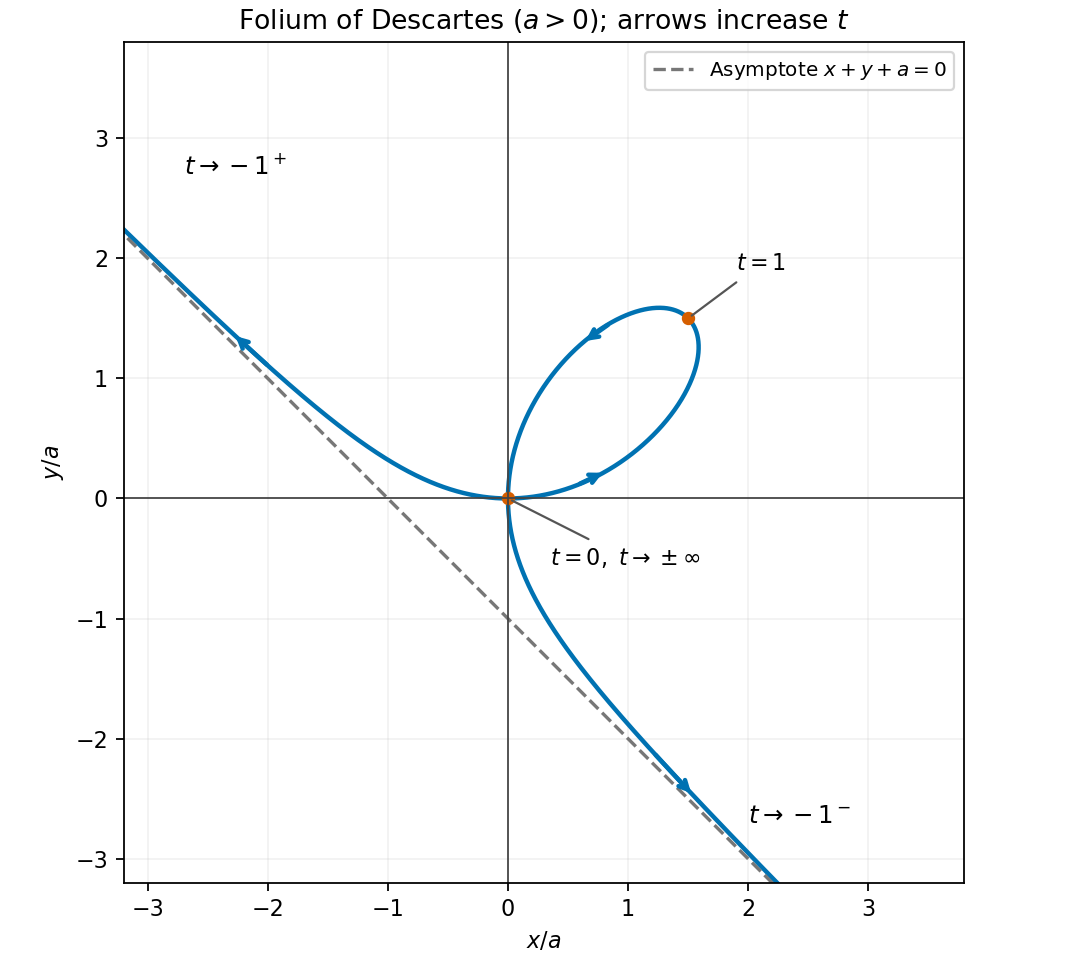

This is the folium of Descartes. If , the parametrization degenerates to the origin for every defined parameter value and there is no nontrivial loop.
For , both coordinates are nonnegative exactly on the loop branch . It leaves the origin at and returns there in the limit . Thus the loop is traced once bywith the limiting endpoint identified with the starting point. The same parameter range traces the rotated loop when .
On the loop, , so and . The traversal is anticlockwise. The area formula from Green's theorem becomesSet to obtainAlthough the parameter interval is unbounded, the return to the origin closes the loop and the integral converges.
Cubing and adding the parametrized coordinates yieldsTherefore the implicit algebraic curve isFor , every nonorigin real point on this curve has and can be recovered using ; the origin is already included. The equation is invariant under exchanging and , so its reflection line is . In the parametrization that reflection corresponds to replacing by . If , the implicit cubic degenerates to the line , whereas the given parametrization only describes the origin, so this degenerate case must be kept separate.
Articles by others on the same topic
There are currently no matching articles.