The complex modulus is a nonnegative real number. Equality therefore requires itself to be real and nonnegative. Its imaginary part gives , and its real part then gives . Conversely every such point satisfies the equality. Hence the complete solution set isGeometrically this is the closed ray on the real axis starting at .
The common ratio in the two plane equations can be denoted by . Their intersection then has , , and . The direction vector has Euclidean norm , so the requested unit vector form isSubstituting this expression into both equations gives the same ratio , verifying the entire line.
Apply the multivariable chain rule, keeping the other new coordinate fixed in each differentiation. At fixed , the derivatives of with respect to are . At fixed , their derivatives with respect to are . ThusThe factor two arises because the ordinary polar angle is .
A double six has probability on each independent throw. For Alice to win on her second turn, her first throw and Bob's first throw must both fail, then her second throw must succeed. Therefore
Write . Alice wins on her st turn if complete rounds fail and then she succeeds. These disjoint events give the geometric seriesConsequentlyThe probability of never obtaining a winner is . The small advantage over comes from taking the first turn.
Yes. The matrix is a real symmetric matrix, so the spectral theorem for real symmetric matrices provides an orthonormal basis of real eigenvectors and hence a real diagonal form. Explicitly its characteristic polynomial is , with distinct real eigenvalues
The characteristic polynomial is , with eigenvalues . A real diagonal form can have only real eigenvalues, so it requires . Conversely, when , the rotation matrix is already . Thus
The potential is smooth everywhere, so its mixed partial derivatives commute. The curl of a gradient therefore vanishes:
The fundamental theorem for line integrals evaluates this conservative vector field integral by the change in potential. At the initial point . At the final point , so the exponential factor is one, andThe detailed shape of the path does not affect this line integral.
Use the double-angle identity . The Fourier series is already a finite trigonometric sum:In the usual Fourier sine series convention, , all other vanish, and all cosine coefficients and the constant coefficient vanish.
Differentiation of the finite sum involves no convergence issue. The derivative has the Fourier cosine series
The characteristic equation is , so the repeated-root constant-coefficient differential equation gives the general solution . The first boundary condition gives , and the second gives , hence . Therefore
For a spherically symmetric mass density, the angular integral in spherical coordinates is . The two disjoint shell contributions therefore give the masssoBoth contributions are positive because and .
In a multivariable Taylor series, order means total degree. The only nonzero monomial of total degree at most three is ; there are no constant, linear, or cubic terms. Thusnear the origin.
The gradient vanishes at the origin. Its Hessian matrix there iswith eigenvalues and . The quadratic term is therefore indefinite, so the origin is a saddle point of a scalar function. Equivalently, the leading term is positive along and negative along .
The independent vectors span the plane through the origin, and their cross product is a nonzero normal vector. Thus the required nonparametric equation is
The orientation assumption gives . The same open half-space is therefore characterized byEquality would put the point in the separating plane, rather than strictly on the same side.
Take two edge vectors in the face, and . Their cross product is the face normal vectorThe face plane is . Every term in except vanishes, givingThe scalar triple product is nonzero, so this normal cannot vanish.
Set . Since these vectors form a basis, write . The reciprocal basis givesA point is in the closed tetrahedron precisely when it is a convex combination of the four vertices, with weights . Thus the necessary and sufficient conditions areThese four half-spaces are the four inward sides of its faces. This is tetrahedron membership via scalar triple products; making all inequalities strict describes the interior.
The opposite face lies in the plane spanned by through the origin. Directly,The distance from a point to a plane is the absolute normal component, soHere , so the perpendicular foot is the origin, a vertex of the opposite triangular face. Thus the distance to the actual face equals the distance to its containing plane.
Put so that the radial range respects the stated allowance . With the azimuth measured from the starting meridian, the cylindrical coordinates of the curved surface satisfyAt all azimuths describe the same apex. The surface is a sector of an elliptic paraboloid.
The volume element in cylindrical coordinates is . Integrating from the base to the curved surface givesHenceFor a complete rotation this is half the volume of the enclosing cylinder.
Use the embedded surface parametrizationIts tangent vectors have cross productwhose magnitude is . Thus the surface area isWith , the radial integral becomes . Evaluating its endpoints givesThis is the scalar-area part of the paraboloid sector surface measures.
For , apply the binomial series to the result in (c):ThereforeFor , the leading term is , the area of the base disk. A very shallow cap is nearly planar; its first area excess is .
The upward orientation of corresponds to traversing the boundary from the apex to the starting rim, around the rim in increasing azimuth, and back to the apex. This is the indicated orientation and is outward from the solid. Integrate that vector area element directly:The radial integrals are in the horizontal components and in the vertical component. Hence the vector area isThe absolute value is needed only because the original statement permits negative . Reversing the boundary orientation reverses the entire vector. For a full rotation the horizontal components cancel, leaving , the signed projected area of the base.
Take for the sketch; changing its sign rotates the picture by . The parametric curve passes through at and through at . As it returns towards the origin, since and . The positive- branch makes a loop in the first quadrant, leaving the origin tangent to the positive axis and returning tangent to the positive axis.
For a more precise sketch, differentiation givesThe loop has its largest at and largest at . Their coordinates are and its reflection in .
The parameter value is excluded. Cancelling the common factor in the sum givesThus the asymptote is . As , and ; as , and . The branch approaches the origin from the fourth quadrant as , while connects the other infinite branch to the origin through the second quadrant.
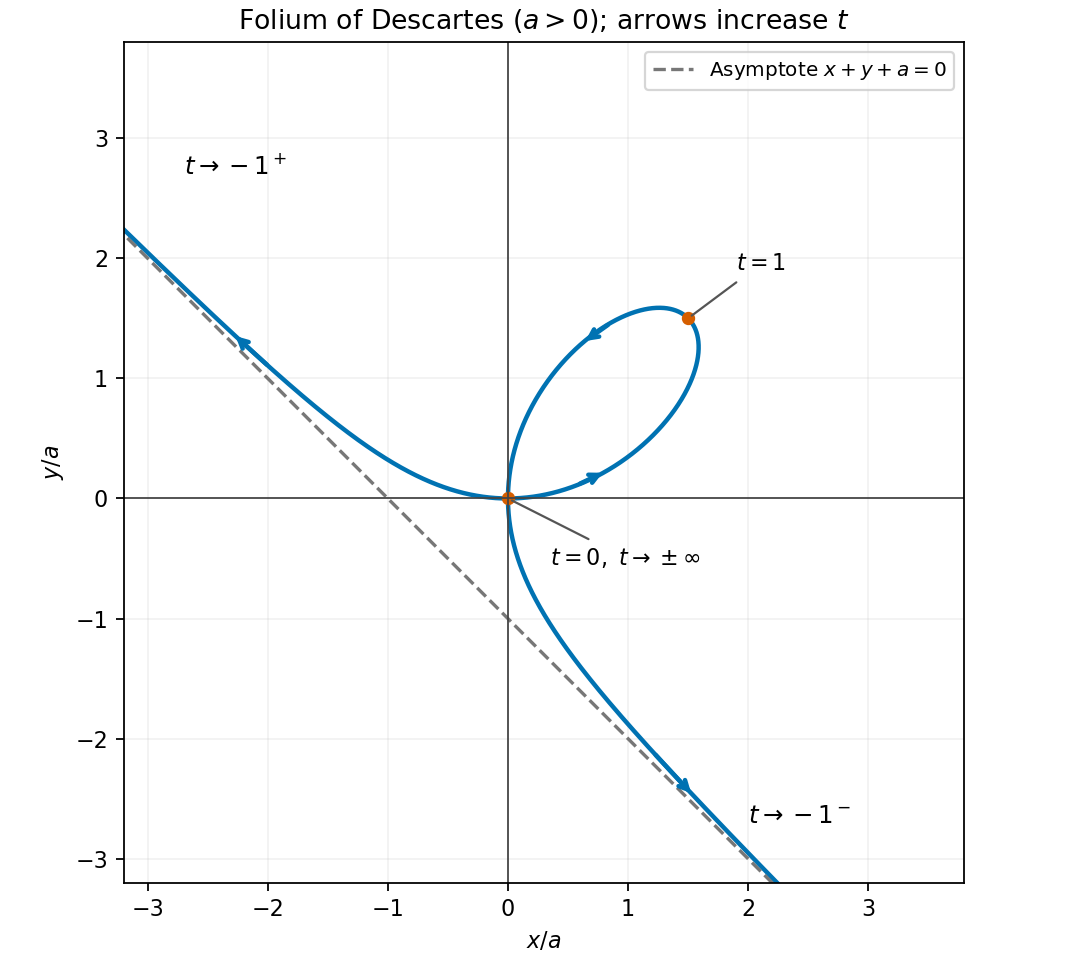

This is the folium of Descartes. If , the parametrization degenerates to the origin for every defined parameter value and there is no nontrivial loop.
For , both coordinates are nonnegative exactly on the loop branch . It leaves the origin at and returns there in the limit . Thus the loop is traced once bywith the limiting endpoint identified with the starting point. The same parameter range traces the rotated loop when .
On the loop, , so and . The traversal is anticlockwise. The area formula from Green's theorem becomesSet to obtainAlthough the parameter interval is unbounded, the return to the origin closes the loop and the integral converges.
Cubing and adding the parametrized coordinates yieldsTherefore the implicit algebraic curve isFor , every nonorigin real point on this curve has and can be recovered using ; the origin is already included. The equation is invariant under exchanging and , so its reflection line is . In the parametrization that reflection corresponds to replacing by . If , the implicit cubic degenerates to the line , whereas the given parametrization only describes the origin, so this degenerate case must be kept separate.
An integrating factor isMultiplying the linear ordinary differential equation by it givesThe right-hand side integrates to , soThis holds on every interval where the coefficient is defined. If , intervals cannot cross ; equivalently the family is on either half-line, with an independently chosen constant.
With , the chain rule givesFor , this separable differential equation givesRestoring and absorbing constants, the nonconstant branches satisfyThe constant branch lost in division is , giving the additional solution . All branches must avoid , where the original differential equation is undefined.
Yes: . Its derivative is , while substitution into the right-hand side gives . This is the equilibrium of the transformed autonomous differential equation; it must be restored separately after dividing by in the separated solution.
It is the only straight-line solution. Substituting into the original equation shows that would require from the coefficients, but the constant coefficients would then give . For , the constant equation gives .
Let , so that . Differentiation givesMove the first term to the left and useSince for real and , cancellation givesThis is the slope parameter for a homogeneous first-order equation reduction.
For , separate variables and use partial fraction decomposition:Integration yieldsOn any connected solution interval, absorb the fixed signs into a real constant to writeThe two real signs of the square root are chosen consistently on a branch where . The constant solutions of the reduced equation are . The original equation excludes the last two; is retained by for .
From , we have . Substitution into the original relation gives , soThese are real parabola branches, with either sign of allowed when the branch is real. For , differentiating gives and verifies both the relation and the slope. Use graph intervals with and , so the slope is finite and . The separate constant-slope case gives , also represented by the degenerate choice . Squaring has not imposed a sign on , so both real graph branches must be included.
The homogeneous linear system has solution set , a vector subspace. If it contains only the zero vector, no two different solutions of the full system can exist: their difference would be a nonzero homogeneous solution.
A particular solution to the full system exists exactly when belongs to the image of a linear map . If it exists, every solution isIndeed, subtracting from gives , and conversely adding a kernel vector preserves the right-hand side. Thus there are no solutions, one solution if the kernel is trivial, or infinitely many solutions if it is nontrivial. The last solution set is an affine subspace of dimension , determined by the rank-nullity theorem. For a square nonsingular matrix there is one solution for every right-hand side.
Subtracting the third row from the first gives , and the third row gives . The second row then reduces toFor , the unique solution isConsequently gives for every , whereas gives
When , the first and second left-hand sides coincide. If , they are the same plane, and the remaining independent plane cuts it in the lineIf , the two planes are distinct and parallel, so there is no solution. Geometrically, for the three planes intersect at a single point; at the coincident-plane case leaves an entire line, while the parallel-plane case has empty intersection.
Let count green balls. Sampling without replacement gives a hypergeometric distribution. The possible values are , and counting equally likely three-element samples givesThereforeTheir sum is , as required for a probability distribution.
Compute the first two moments from the probability distribution:The variance is , so the expected value and standard deviation are
The interval within one standard deviation is . Of the possible integer outcomes , only lies in this interval. Hence
Three draws cannot all be green because there are only two green balls. Thus the probability of at least one red ball is . At least two red balls means , so
Articles were limited to the first 100 out of 157 total.
Articles by others on the same topic
There are currently no matching articles.