In polar coordinates, , , with . Thus the polar form of a complex number isHere is its complex modulus; for , the complex argument is determined modulo . At the angle is undefined, although every value of gives the same point when .
For , the complex logarithm is , where . ConsequentlyA specified branch chooses one continuous determination of the complex argument on an appropriate cut domain. For the usual principal-value convention use the principal argument . A formula using only would lose the quadrant information; it is a valid local angle only with the appropriate additive multiple of .
Expand the defining complex exponential functions:Thus the real part and imaginary part of the hyperbolic cosine are
A constant real part means , so its level sets are the concentric circlesTheir radii are strictly positive. The real part is independent of the logarithm's branch, so there is no branch ambiguity in these circles.
For , the equation is . If , complete the square to obtainThese circles have centres on the real axis and are tangent to the imaginary axis at the excluded origin. Positive puts the circle to the right, negative to the left. The separate case gives the punctured imaginary axis . The sketch uses an open marker at the origin to emphasize that is never defined there.
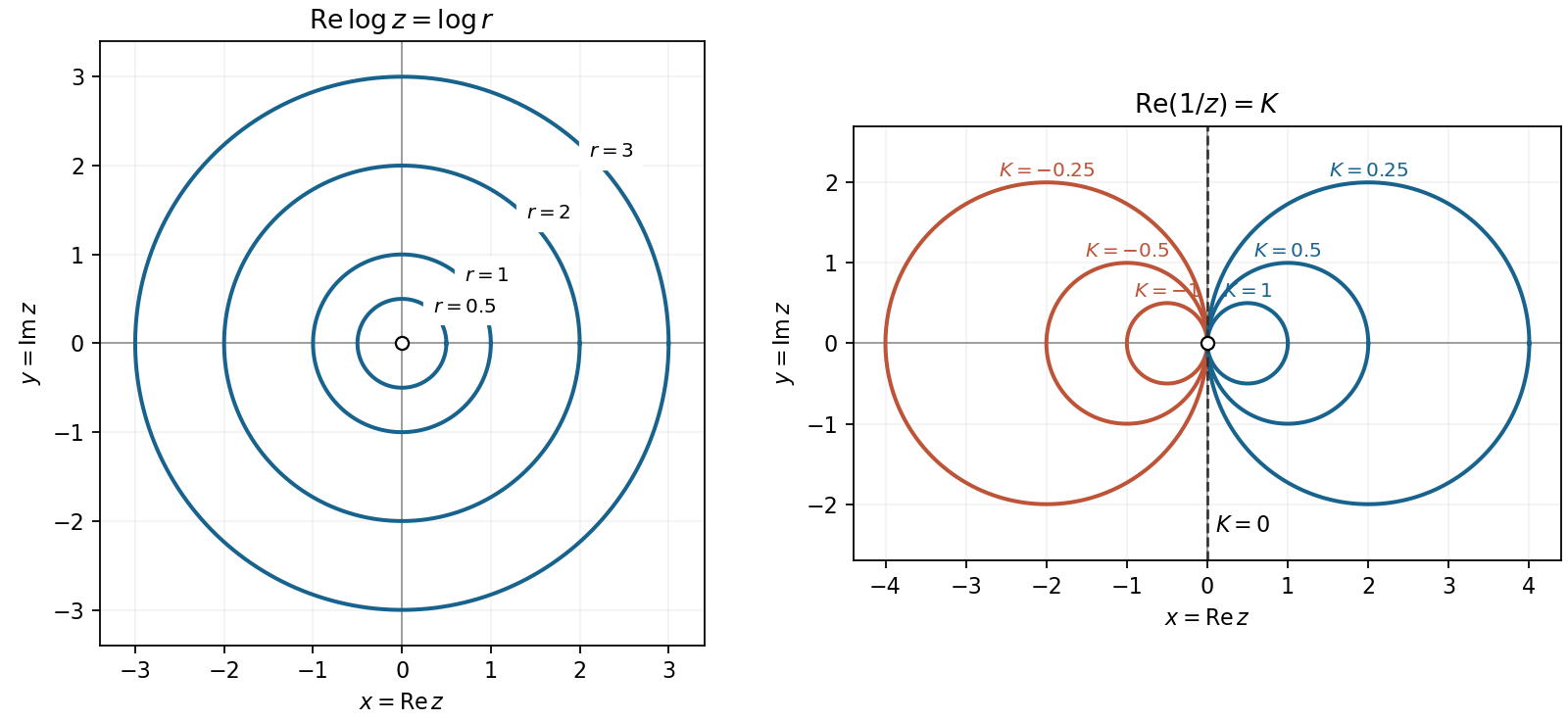
Constant real-part contours of the complex logarithm and reciprocal
. Details. 
Set . The hyperbolic cosine equation becomes , hence . Its two polynomial roots are , both negative. Taking every value of the complex logarithm yieldsSince , their real logarithms have opposite signs. All solutions are thereforeThe positive real constant is also , the inverse hyperbolic cosine of . Substitution gives for both signs and every integer .
Articles by others on the same topic
There are currently no matching articles.