The seven requested parabolas are for ; the case is the horizontal axis. Positive opens upward, negative downward, and larger gives a narrower parabola. All pass through the origin with a horizontal tangent line.
To find orthogonal trajectories, use the continuous family containing these seven representative members. Its slope is away from . Two finite slopes of perpendicular tangents multiply to , so the orthogonal slope isThis separable differential equation gives , henceThese ellipses are the regular real trajectories; is a single point, not a regular curve, and has no real points. One example is , with semiaxes horizontally and vertically.
The implicit tangent relation also describes points with vertical tangents, where the slope quotient is unavailable. At intersections with the member , the ellipse has a vertical tangent line and is perpendicular to that horizontal axis. The common origin of the parabolas is not on any regular trajectory with . The sketch shows the requested seven members and the example ellipse.
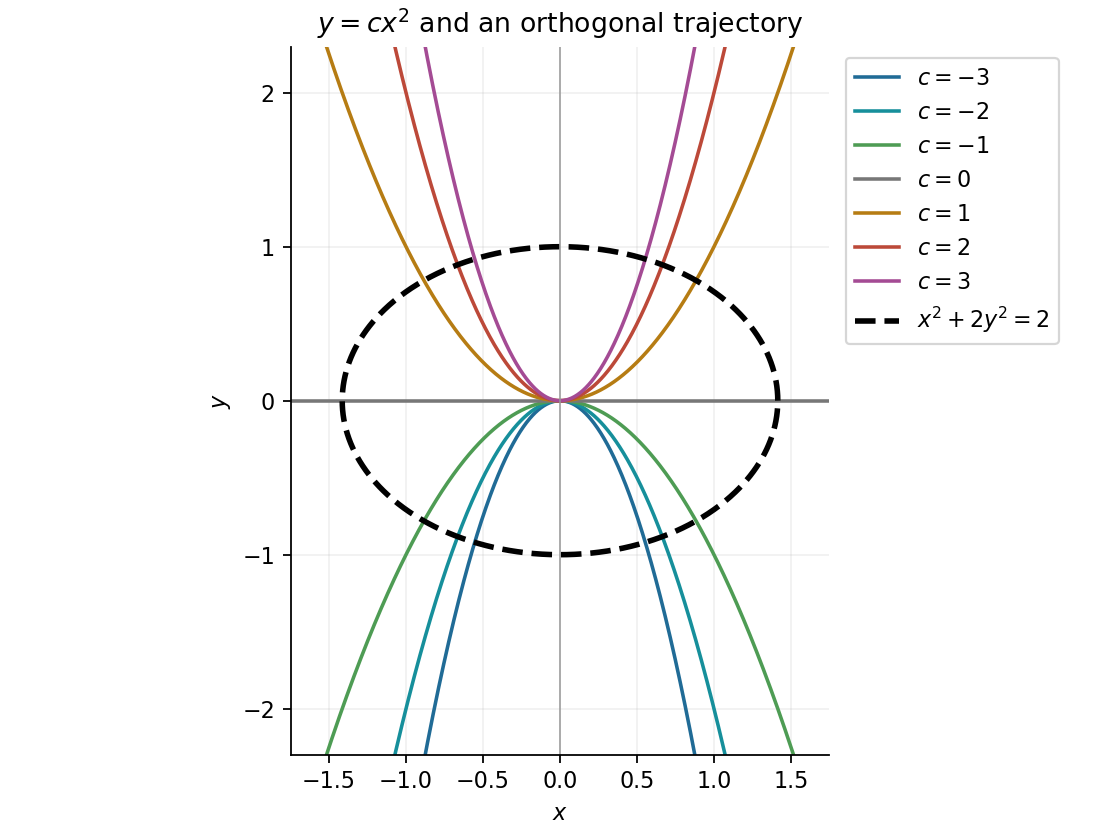
Seven parabolic family members and an elliptical orthogonal trajectory
. Details. 
Articles by others on the same topic
There are currently no matching articles.