The region is an unbounded wedge in the first quadrant, lying between the rays and . Both boundaries and the origin are included. For integration in the opposite order, the same region is with .
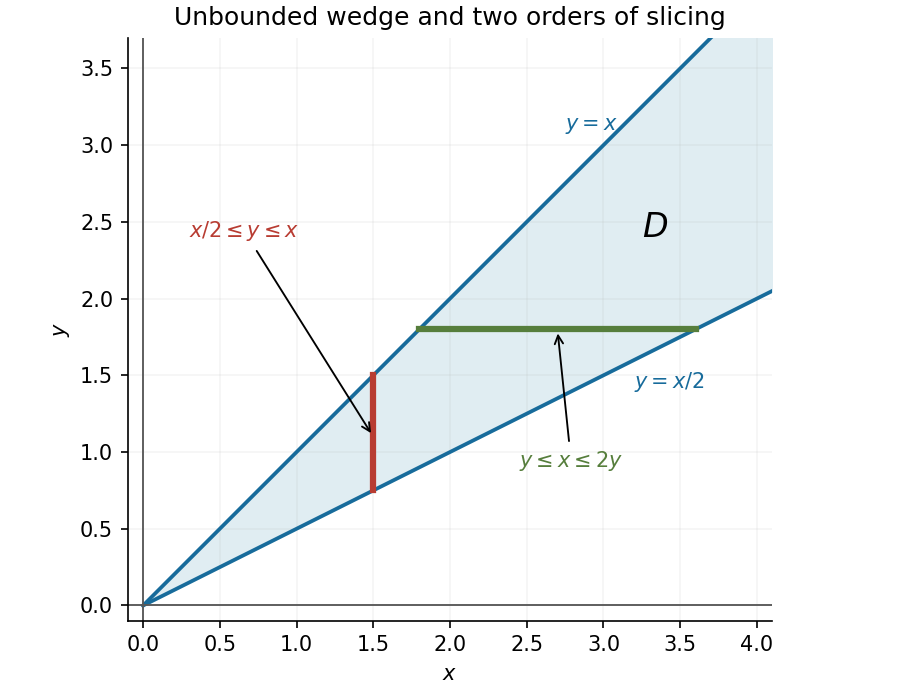
The integration wedge and representative vertical and horizontal slices
. Details. 
For fixed , integrate first over :The integrand is nonnegative, so this order of the double integral is legitimate even before its finiteness is known. Applying the scaled Gaussian integral yields
Reverse the order in the nonnegative double integral, using and . For , an antiderivative in is . ThusLet denote the requested improper integral. Its numerator is near zero, so its apparent singularity is removable; it also decays at infinity. We may therefore separate the preceding expression into the convergent integralsIt follows thatThe two terms divided separately by would each have a divergent integral at zero; the cancellation in their difference is essential.
Scale the ellipsoid to a unit ball usingwith , and . This is spherical coordinates followed by a diagonal linear transformation, so the Jacobian determinant is . The required volume integral is
The ellipsoid and the exponential factor are invariant under separate reflections of any coordinate. Split the integrand into its two polynomial terms. The term times that exponential is odd in , so its volume integral vanishes by reflecting . The other term times the exponential is odd in , so its volume integral vanishes by reflecting . Both integrands are continuous on a bounded region. Therefore odd-integrand cancellation by reflection gives
Articles by others on the same topic
There are currently no matching articles.