In spherical coordinates, with polar angle and azimuth , the volume element isThe mass density is radial, so integrating over both angles givesWriting , this becomesAlthough the mass density diverges like near the origin, multiplication by the spherical volume element gives an integrable expression. Thus the central singularity does not produce infinite mass.
For , expand the exponential function in powers of :The constant and linear terms cancel in , givingFor , is exponentially small:The small- correction is smaller than every positive power of beyond the displayed linear term. In dimensional terms, the large- leading mass is , while the small- limit is .
The positive-domain graph starts with limiting value and limiting slope , then decreases towards the horizontal asymptote , with for large . In fact direct differentiation givesThe first inequality follows from for . Thus the graph is strictly decreasing and convex upward, with and no stationary points. The integral representation also shows its positivity.
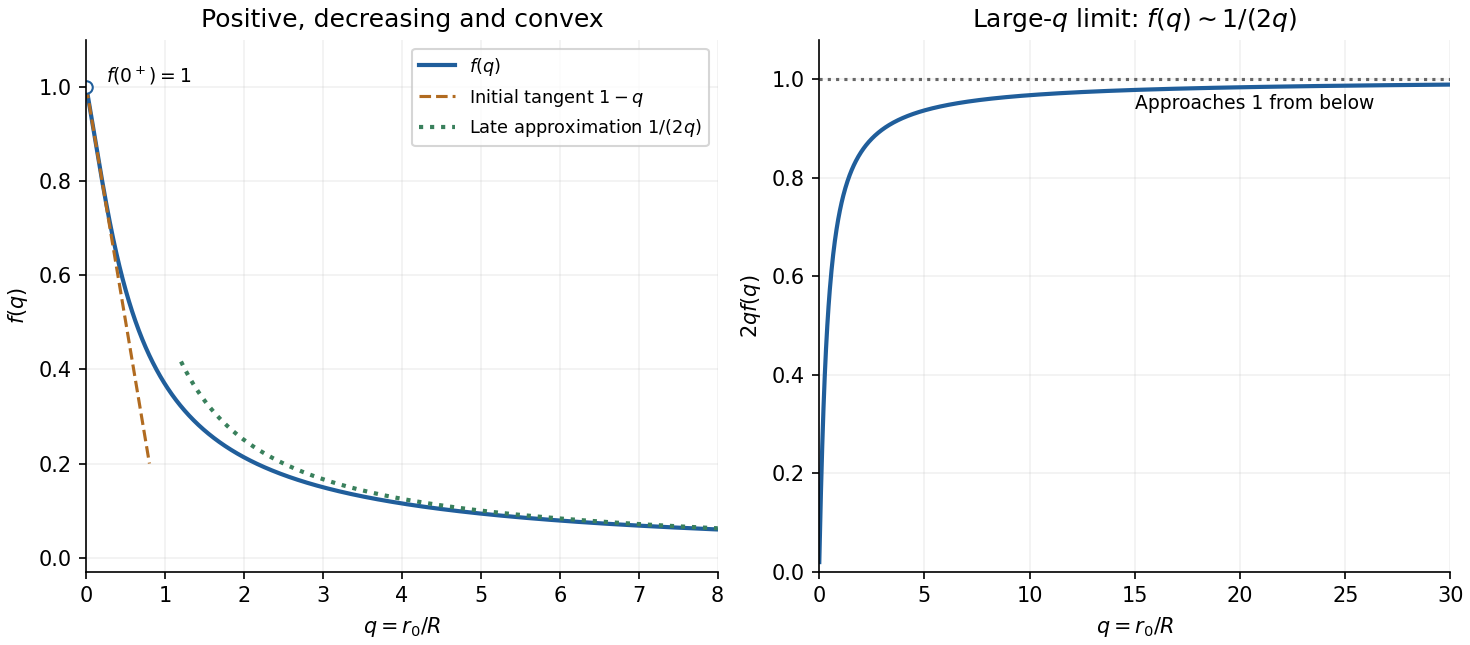

These properties belong to the reusable exponential spherical mass factor.
Use cylindrical coordinates , . The Jacobian determinant givesThe inequalities imply and . Thus the volume isEquivalently, integrating vertically first gives . The region is bounded by an elliptic paraboloid and its top disc; its volume is half that of the cylinder with base radius and height . Including or excluding the boundary surfaces does not change the volume.
Articles by others on the same topic
There are currently no matching articles.