The probability density is symmetric about , vanishes at and , and has its single maximum at . It is zero outside that interval. Its area is one: with the dimensionless change of variablesnormalization is .
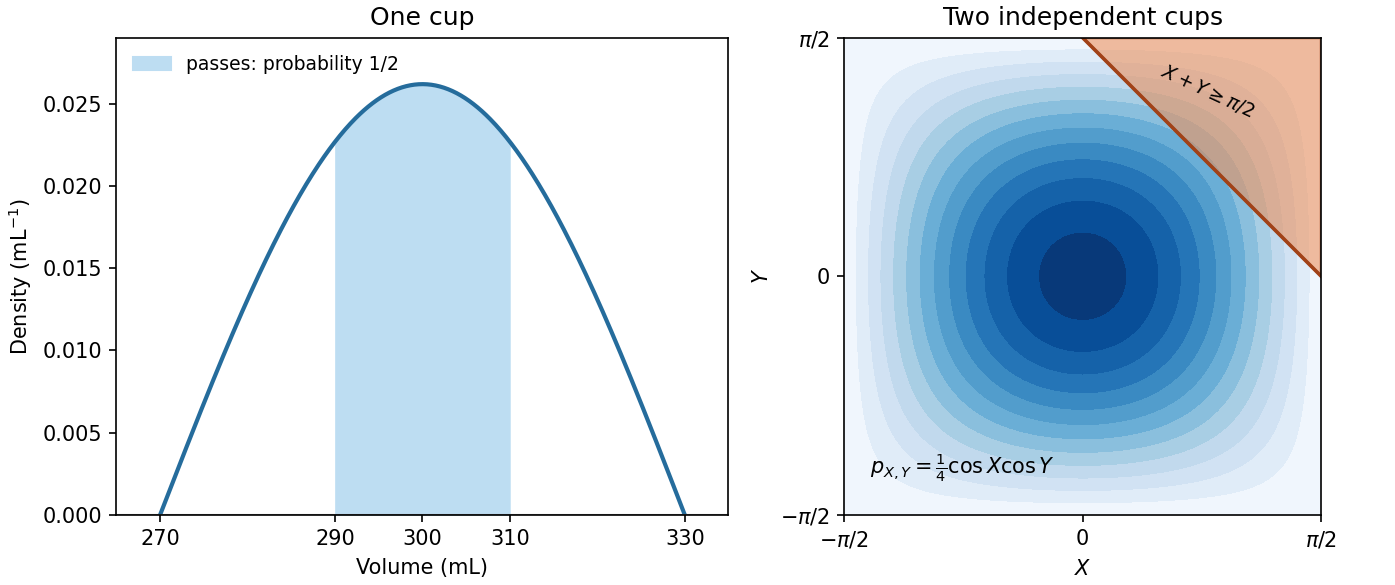

Passing corresponds to in the normalized variable from part (i). Integrating its probability density,The complementary probability of detecting the fault in one test is also .
The absolutely convergent geometric series has sum for . Its Cauchy product with itself isThere are exactly pairs of nonnegative integers whose sum is . Relabeling provesAbsolute convergence justifies the multiplication and regrouping; no differentiation of an infinite series is needed.
Let count tests up to and including the first failure. By independence of random variables, the event requires passes and then a failure. With pass probability and failure probability , this is the geometric distributionUsing part (iii), its expected value isThis counts the test that discovers the fault. The expected number of earlier passing tests alone would be one.
Apply the same dimensionless transformation independently to the two cups, giving . The total-volume condition becomes . Since neither variable can exceed , this region has and , the triangle shown above.
By independence of random variables, the joint probability density is . The desired double integral isThusBoundary equality has probability zero for these continuous random variables.
Articles by others on the same topic
There are currently no matching articles.