Use the full set of complex logarithm values of :By the definition of complex exponentiation, the inner power can therefore take any value , a positive real number. Its complex logarithm values are , where . ThusAll possible real parts and imaginary parts are consequentlyChoosing the principal complex logarithm at both stages gives the particular value . The independent logarithm choices are needed because the question asks for all possible values.
The inner power takes the values . For each such real exponent, all values of the outer complex exponentiation are obtained from all complex logarithm values of its base :Writing , the answer isAll values lie on the unit circle. The principal choice is , giving . In particular the two nestings in parts (i) and (ii) are different: complex exponentiation is not associative.
The complex modulus is the Euclidean distance from to . Thus the locus isa circle with centre and radius . Its extreme horizontal coordinates are and , and its extreme vertical coordinates are also and .
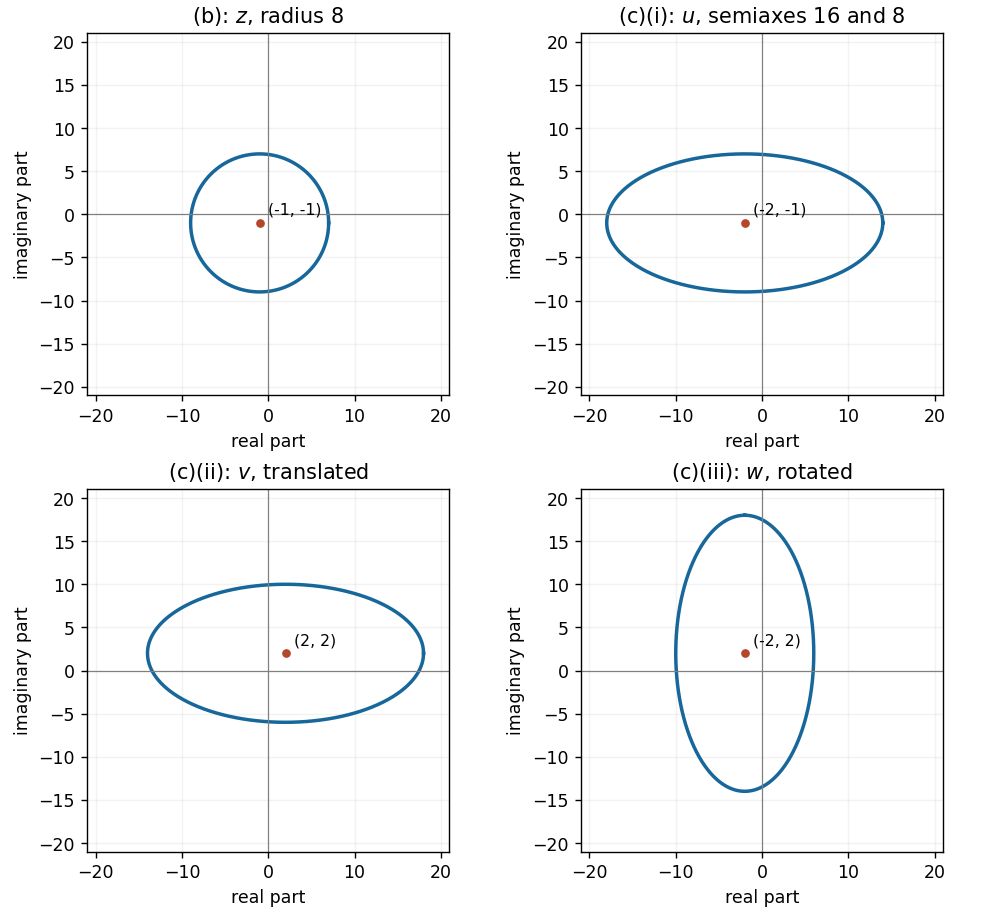
The circle and its three transformed loci in Question 11, drawn with equal horizontal and vertical scales
. Details. 
Write and use the complex conjugate . ThenThus the real part is stretched by a factor of two while the imaginary part is unchanged. If , substitution into the circle equation givesThis is an ellipse with centre , horizontal semiaxis and vertical semiaxis . It is the second panel in the figure in part (b).
Adding is a translation by in the complex plane. The ellipse of part (i) therefore keeps its semiaxes and axis directions, with new centre . Writing , its equation isThe third panel in the figure in part (b) shows the translated ellipse.
Multiplication by is a counterclockwise rotation through : it maps coordinates to . The centre therefore becomes , and the long axis becomes vertical. For , the resulting ellipse isIts horizontal semiaxis is and its vertical semiaxis is , as shown in the final panel of the figure in part (b).
By De Moivre's theorem, is the imaginary part of . The binomial theorem gives, with ,Use and simplify:The requested equation cancels the term, leaving . Thus or . The complete list in is
Articles by others on the same topic
There are currently no matching articles.