The difference of two cubes identity gives the real polynomial factorizationExpanding the right side cancels the two mixed terms of each degree. The quadratic factor satisfies .
Completing the square under the square root gives . Thus the equation is , and the definition of absolute value gives . Hence
The domain excludes . Rearranging the inequality givesA sign check on the intervals separated by and shows that the ratio is nonnegative when or . The point is allowed because it makes the numerator zero. Therefore
The original PDF puts both in the exponent in the second equation. Since the exponential function is injective, gives . Put , so . The first equation then givesThus , so and . The unique real solution of the simultaneous equations is
Put . The geometric series has first term and common ratio , with absolute value less than one. Therefore its sum is
The product rule givesFor , the derivative is positive before and negative after . Also and as . Thus the global maximum on the requested range is
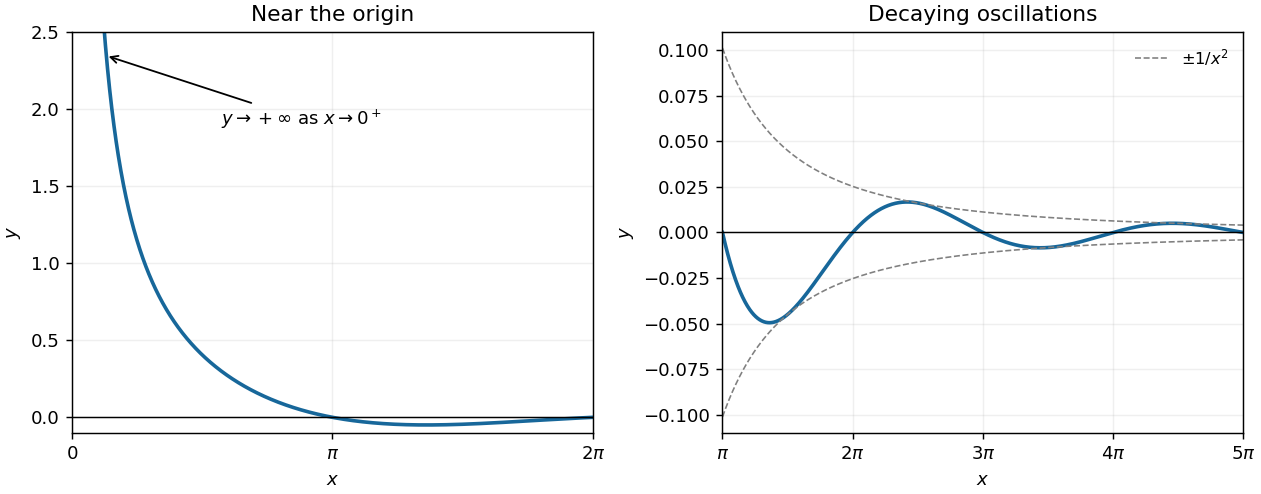
For , the denominator is positive, so the function graph has the same sign as . Its crossings of the horizontal axis areEach crossing is genuine because the derivative there is . Near zero, , so ; the origin is excluded and is not a crossing. The oscillations alternate sign and decay towards zero as , with absolute value at most .
The dot product isBoth vectors have squared Euclidean norm . Under the given condition , their dot product is and each squared Euclidean norm is . Hence
Use the full set of complex logarithm values of :By the definition of complex exponentiation, the inner power can therefore take any value , a positive real number. Its complex logarithm values are , where . ThusAll possible real parts and imaginary parts are consequentlyChoosing the principal complex logarithm at both stages gives the particular value . The independent logarithm choices are needed because the question asks for all possible values.
The inner power takes the values . For each such real exponent, all values of the outer complex exponentiation are obtained from all complex logarithm values of its base :Writing , the answer isAll values lie on the unit circle. The principal choice is , giving . In particular the two nestings in parts (i) and (ii) are different: complex exponentiation is not associative.
The complex modulus is the Euclidean distance from to . Thus the locus isa circle with centre and radius . Its extreme horizontal coordinates are and , and its extreme vertical coordinates are also and .
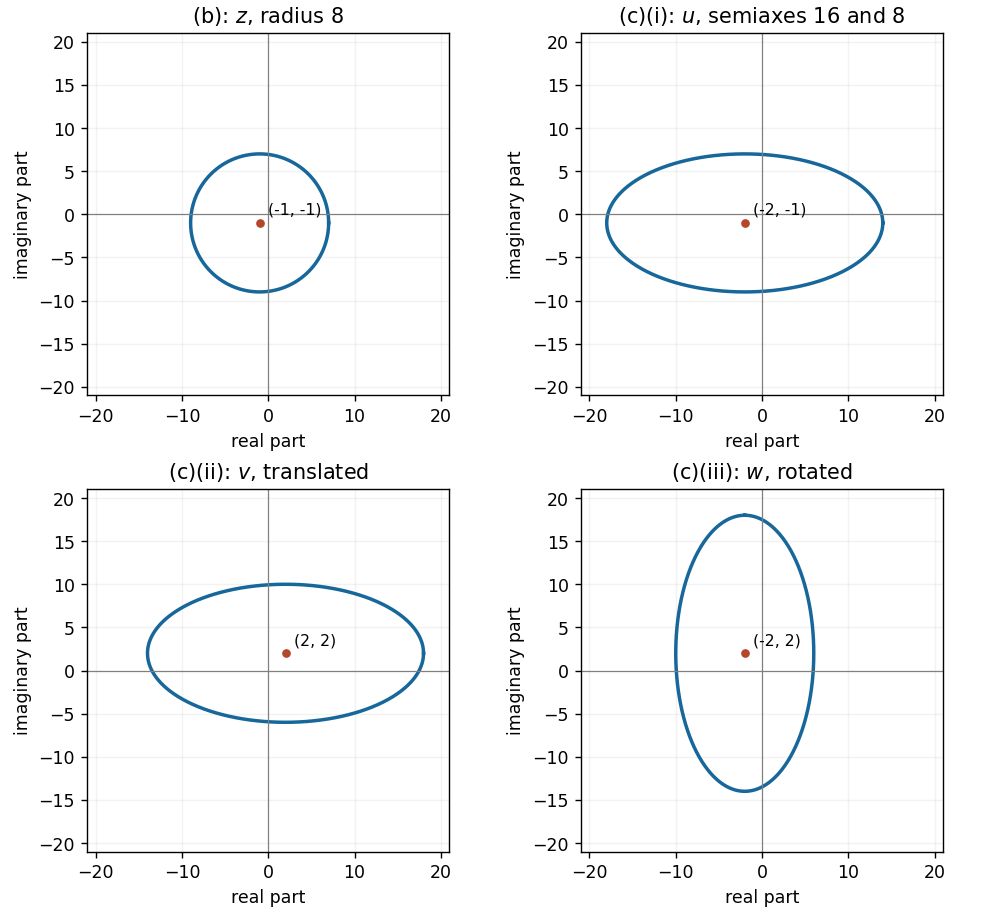
The circle and its three transformed loci in Question 11, drawn with equal horizontal and vertical scales
. Details. Write and use the complex conjugate . ThenThus the real part is stretched by a factor of two while the imaginary part is unchanged. If , substitution into the circle equation givesThis is an ellipse with centre , horizontal semiaxis and vertical semiaxis . It is the second panel in the figure in part (b).
Adding is a translation by in the complex plane. The ellipse of part (i) therefore keeps its semiaxes and axis directions, with new centre . Writing , its equation isThe third panel in the figure in part (b) shows the translated ellipse.
Multiplication by is a counterclockwise rotation through : it maps coordinates to . The centre therefore becomes , and the long axis becomes vertical. For , the resulting ellipse isIts horizontal semiaxis is and its vertical semiaxis is , as shown in the final panel of the figure in part (b).
By De Moivre's theorem, is the imaginary part of . The binomial theorem gives, with ,Use and simplify:The requested equation cancels the term, leaving . Thus or . The complete list in is
The stated bounds depend on , so must be held fixed while the integral over is performed. The intended iterated integral isThe original PDF places the two sets of bounds beside the opposite integral signs relative to the printed . That placement cannot be read literally as a conventional nested integral; the dependence of the lower bound on , and the explicit instruction to integrate over first, specify the intended region unambiguously.
The inequalities describing the region are and . It is the closed triangle bounded by , and , with verticesA horizontal slice runs from the sloping edge to the vertical edge .
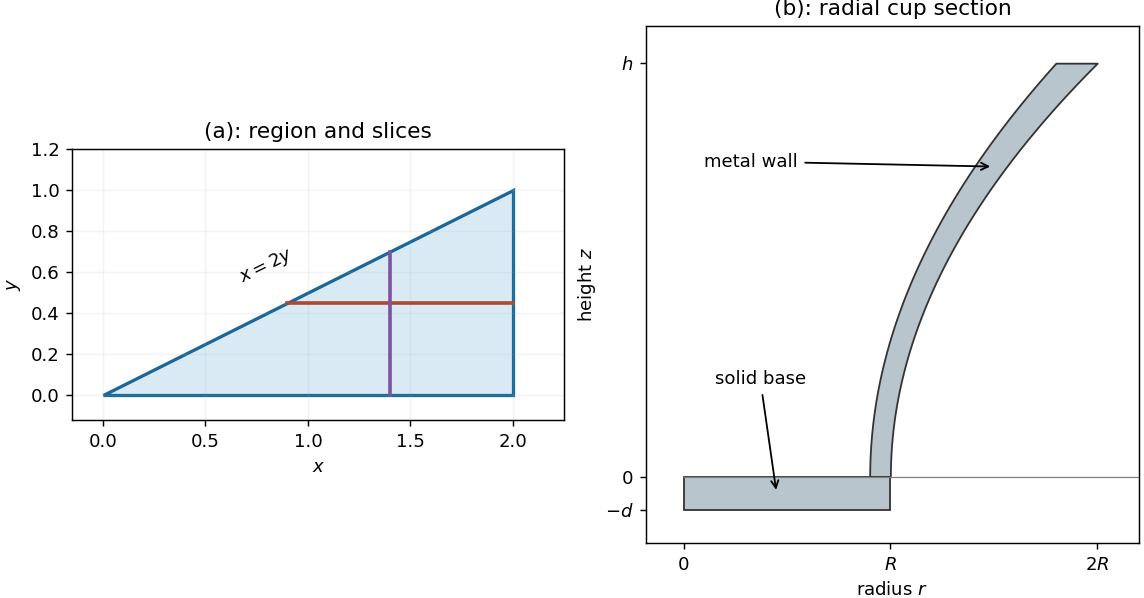
The triangular integration region and the cup cross-section, including its solid base, in Question 12
. Details. For a vertical slice through the triangle, and . Reversing the order by Fubini's theorem givesThe agreement checks that both orders describe the same region.
The PDF diagram includes a solid base of thickness , occupying and . Above it, , the metal lies between the two specified curved surfaces. In cylindrical coordinates, the Jacobian determinant contributes a factor , so the mass isThe base contributes . The wall contributesConsequentlyThe base thickness comes from the diagram; omitting it would omit part of the cup's volume.
Because the original differential equation divides by , its domain requires and . Set , so . The equation becomes the first-order linear differential equationAn integrating factor is , since . ThusReturning to gives the explicit general real solutionsEach sign is fixed on a connected interval where and the radicand is strictly positive. The strict condition excludes , where the original differential equation is undefined. There is no additional zero solution.
Where , divide by it to obtain . The integrating factor is , and the product rule givesThe initial condition gives . HenceThe simplified expression has a differentiable extension through , with . Direct substitution verifies the original undivided differential equation there as well: its left side is . Thus the maximal interval containing on which this solution is finite is ; the apparent exclusion of arose only from division by . This is continuation through a zero of the leading ODE coefficient.
An exact differential form must have . Direct partial differentiation givesThus must hold identically. Since is not identically zero for a fixed nonzero , the only possibility isThe explicit potential in part (ii) verifies sufficiency.
For , integrate with respect to to obtainIts other partial derivative is . Comparing with gives . Thus the most general potential on the plane is
The chain rule gives and . Since , , and , the answer isEvery partial derivative of on the right is evaluated at , .
Apply the product rule and the chain rule once more to each expression in part (i). The second derivative chain rule givesandFor example, the coefficient of in the mixed partial derivative is , while the final term is . The symmetry is used in combining the mixed terms under the usual twice-continuously-differentiable interpretation.
For , the needed partial derivatives areSubstituting these into part (ii) givesSince , the last two terms combine. Thus
First express the function in the original variables:The chain rule givesTaking its partial derivative with respect to yieldsThe numerator in the second fraction reduces to , reproducingBoth logarithms are defined for every real because their arguments are at least one.
For , factor out , not , and apply the binomial series with exponent :For each fixed nonzero , these are the first three nonzero terms of the Taylor series about zero; the full binomial series converges when .
For , the function is . Its right derivative at zero is and its left derivative is , so no Taylor series about zero exists when . The one-sided formulas are exactly for and for ; they do not form a single two-sided Taylor expansion, nor can they supply three nonzero terms. The parameter case explicitly included in the question must therefore be treated as this exception.
Write and . The chain rule givesThe condition ensures . Since , also and . Hence the first two nonzero terms are the constant and linear terms:The inequality , together with continuity of , makes the logarithm defined on a neighbourhood of zero. The remainder is written in Big O notation.
The second derivative chain rule givesWith , the constant term vanishes, , and by the specified case. Thus the first two nonzero terms in the Taylor expansion are
Here and , so the constant and quadratic terms vanish, while the linear coefficient remains . A further derivative givesConsequently . Since and have opposite signs, and also have opposite signs, and their difference is nonzero. The first two nonzero terms are thereforeThis is where the full sign condition rules out a further cancellation in the Taylor expansion.
A probability density function must have total integral one. The numerator is an even function, soThis is positive, ensuring nonnegativity of the probability density function.
Put . The function graph is symmetric about the vertical axis, zero outside , and has its unique maximum at with height . On , it decreases as ; the negative side is its reflection. The one-sided interior endpoint values are , so the probability density function jumps to zero at both ends of its support. It also has a corner at its central maximum because of the absolute value in the exponent.
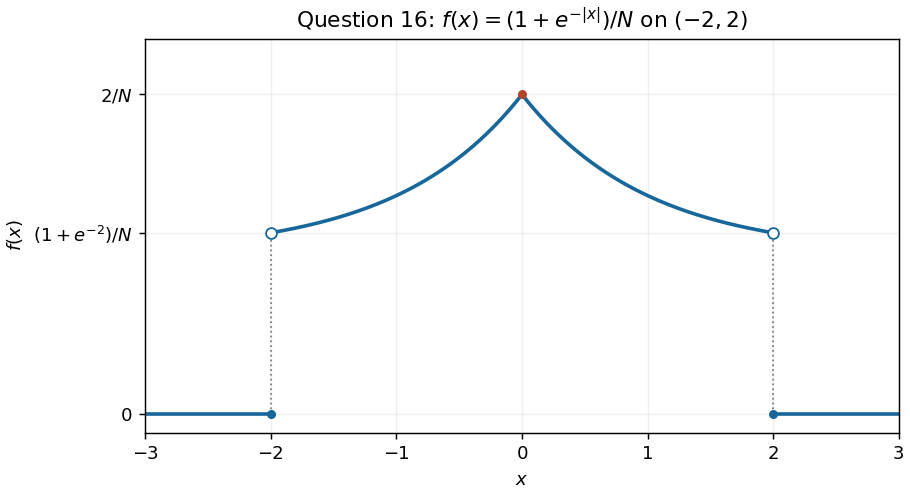


Values assigned exactly at do not affect any probability.
Since the probability density function is an even function, is an odd function. Its integral over the symmetric support vanishes, so
The expected value is zero, so the variance is . Symmetry givesThe polynomial term contributes . Two applications of integration by parts giveso its definite value on is . Therefore
Let be the cumulative distribution function of . Normalisation of the proposed probability density function requires . The integrated cumulative distribution function on a bounded interval identity givesFor a direct symmetry proof, the continuous symmetric probability distribution satisfies . HenceIn particular is nonnegative and has total integral one over its stated support.
Write and . Two applications of integration by parts, first taking the sine and then the cosine as the differentiated factor, giveThus and , in each case up to an arbitrary constant of integration. Keeping that freedom avoids identifying independently chosen antiderivatives too rigidly.
Articles were limited to the first 100 out of 135 total.
Articles by others on the same topic
There are currently no matching articles.