At height , the horizontal triangle has half-width along and depth along . These shrink with , so its orthogonal projection onto the plane is the base triangle with vertices , and :The orthogonal projection onto the plane is the triangle with vertices , and :The orthogonal projection onto the plane is bounded by , and the two curvesEquivalently, these curves lie on the parabola , truncated at height . In particular the top width is , so this projection has a horizontal upper edge from to ; it is not triangular. The top horizontal cross-section has zero depth, consistent with this edge.
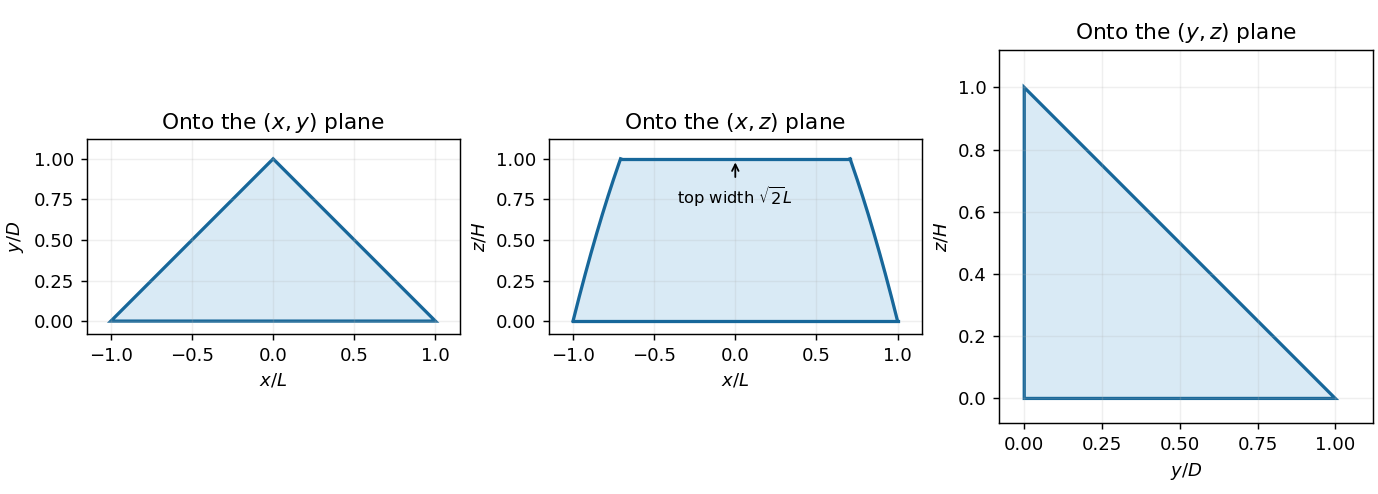
The three coordinate projections of the triangular-section solid in Question 12
. Details. 
The horizontal cross-section is a triangle, so its area is half its width times its depth:Thus the volume integral, with , isFor the substitution rule, put . The endpoint values are and , and , givingTherefore .
Articles by others on the same topic
There are currently no matching articles.