The binomial theorem gives . The required binomial coefficients are thereforeHere denotes the coefficient of in the polynomial.
The given polynomial root supplies the factor . Polynomial division givesSolving the remaining quadratic equation, the other two polynomial roots are
Use the first of the simultaneous equations to put . Substitution into the second givesThus or . The corresponding values of give exactly
Completing the square transforms the equation intoComparison with the standard circle equation gives
The addition formula for the sine givesEquating the sine and cosine coefficients gives and . Squaring and adding yields , so because . Both coefficients are positive, so is in the first quadrant. Consequently
The chain rule and the quotient rule giveThe exponential function and denominator are positive, so the stationary points occur exactly at . Their values areThe derivative is negative for and positive for , so is a local minimum and a local maximum. They are also global extrema, since .
Apply implicit differentiation, remembering that depends on :Since , division is always legitimate. Therefore
The partial fraction decomposition isTaking antiderivatives and using the positive endpoints givesHence .
The function graphs intersect when , so or . For , the exponential function satisfies , making the upper graph. The enclosed area is thereforeThe antiderivative of follows by integration by parts.
Multiply numerator and denominator by the complex conjugate :Thus the real part is and the imaginary part is .
Since , equating its real part and imaginary part gives , orThe quadratic equation in factors as . Thus the set is the union of two straight lines through the origin:Their slopes multiply to , so they are perpendicular. Their angles to the real axis are and , modulo . The origin is included.
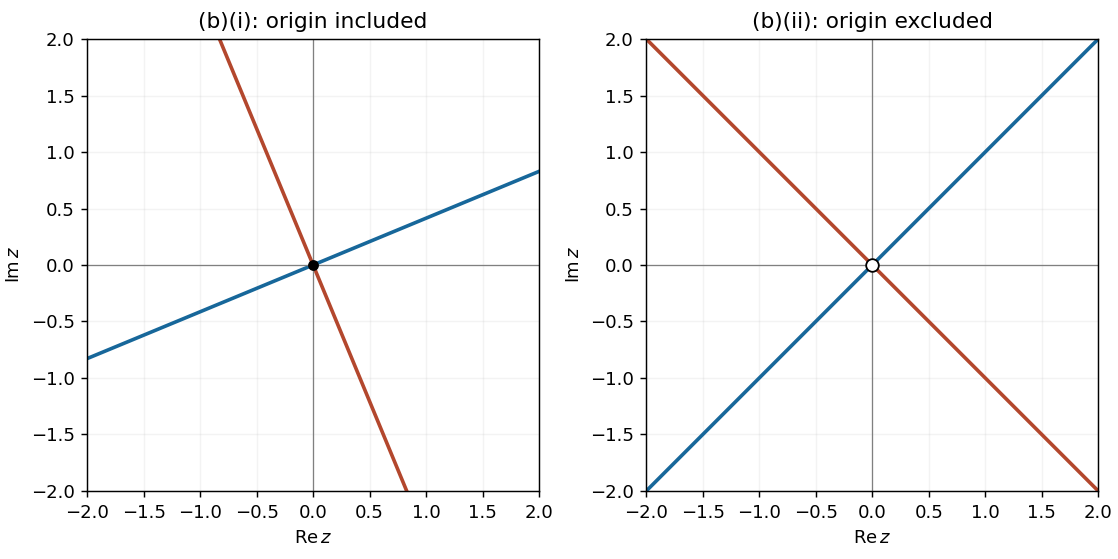
The denominator requires . Write , where and . Multiplication by the nonzero denominator givesso . Conversely, if and , then and . Thus the required Argand diagram consists exactly ofThese are two perpendicular straight lines, with the origin removed as shown in the figure in part (i).
For real , , so multiplication by the hyperbolic cosine is reversible. The identities and giveThus . The exponential function is injective, so the unique real solution is
Set . The hyperbolic cosine identity gives , hence the quadratic equationLet . The first root has modulus and complex argument ; the second has modulus and complex argument . Taking all complex logarithm values givesThe two families are distinct because their real parts are respectively and . This exhausts the solutions because both roots for and all possible complex arguments have been included.
At height , the circular sector has radius and angle . Its area is , so slicing by horizontal cross-sections gives the volume integralUse the substitution rule . ThenAn integration by parts gives the antiderivative , whose endpoint difference is . Therefore
At each height, the removed circular sector has the same angle and of the original radius. Its area and hence its volume are therefore multiplied by . Equating the removed volume to that of the reformed solid sphere givesConsequently
At height , the horizontal triangle has half-width along and depth along . These shrink with , so its orthogonal projection onto the plane is the base triangle with vertices , and :The orthogonal projection onto the plane is the triangle with vertices , and :The orthogonal projection onto the plane is bounded by , and the two curvesEquivalently, these curves lie on the parabola , truncated at height . In particular the top width is , so this projection has a horizontal upper edge from to ; it is not triangular. The top horizontal cross-section has zero depth, consistent with this edge.
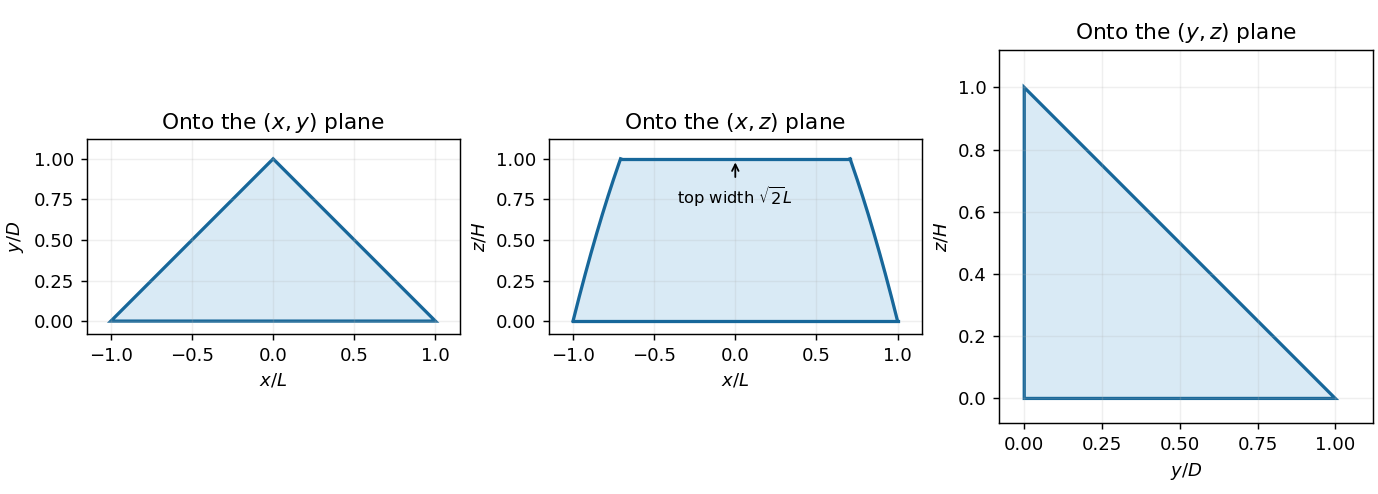
The three coordinate projections of the triangular-section solid in Question 12
. Details. The horizontal cross-section is a triangle, so its area is half its width times its depth:Thus the volume integral, with , isFor the substitution rule, put . The endpoint values are and , and , givingTherefore .
On an interval with , division by gives the separable differential equation . For , take antiderivatives:Renaming the constant yields the explicit nonzero familyFor , the interval of definition must avoid zeros of the denominator. Division by excluded the additional solution , which must also be included.
The original undivided differential equation also makes sense at , where it requires . For continuation through a zero of the leading ODE coefficient, rewrite the nonzero family asIt extends differentiably with and , since . One may choose the integration constants independently on the two sides of zero and obtain a differentiable solution through zero. The zero solution also extends through zero, with derivative ; joining a nonzero branch on just one side to a zero branch on the other would fail differentiability.
For this first-order linear differential equation, an integrating factor on an interval avoiding zeros of is . The product rule then givesThe initial condition gives , hence . ThusThe displayed interval is the maximal one containing the specified initial point, since the coefficient is undefined at its endpoints.
Use the substitution for a homogeneous first-order differential equation. Since , it givesWhere , this separable differential equation integrates to , hence . One can obtain the same relation without division by : the equation gives , so , including .
All real branches of the inverse sine are captured byEach branch is used on an interval with and , with fixed . The strict inequality excludes zeros of , where the original tangent is undefined. When , the formula includes all straight-line solutions . Keeping both families of inverse sine branches is essential for the two different initial conditions below.
The initial condition gives . Since belongs to the principal inverse sine range, choose in part (i). The particular solution isThe upper endpoint is excluded because there and the original tangent ceases to be defined.
Again , but the principal inverse sine would give at . The required branch is , corresponding to . ThereforeAt the bracket is , as required. Both the initial condition and the original differential equation are thus satisfied on the stated branch.
For an exact differential form, equality of the mixed partial derivatives requires . HereEquality for all and real forces , so . To construct the potential, integrate with respect to :Differentiation with respect to gives , so . Thus the most general potential on the connected domain isIts explicit partial derivatives verify sufficiency as well as necessity.
The stated total differential is that of , so . The zero-volume condition gives . For positive , divide the total differential by this volume to obtainFor the specified small changes, , so the volume increases by approximately . The fractional expression requires ; at a degenerate zero-volume state it is undefined. For finite changes, the exact multiplier is , whose difference from is ; the total differential gives its first-order approximation.
Let . The product rule and the chain rule give the partial derivativesHence the terms containing cancel:This also follows from the Euler theorem for homogeneous functions, because for .
The chain rule expresses the coordinate differential operators asThe coefficients are constant, so a second application givesandAdding cancels the mixed partial derivatives, and givesThe transformation has rotation matrix , so this identity expresses the rotational invariance of the Laplacian.
The Maclaurin series , applied with and then multiplied by , givesThese are the first three nonzero terms. The remainder is written in Big O notation.
Put . Since , the outer Taylor series requires and . ThereforeBoth logarithms are defined on a neighbourhood of zero, so this composition of power series is valid there.
Factor the leading term out of the Maclaurin series for the sine:The binomial theorem gives, through degree four inside the bracket,The coefficient of is . Multiplying back by yields
The full cumulative distribution function isThus the function graph is horizontal at zero for , rises continuously from to , and is horizontal at one for . Its derivative is positive on and zero at both endpoints. The second derivative changes sign at , giving an inflection point there.
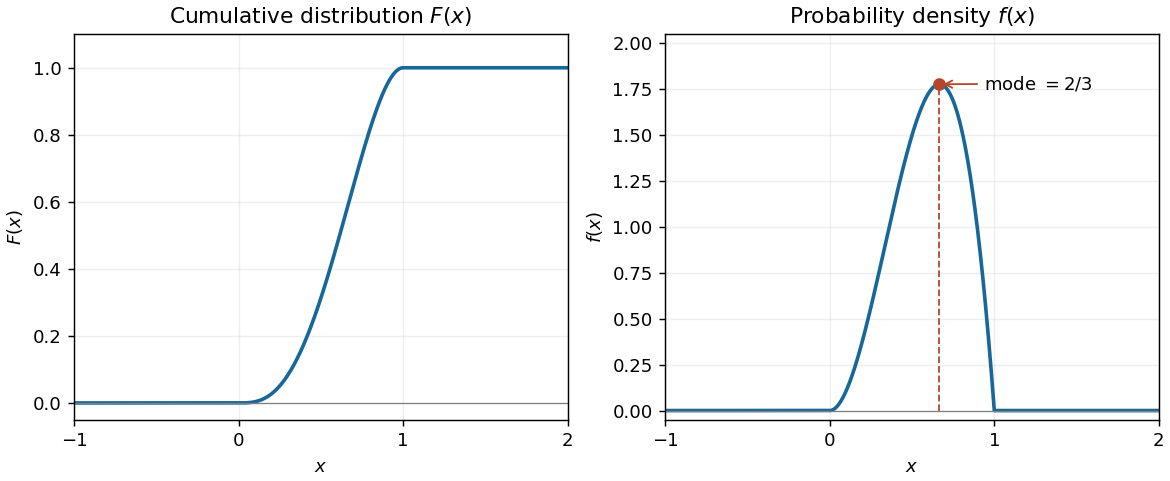


The probability density function is the derivative of the cumulative distribution function:It is nonnegative and has integral . This is a beta distribution with parameters and .
The probability density function is zero outside . Inside that interval, it rises from , reaches its only interior maximum at , and falls to . The derivative ispositive for and negative for . Its maximum height is . The second panel of the figure in part (b) shows the function graph on the requested full range, with this mode marked.
The interior stationary point of the probability density function solves with , giving . The sign change of established in part (d), together with zero endpoint values, makes this the global maximum. Thus
At the mode, the cumulative distribution function has valueSince is strictly increasing on , its unique crossing of occurs earlier. Therefore the median is less than the mode.
The requested bounds are and , both within the support. Since the probability distribution is continuous, endpoints have zero probability, and subtraction of the cumulative distribution function givesThis leaves the answer in rational fractions as requested.
With the standard unweighted inner product on real square-integrable functions, orthogonality on meansMultiplying this inner product by a common nonzero normalising constant does not change orthogonality.
The Fourier coefficients follow by multiplying the expansion by , by the appropriate cosine, or by the appropriate sine, then using orthogonality. In the convention with constant term ,The factor comes from the squared norms of the nonconstant sine and cosine functions: the integral of each square over is . The constant function has squared norm .
For , the even function has , because is an odd function. Its constant coefficient is . The remaining Fourier coefficients areTwo applications of integration by parts give the antiderivative, with ,Its endpoint difference is , so . ThereforeThe periodic extension is continuous and piecewise smooth, so pointwise convergence of a piecewise smooth Fourier series gives equality, including at the endpoints.
Articles were limited to the first 100 out of 298 total.
Articles by others on the same topic
There are currently no matching articles.