Take the dumbbell axis to be the axis, with its midpoint at . The right-hand sphere has centre and radius , while its junction with the cylinder is at . Put , so . The Pythagorean theorem in a meridional cross-section gives the handle radius from . Thus
Use cylindrical coordinates about the dumbbell axis. Their Jacobian determinant contributes the volume factor , so the handle's mass is the volume integralInserting the radius from part (a) yields
Centre cylindrical coordinates on the right-hand sphere, with the axial coordinate positive outwards. Using and , the retained solid satisfiesIn particular, it contains more than a hemisphere; it is the small cap on the inward side that has been removed. The volume integral for its mass, including the Jacobian determinant , isThus each end piece has massEquivalently this is the volume of a spherical cap with height , multiplied by the uniform mass density.
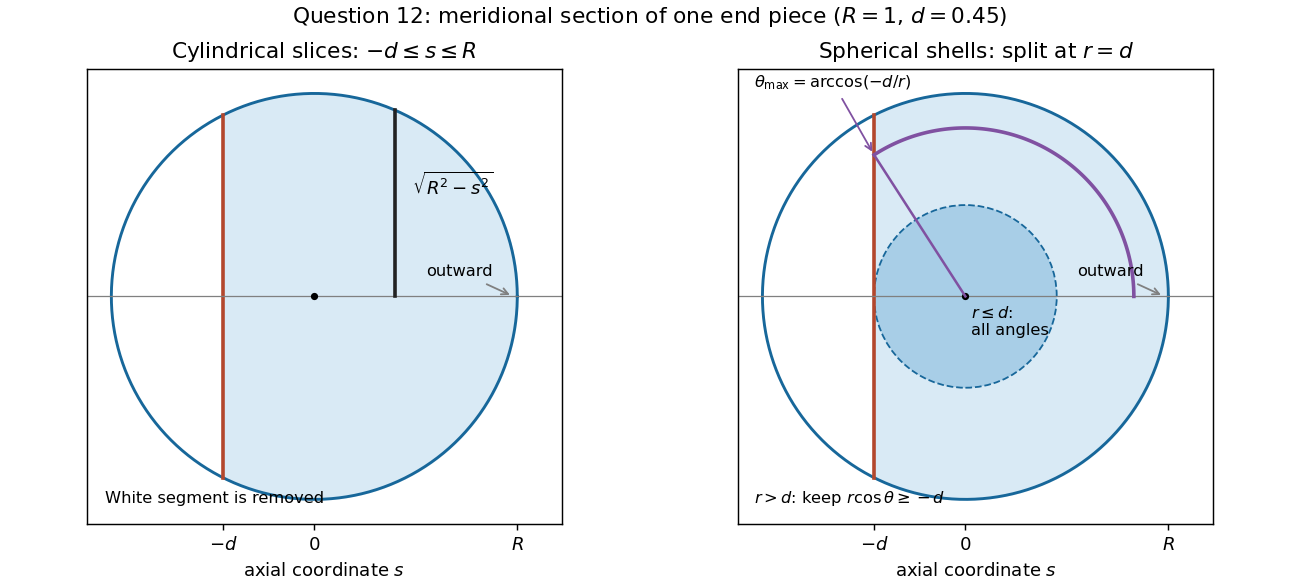

Use spherical coordinates centred on the right-hand sphere, with polar axis pointing outwards along . The Jacobian determinant is , and the retained region is with .
For , every polar angle is allowed. For , the cut requires . Splitting the volume integral at therefore givesSubstitution of and reproduces the mass in part (c). The radial split avoids integrating over a polar angle range independent of , which would incorrectly include part of the removed spherical cap.
Articles by others on the same topic
There are currently no matching articles.