The modulus is the Euclidean norm, obtained by taking the square root of the dot product of the vector with itself:
The derivative is , so the tangent line has slope at . The corresponding point is because . Hence the tangent line is , or . Thus
The chain rule givesSince , the exponent is at most , with equality precisely at . The exponential function is increasing, soThe sign of the derivative, positive for and negative for , gives the same conclusion.
The terms form an arithmetic progression with common difference . There are terms. The arithmetic series formula gives
The geometric series converges because the absolute value of its common ratio is below one. Its sum is
Rearrangement gives the quadratic inequality . The associated quadratic equation has roots . Since the coefficient of is positive, the quadratic inequality holds between these roots, including the endpoints:
Substitution for reduces the two simultaneous equations toThe remaining quadratic factor is positive for all real , since . Thus there are exactly .
From the factorisation in part (a), or . Substitution into the parabola equation gives respectively or . Thus the two intersections of the parabola and the unit circle are
Since throughout the given interval, multiplying by is reversible. The equation simplifies toThe sine equals only at . Here , so only is allowed. Hence
The binomial series beginsEquating coefficients gives and . Since , substitute into the second equation to obtain , so and . ThereforeIndeed for .
The sine is nonnegative on , so the geometric area equals the definite integral, without cancellation:
The given complex numbers have positive real parts, so and . Their product isBy the assumed complex argument ranges, this product also has positive real part, hence . Its complex argument is consequently , with no extra multiple of . Since multiplication adds complex arguments,This proves the arctangent addition formula under the stated branch restriction. For arbitrary real , the principal inverse tangent formula can require adding or subtracting when .
A counterclockwise rotation through about the origin in the complex plane sends to . By part (a), and because the complex conjugate of is ,Thus is invariant under the common rotation.
Write . Multiplication givesTherefore the real part is the dot product of the corresponding vectors:For nonzero vectors, this is , measuring their alignment.
From the same multiplication, the imaginary part isHere the planar vectors are embedded in three dimensions with zero third coordinate. Its magnitude is the area of their parallelogram; its sign is positive when the oriented angle from to has positive sine. The reversed order matters: is the negative of the usual signed area for the order .
Since with real , necessarily . Use Euler's formula and set . Thenso the quadratic equation gives . Let . It lies on the upper half of the unit circle, so with . Choose the complex logarithm value , taking at . The two roots are , so gives .
Because , this set of real solutions is exactlyThe formula includes : the two sign families then coincide after adjusting . No real exists if .
For , use the finite geometric series with ratio :The second equality follows by factoring in numerator and denominator. Taking real parts proves the finite trigonometric sum identityWhen , every cosine is , so the sum is . This also gives the continuous limiting value at the excluded arguments.
Take the dumbbell axis to be the axis, with its midpoint at . The right-hand sphere has centre and radius , while its junction with the cylinder is at . Put , so . The Pythagorean theorem in a meridional cross-section gives the handle radius from . Thus
Use cylindrical coordinates about the dumbbell axis. Their Jacobian determinant contributes the volume factor , so the handle's mass is the volume integralInserting the radius from part (a) yields
Centre cylindrical coordinates on the right-hand sphere, with the axial coordinate positive outwards. Using and , the retained solid satisfiesIn particular, it contains more than a hemisphere; it is the small cap on the inward side that has been removed. The volume integral for its mass, including the Jacobian determinant , isThus each end piece has massEquivalently this is the volume of a spherical cap with height , multiplied by the uniform mass density.
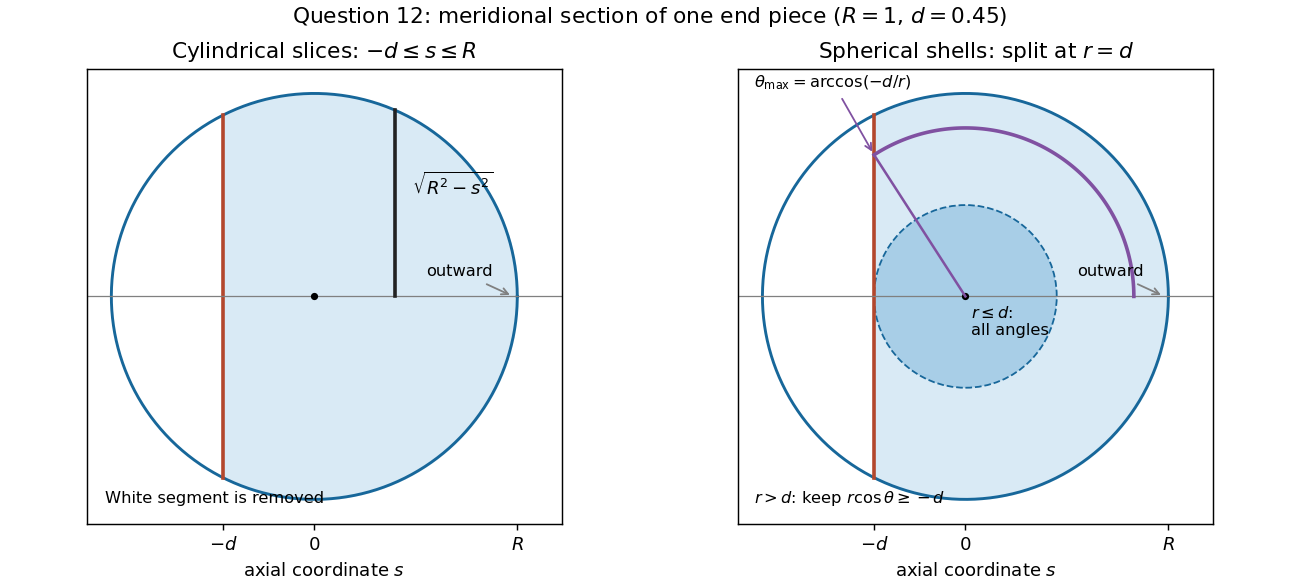

Use spherical coordinates centred on the right-hand sphere, with polar axis pointing outwards along . The Jacobian determinant is , and the retained region is with .
For , every polar angle is allowed. For , the cut requires . Splitting the volume integral at therefore givesSubstitution of and reproduces the mass in part (c). The radial split avoids integrating over a polar angle range independent of , which would incorrectly include part of the removed spherical cap.
The handle and the two end pieces have disjoint interiors; their common boundary circles contribute no volume. Hence the total mass is . With , the results above giveEquivalently, since ,
On an interval with , the equation is a separable differential equation. For ,Taking antiderivatives gives . Renaming the constant, the explicit general nonzero solution isIt is defined on any interval avoiding and zeros of its denominator. The separation divided by , so the additional solution must be included.
Using the general solution in part (a), the initial condition givesTherefore the solution of this initial value problem isThe formula is used on the interval containing where the original ordinary differential equation and the displayed expression are defined.
The zero solution satisfies both the ordinary differential equation and the initial condition. The right-hand side is continuously differentiable in near , so the Picard-Lindelöf theorem gives local uniqueness; equivalently the nonzero family in part (a) can never take the value zero at . ThusThe restriction is the maximal interval containing on which the original ordinary differential equation is defined.
Let and . An exact differential form must satisfy . These partial derivatives giveTaking antiderivatives produces . A convenient nonzero integrating factor for a differential one-form is thereforeAn explicit potential, which also proves global exactness, isIndeed and for the chosen integrating factor.
Multiplying the ordinary differential equation by the nonzero integrating factor from part (i) makes its left-hand side . Hence the potential is constant:Since for every real , this is equivalent to the explicit general solutionIt is defined for all real . There are no lost solutions, since the integrating factor and the coefficient of are everywhere nonzero.
The Pythagorean theorem gives . Taking a total differential gives , soThe area of the right triangle is , so the product rule gives andThe prescribed small changes therefore give : the area decreases by approximately . For comparison, retaining the product of the two finite percentage changes gives , an exact decrease of ; the total differential retains only the first-order terms.
Put . Apply implicit differentiation with respect to and , using the chain rule:ConsequentlyAt a point where the assumed differentiable function exists, the first equation forces . Combining the equations therefore givesThe assertion is understood on such differentiable branches of the implicit function; arbitrary parameter choices need not produce one everywhere.
The scaling relation says that is a homogeneous function of degree . Fix and differentiate the identity with respect to the positive parameter . The chain rule givesSetting proves the Euler theorem for homogeneous functions identityDifferentiate once more with respect to , using equality of the mixed partial derivatives for the assumed twice continuously differentiable function:At this is the second-order Euler identity for homogeneous functions:The repeated parameter differentiation accounts for the factor , rather than .
Taylor's theorem gives a finite Taylor polynomial of degree , consisting of the first terms, and a remainder:In the Taylor theorem with Lagrange remainder form, assuming the required derivatives exist on an interval containing and ,for some strictly between and when ; at the remainder is zero. In particular, if on that segment, then . This is a finite expansion; it does not assume equality with an infinite Taylor series.
For the natural logarithm, , , , and . The quadratic Taylor polynomial therefore givesThe Taylor remainder is with . It is positive, so the approximation is an underestimate. Moreover,Thus is a valid upper bound on the absolute error.
The Maclaurin series of the hyperbolic cosine is . The binomial series with exponent gives . Substituting yieldsThese are the first three nonzero terms; the remainder is written in Big O notation.
Put . The sine addition identity gives . Applying the exponential series givesThus the first three nonzero terms in the Taylor series about are
With white balls, uniform sampling without replacement gives the probabilityRearranging, , soA finite admissible population has even and , so the denominator is nonzero.
Interchanging the two colours preserves the probability distribution when their population counts are equal. Thus the probability of two black balls is also . The three mutually exclusive possibilities are two white, two black, or different colours, so
The probability that the first ball is white is . Partitioning that event according to the second colour shows that . Uniform sampling without replacement makes the two draw positions exchangeable, so . ThereforeFor a direct count, the same value is .
Articles were limited to the first 100 out of 159 total.
Articles by others on the same topic
There are currently no matching articles.