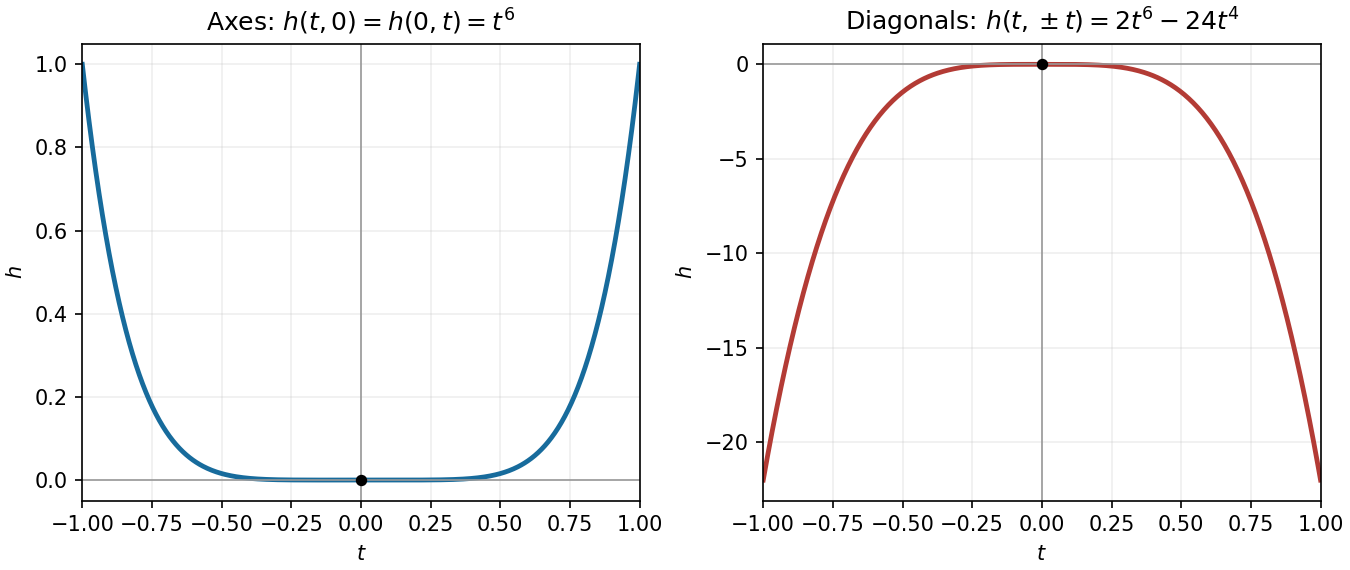
Along either coordinate axis, the restriction is , which is positive for . Along either diagonal it iswhich is negative for sufficiently small nonzero . Therefore every neighbourhood of the origin contains both positive and negative values, whereas . ConsequentlyThe Hessian matrix vanishes there, so the ordinary second-derivative test is inconclusive; the restrictions settle the question.

Articles by others on the same topic
There are currently no matching articles.