The gradient is horizontal when and vertical when . Factoring those partial derivatives gives the two loci:Thus each locus consists of an axis and two parabolas. Their common points are the five stationary points found below. At those points the gradient is zero and has no direction, so they are included in both algebraic zero-component conditions but excluded if “parallel” is required to mean a nonzero directed vector.
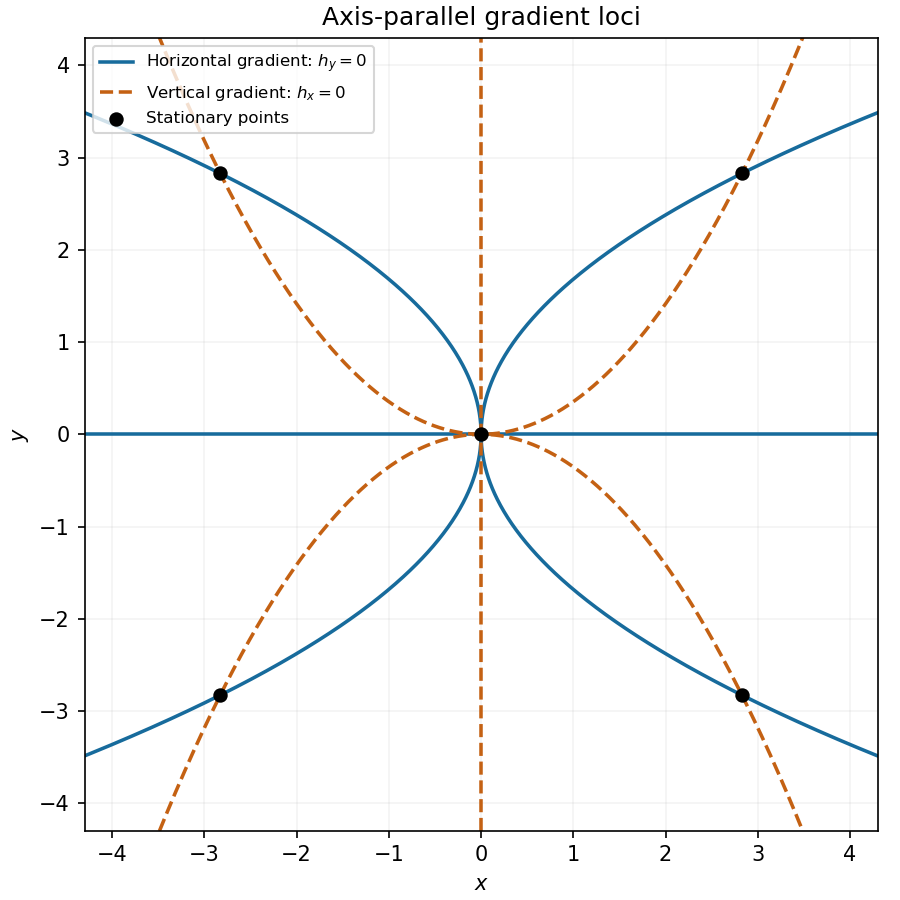
Loci of horizontal and vertical gradients
. Blue curves have , orange curves have , and black points mark their intersections. At the black points the gradient itself vanishes. Details.A stationary point must satisfy both factored equations from part (a). If either coordinate is zero, the other equation forces the other coordinate to vanish. This gives .
Otherwise and . With and , these become and . Dividing gives , so . Then forces . Hence all five stationary points are
The Hessian matrix isAt each nonzero stationary point, its diagonal entries are and the off-diagonal entries are . Its eigenvalues are and , both positive. Thus the Hessian matrix is positive definite, and the second-derivative test proves thatTheir common value is . In fact they are global minima: with , the arithmetic-geometric mean inequality gives , soThe last one-variable polynomial attains its minimum at , and equality in the first bound requires , precisely the four points above.
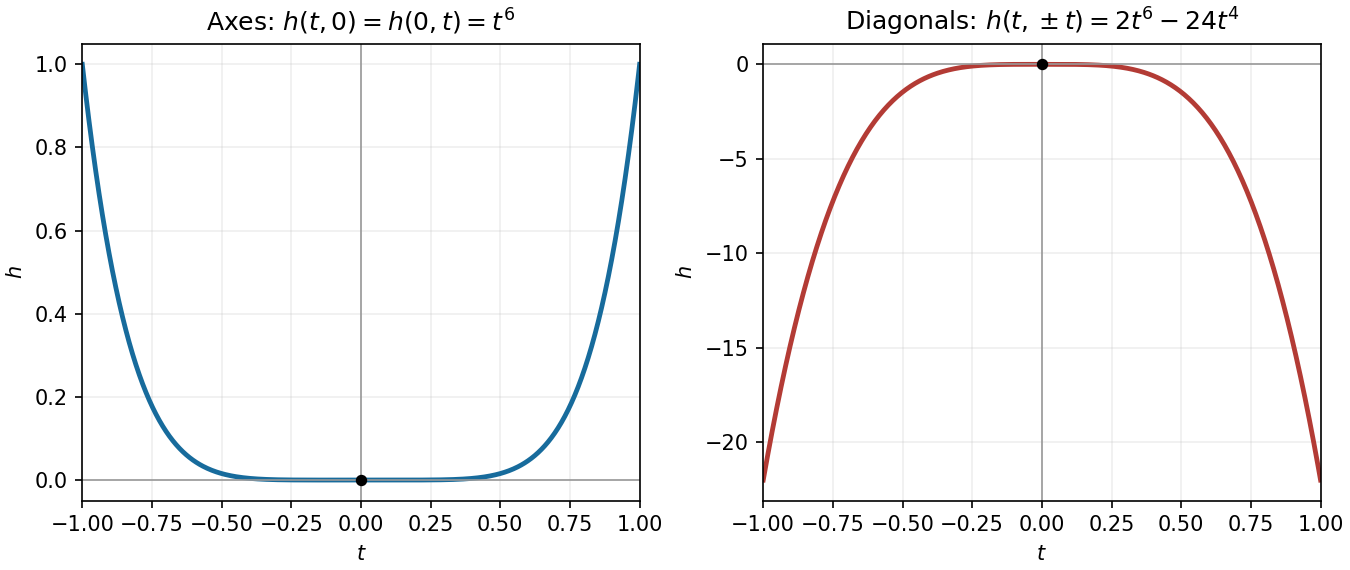
Along either coordinate axis, the restriction is , which is positive for . Along either diagonal it iswhich is negative for sufficiently small nonzero . Therefore every neighbourhood of the origin contains both positive and negative values, whereas . ConsequentlyThe Hessian matrix vanishes there, so the ordinary second-derivative test is inconclusive; the restrictions settle the question.
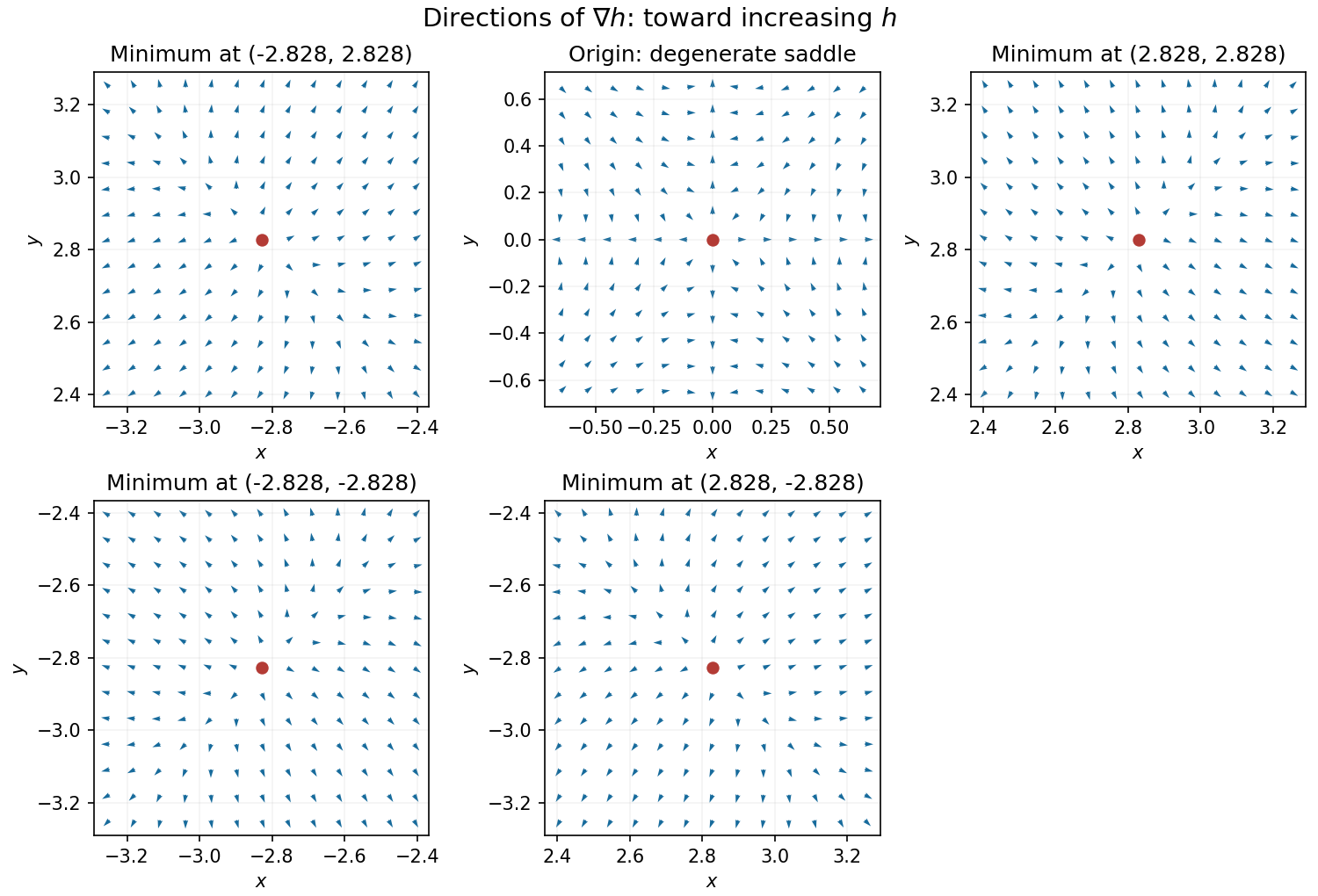
Near a nonzero stationary point , Taylor expansion of the gradient gives . Since the Hessian matrix is positive definite, for sufficiently small nonzero . Thus the gradient arrows point away from each of the four local minima, with different strengths in the two eigenvector directions.
At the origin, on the -axis the gradient is and on the -axis it is , so arrows point outward. On the gradient is , and on it is , so arrows point toward the origin for small . Away from the axes the leading terms are , pointing inward in both coordinate signs. The narrow outward sectors close to the axes are visible in the exact vector field.


Articles by others on the same topic
There are currently no matching articles.