With constant positive thermal diffusivity , no internal heat source and one spatial coordinate, the heat equation isSeparation of variables makes each spatial mode decay by . The endpoint conditions determine whether the initial triangular profile is expanded in a Fourier sine series or a Fourier cosine series.
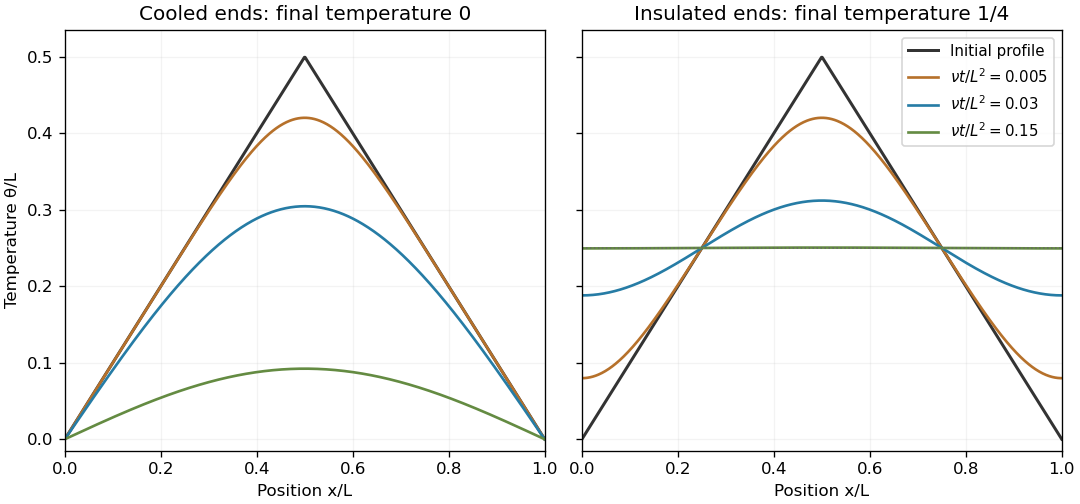
The same triangular initial temperature with cooled and insulated ends
. Original heat-equation solutions for several dimensionless times. Fixed zero-temperature ends cool the bar to zero; insulated ends preserve its initial mean and approach a uniform temperature. Details.
The cooled endpoints impose Dirichlet boundary conditions . The spatial modes are . Integrating the initial profile on its two straight segments givesThe heat flow from a triangular initial temperature with height is thereforeEvery nonzero mode decays, so as . There is no nonzero constant mode compatible with these endpoint temperatures.
By Fourier's law, insulation means zero outward heat flux. The Neumann boundary conditions are . The constant mode equals the initial integral average . For , the cosine coefficients areOdd modes and modes divisible by four vanish; write the remaining indices as . The heat flow from a triangular initial temperature with insulated endpoints givesThe nonconstant modes decay, so uniformly as . Integrating the heat equation gives , explaining the conserved mean. The cooled case tends instead to zero because heat leaves through its ends.
The initial triangle has nonzero endpoint slopes, so it is not compatible with the insulated condition at the corner . The series nevertheless recovers the continuous initial temperature and satisfies the insulated condition for every ; one should not assert continuity of its spatial derivative at that initial corner.
Articles by others on the same topic
There are currently no matching articles.