For real-direction increments, complex differentiability gives . For imaginary-direction increments it gives . Equating these expressions gives the Cauchy-Riemann equationsA holomorphic function is smooth, so mixed partial derivatives commute. Differentiating these equations givesThus both real and imaginary parts are harmonic functions:
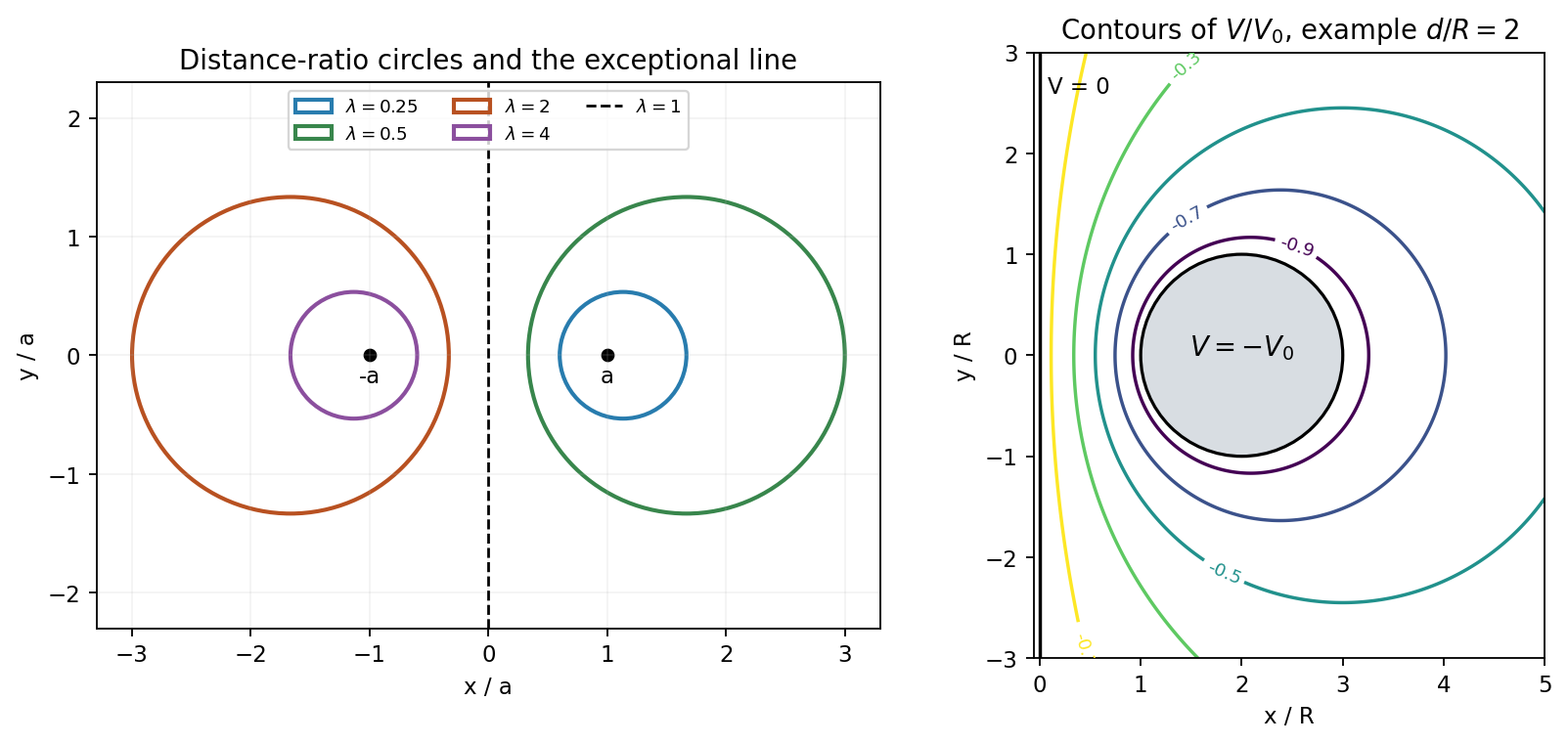
Squaring the ratio of moduli givesFor , complete the square to obtain the Apollonius circleIts centre is and its radius is . The centres are positive for and negative for .
At the allowed exceptional value , the locus is the line , the perpendicular bisector of the two fixed points. It is a generalized circle, but not an ordinary finite-radius circle. The point is excluded from the original ratio.
For a circle in the right half-plane use . Its centre and radius from part (ii) satisfy . Hence choosePut . Then andIndeed the Apollonius circle has centre and radius . Its logarithmic modulus is therefore , while on the modulus is one. The logarithmic Dirichlet potential between a circle and a line isThe logarithmic singularity at lies inside the excluded disk, since . The other singularity, at , lies outside the right half-plane. Thus the real logarithmic modulus is harmonic throughout the required region and has exactly the two specified boundary values.
Local branches of the complex logarithm justify harmonicity; its real part is globally single-valued even though the complex logarithm need not be single-valued around the excluded disk. The displayed solution is bounded and tends to zero at infinity. A boundedness or corresponding far-field condition supplies uniqueness in this unbounded domain; finite boundary values alone do not rule out unbounded additional harmonic solutions. The same geometry appears in cylinder-plane image charges.

Articles by others on the same topic
There are currently no matching articles.