For a subgroup of a finite group , Lagrange's theorem statesHere is the number of distinct left cosets. Every coset has members, and the cosets partition , proving the identity. In particular the order of a subgroup divides the order of the group. Divisibility is generally necessary, not sufficient, for a subgroup of a given order to exist.
The relation implies . Move each reflection generator to the right in any word, cancel pairs using , and reduce exponents modulo . Every element then has a normal form or , .
For the actual symmetry group of a regular polygon these are distinct rotations and distinct reflections. The determinant distinguishes rotations from reflections in the planar action. Hence the source's dihedral group has order , with its subscript counting polygon vertices. The calculations below use that convention.
For a regular pentagon, take as rotation through and as reflection in the horizontal axis through vertex zero. The distinct elements areEvery nonidentity rotation has order five. The reflections are the five order-two elements, since .
The reflection has axis at angle to the horizontal, understood modulo . If vertices have angles , it sends vertex to vertex . Each axis passes through one vertex and the midpoint of the opposite edge; that vertex stays fixed and the other four vertices exchange in two pairs.
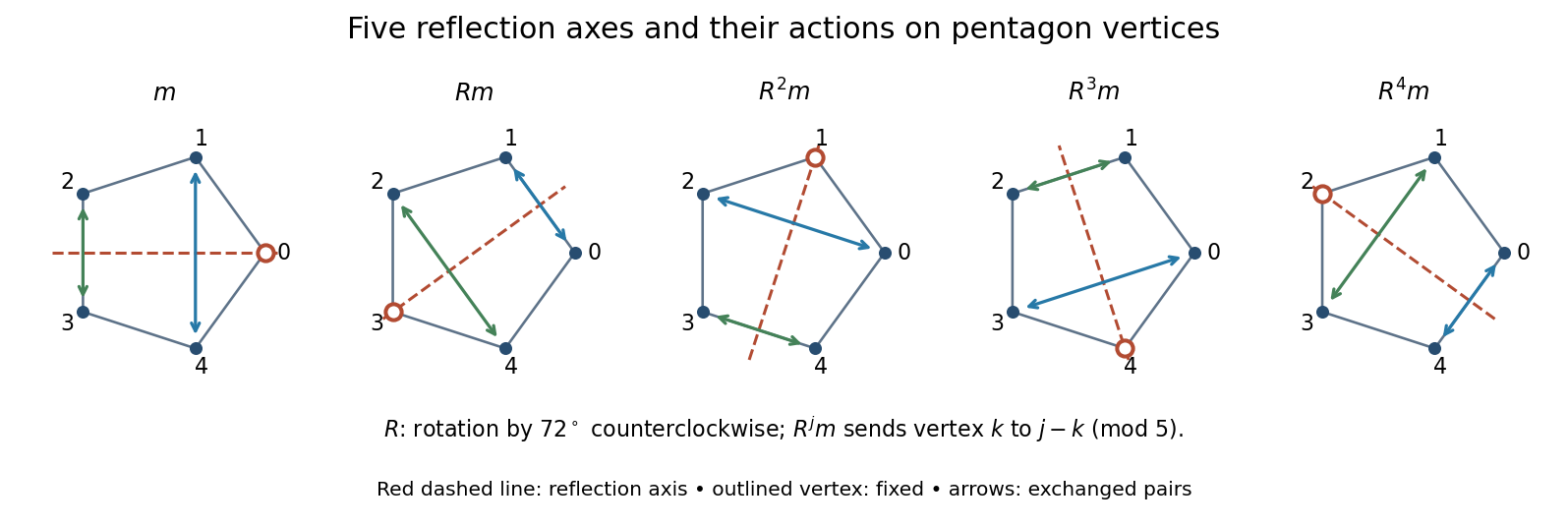
The five order-two pentagon symmetries; each dashed reflection axis fixes one vertex and exchanges the two indicated pairs
. Details. 
Since , Lagrange's theorem permits proper subgroup orders only . The complete list isTo show completeness, an order-two subgroup must be generated by its unique nonidentity element, necessarily one of the five reflections. An order-five subgroup is cyclic, since its order is prime; its generator cannot be a reflection, and every nonidentity rotation generates the same rotation subgroup. There is only one order-one subgroup.
Thus there are seven proper subgroups when the trivial subgroup is included, or six nontrivial proper subgroups. These are the prime-sided case of the classification of subgroups of a dihedral group.
The conjugacy class of is . Rotations commute with one another, while conjugation by a reflection changes to . Thus the rotation classes are , and .
For reflections,Because multiplication by two permutes the residues modulo five, these conjugates exhaust all five reflections. Consequently the complete class partition isTheir sizes account for every element, as in the conjugacy classes of a finite dihedral group.
A normal subgroup is a union of complete conjugacy classes. The trivial subgroup is normal, and the rotation subgroup is normal because conjugation preserves it; equivalently it has index two. None of the five order-two subgroups is normal, because it contains just one member of the five-element reflection class. Thus the proper normal subgroups are exactly
Articles by others on the same topic
There are currently no matching articles.