Using Fourier inversion with the stated convention,Hence applying the transform twice gives the duality property of the Fourier transform:The formula holds directly for rapidly decreasing smooth functions, and extends through the usual L2 space or tempered distribution formulations when absolute convergence is unavailable.
For a real nonzero , put in the Fourier transform. Reversing the integration limits when produces the absolute value:This is the scaling property of the Fourier transform. If and exists, the transformed function is constant in time; its transform is in the sense of tempered distributions, rather than an ordinary convergent Fourier integral.
The Heaviside step function restricts the integral defining the Fourier transform to , soThe convergence condition is essential. For real it means , which is the decay assumption used in the subsequent parts. At a distributional Fourier transform is needed; for negative real the defining improper integral diverges.
For , the even exponential is except for an irrelevant single value at zero. Linearity and the scaling property of the Fourier transform at giveIn particular, for positive real the transform is real and even, as expected from the symmetry of .
Set in part (d), obtaining . Apply the duality property of the Fourier transform from part (a):Therefore
For the difference of Heaviside step functions is an interval indicator, and on and zero elsewhere. Its Fourier transform isThe apparent singularity at is removable. The formula remains valid for real negative , because the original step-function difference and the oriented integral both reverse sign; for both vanish. This is the Fourier transform of an interval indicator and produces a scaled sinc function.
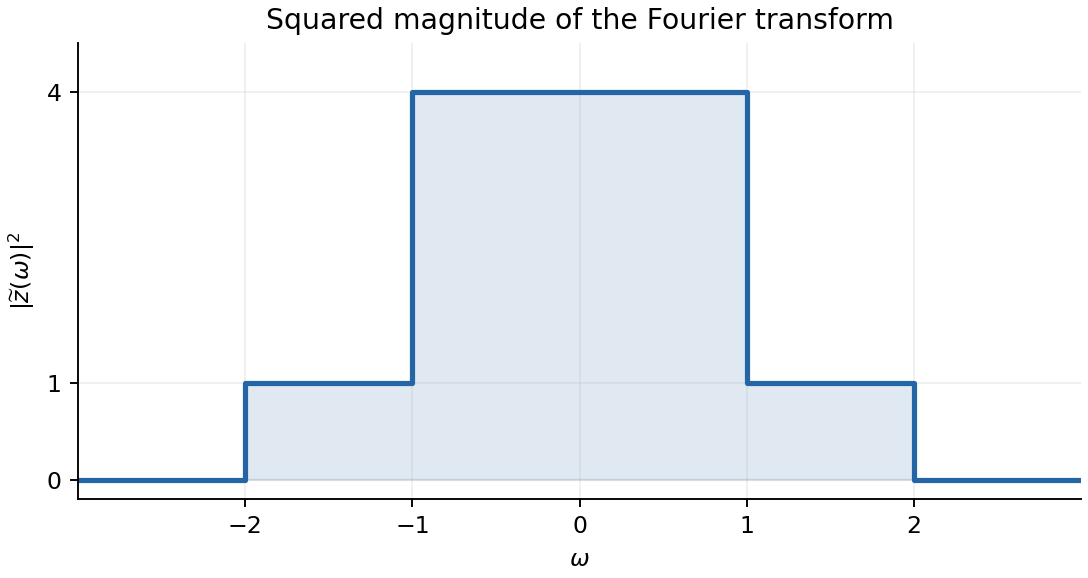
By Fourier inversion, the sinc function has Fourier transform equal to one for and zero for . Thus the two bandwidths add to giveThe requested squared-magnitude spectrum therefore has heights four and one:Values at the jump points depend on the chosen Fourier convergence convention and do not affect any integral. The graph is shown below.

Articles by others on the same topic
There are currently no matching articles.