Fermat principle states that the optical path length , or equivalently travel time , is stationary under small variations of the ray with fixed endpoints. Stationarity need not mean a global minimum.
For a plane ray written as , use , with . Its stationary paths obey the Euler-Lagrange equationIt follows by taking the first variation, integrating the term in by parts, and using zero endpoint variations.
Choose the mirror as the line , the source as and the observer as , with positive heights. Within the plane of incidence, let the reflection point be . In a uniform medium the optical length is a constant index timesStationarity with respect to the point on the mirror givesThese two ratios are the sines of the angles to the normal, with the stationary point between the two projected endpoints. ThereforeThe angles lie in , where sine is injective. Varying a second tangential coordinate in three dimensions also enforces that the source, normal and reflected ray lie in one plane. This derives the law of reflection from Fermat principle.
Place the interface at , with source and observer in the two uniform media. Let be the crossing point. The optical length isDifferentiating with respect to and setting the result to zero givesRecognizing the ratios as the sines of the angles measured from the interface normal proves Snell's law:The stationarity condition is the continuity of the tangential optical momentum across the planar interface.
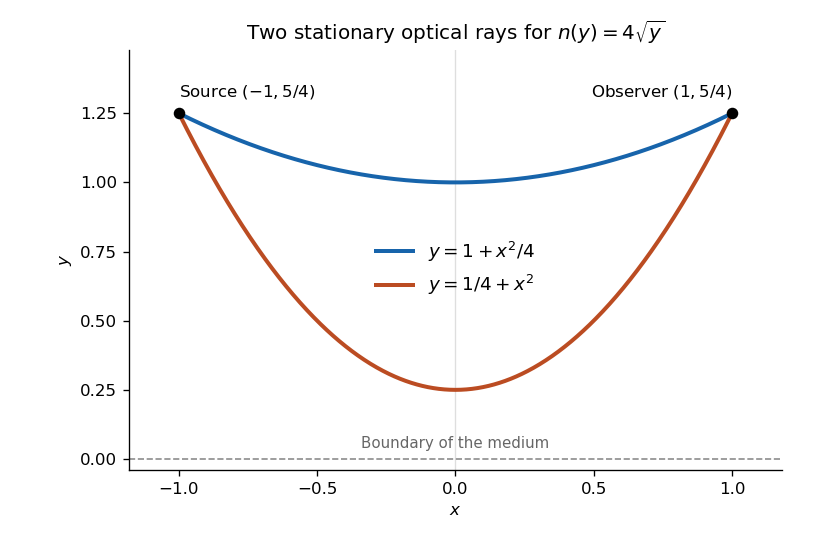
The original PDF places both endpoints at height ; the vertically stacked fraction can be misread in extracted text. The coefficient in the index is , multiplying .
For the optical-length integrand , the Beltrami identity applies because there is no explicit dependence. It giveswhere is constant. Therefore . The full Euler-Lagrange equation is , and combining these gives . This also excludes a constant curve, which would satisfy the squared first integral but not the full variational equation. Integration yieldsEqual endpoint heights at require . The height condition then becomes , or . Its two positive roots are and . Hence the two possible stationary rays areBoth stay in , have the required endpoints and satisfy the variational equation. These are the two optical rays in a square-root refractive-index profile. Fermat stationarity supplies two rays; it does not assert that both globally minimize travel time.

Articles by others on the same topic
There are currently no matching articles.