A function is an analytic function at if it is holomorphic throughout some open neighbourhood of , equivalently if it has a convergent power series there. In real components , continuous first partial derivatives in a neighbourhood together with the Cauchy-Riemann equationsthroughout that neighbourhood are sufficient, and for an analytic function they hold there. Satisfying these equations only at the single point is not enough to establish analyticity in a neighbourhood.
Factor the polynomial denominator as . The numerator has values and at the two roots, so neither cancels. ThereforeThe factor gives a branch point at zero, with local behaviour . Infinity is also a branch point, since in the coordinate the leading behaviour is . A single-valued branch requires a branch cut joining these points. Away from that cut and the two poles, the selected branch is holomorphic. For the integral below, use , putting the cut along the positive real axis.
Use a counterclockwise keyhole contour around the positive real branch cut, with small radius and large radius . On the upper bank , so the integral tends to . On the lower bank , , giving the negative of the upper-bank integrand. That bank is traversed from to , so its contribution also tends to .
The outer circle contributes , since and its length is . The small circle contributes , since . Both vanish. HenceThe contour encloses both double poles but excludes the branch point.
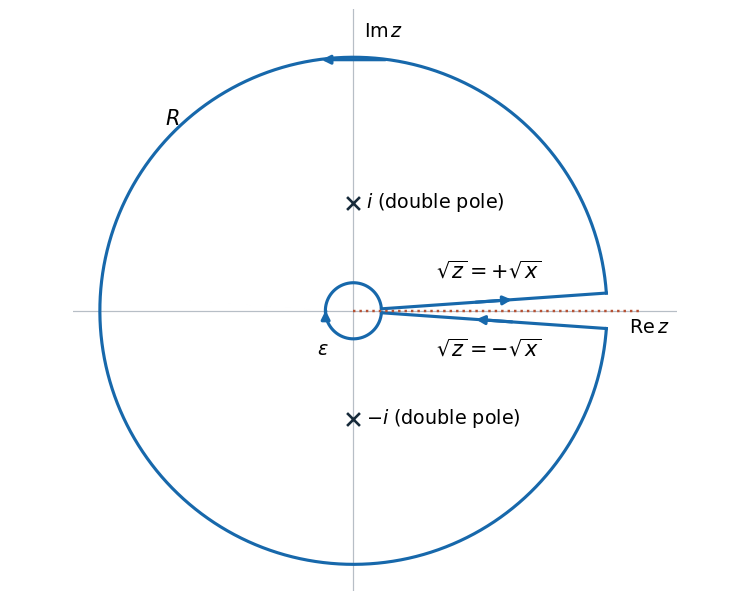
Keyhole contour around the positive real branch cut
. The upper bank runs outwards and the lower bank runs inwards. The large circle is counterclockwise and the small circle is clockwise; both poles lie inside the contour. The gaps are enlarged for visibility. Details.
Articles by others on the same topic
There are currently no matching articles.