The signal is continuous at zero with . Its envelope is , but its angular frequency falls from on the incoming side to on the outgoing side. Its one-sided slopes are and , producing a cusp at the peak. Both tails decay to zero.
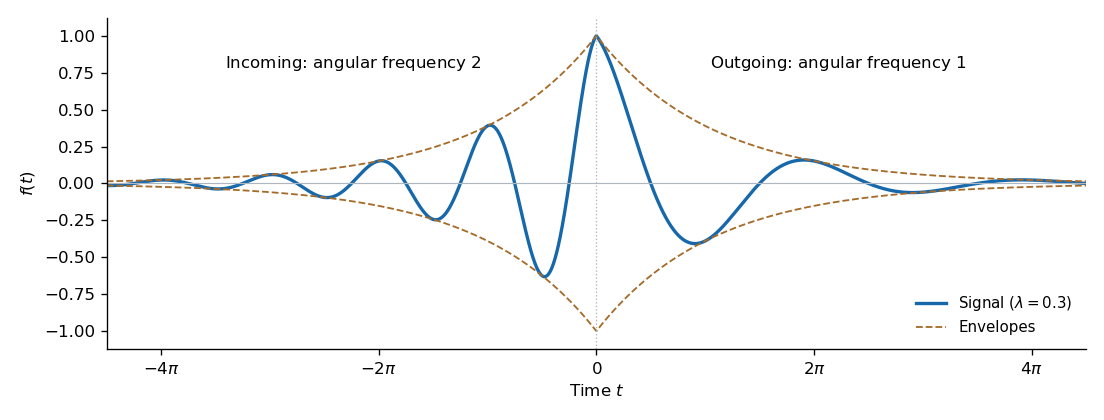

Use . Expanding each cosine into two exponentials and integrating its half-line givesEquivalently,The positive guarantees convergence of the Fourier transform integrals.
The Fourier transform of a derivative gives . For ,This selects the solution decaying at both time infinities. Indeed, the inverse transform of is the one-dimensional modified Helmholtz Green function , and the convolution theorem gives . The printed equation has homogeneous solutions , so these two decay conditions matter; no causal initial-value condition was specified.
For , evaluate Fourier inversion by closing the contour in the lower half-plane, where decays. The contour is clockwise. The enclosed simple poles and residues of areThus inversion equals times the sum of the residues of , givingAs a check, applying gives . The convolution also gives for ; the two pieces have matching values and matching first derivatives at zero.
Articles by others on the same topic
There are currently no matching articles.