Original question.
What are the mechanical principles upon which the use of a pendulum in a clock, and of a balance wheel in a watch, depends ?
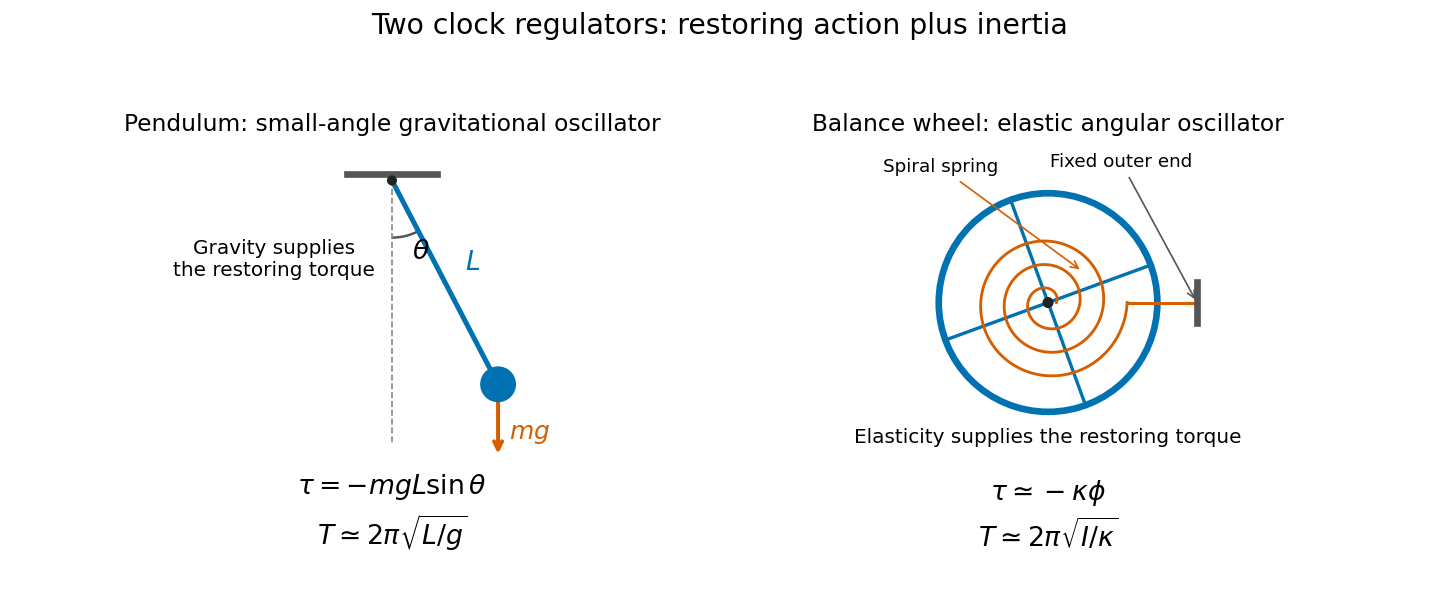
Both instruments regulate a sequence of time intervals with an oscillator. A restoring action opposes displacement, while inertia carries the moving part through equilibrium. Their repeated swings control an escapement, which releases the gear train in steps and supplies enough energy to offset frictional losses.
For a simple pendulum of length ,At small amplitude, , giving simple harmonic motion withA real clock pendulum is a physical pendulum. If its pivot moment of inertia is and its centre of gravity is a distance below the pivot, its small-swing period is . Gravity supplies the restoring torque. A controlled swing amplitude and stable dimensions are needed: large swings, thermal expansion and changing effective gravity alter the rate.
A watch's balance wheel turns back and forth about its spindle. A torsion spring supplies an approximately linear restoring torque , soThe restoring mechanism is elastic rather than gravitational. This makes the balance-spring system suitable for a portable watch, although disturbances, imperfect balance, changing spring properties and escapement interactions still affect the rate.

Near independence of period from amplitude is isochronism. It is approximate for the simple pendulum: its leading correction is with in radians. Keeping the oscillations repeatable therefore matters as well as selecting the nominal period.
Articles by others on the same topic
There are currently no matching articles.