A suitable donor-acceptor heterojunction provides an energetically favourable route from a bound excitation to an interfacial charge-transfer state and then separated carriers. The electron is preferentially transported in the acceptor and the hole in the donor. The interface facilitates dissociation that is inefficient in a single strongly excitonic material; it must also avoid excessive energy loss and rapid interfacial recombination.
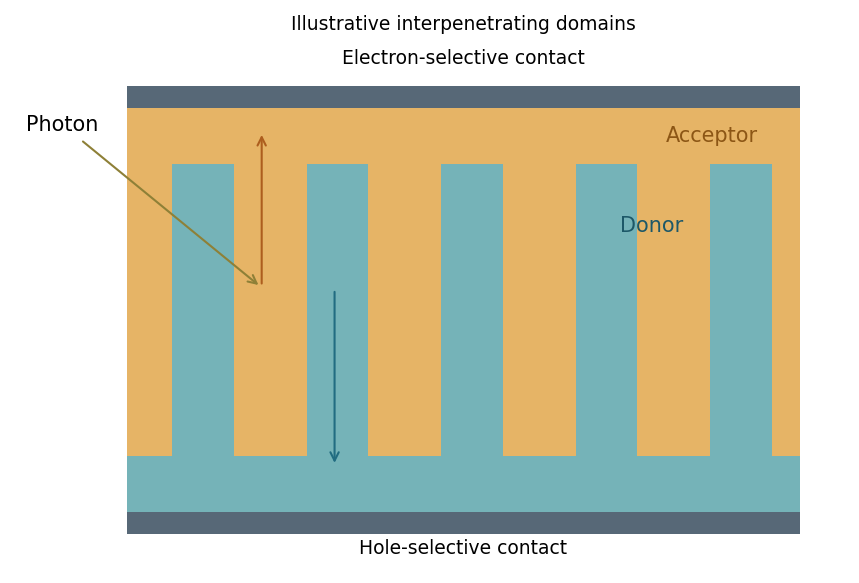
An interpenetrating donor-acceptor structure balances short exciton travel with continuous charge-extraction paths
. Source. Details. 
An idealized bulk heterojunction places most generated excitons within roughly a diffusion length of an interface while maintaining continuous donor paths to the hole contact and acceptor paths to the electron contact. Domain dimensions should therefore be comparable to the material's exciton transport scale, not arbitrarily large. The total absorbing thickness should capture substantial light yet remain within the charge-collection capability set by mobility, field and recombination. Excessive mixing can impair transport or increase recombination; very coarse domains waste excitons before they reach an interface.[ref]
Articles by others on the same topic
There are currently no matching articles.