In generic resistive-pulse sensing, two electrolyte reservoirs are connected through a small aperture. Electrodes apply a bias and a low-noise current amplifier records the pore current. Passage of a weakly charged insulating particle excludes conducting liquid, usually increasing resistance and giving a transient current decrease at fixed voltage. Pulse amplitude, duration and event rate contain size-, transport- and concentration-dependent information, subject to calibration.
Advantages include label-free single-particle counting, electrical readout and small active volume. Limitations include clogging, electrode/pore noise, finite bandwidth, uncertain particle trajectories and surface-conduction effects; a pulse is not intrinsically chemically specific. Strong particle charge or concentration polarization can complicate, or even reverse, the simple blockade signal. The schematic below uses only generic nonbiological particle transport.
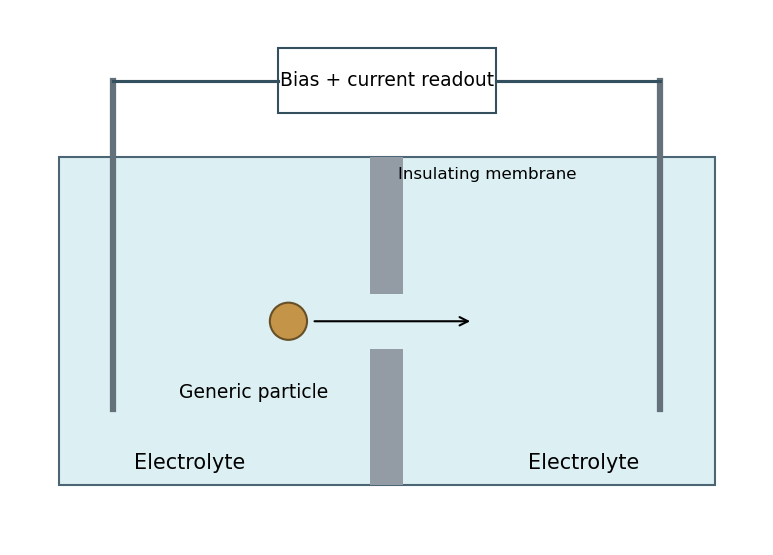
Generic particle sensing through an electrolyte-filled aperture with voltage bias and current readout
. Source. Details. 
Ignoring access effects and wall charge, the cylindrical conducting liquid hasThe corresponding conductance is approximately . A charged surface can contribute mobile counterions and change this estimate. Surface conduction is important when its conductance is comparable with the bulk contribution: for surface conductance , their ratio in a cylinder is , twice the Dukhin number convention . Double-layer overlap, when the Debye length is comparable with the pore radius, is another warning that uniform bulk conductivity is inadequate. No surface-charge or ionic-strength data are supplied to quantify those corrections.
With the left reservoir at and the right at zero, let the pore run from to . In the stated idealization the reservoir potentials are flat, the pore potential is , and its electric field is , directed from high to low potential. The field is zero in the ideal equipotential reservoirs; real access regions would round these abrupt boundaries.
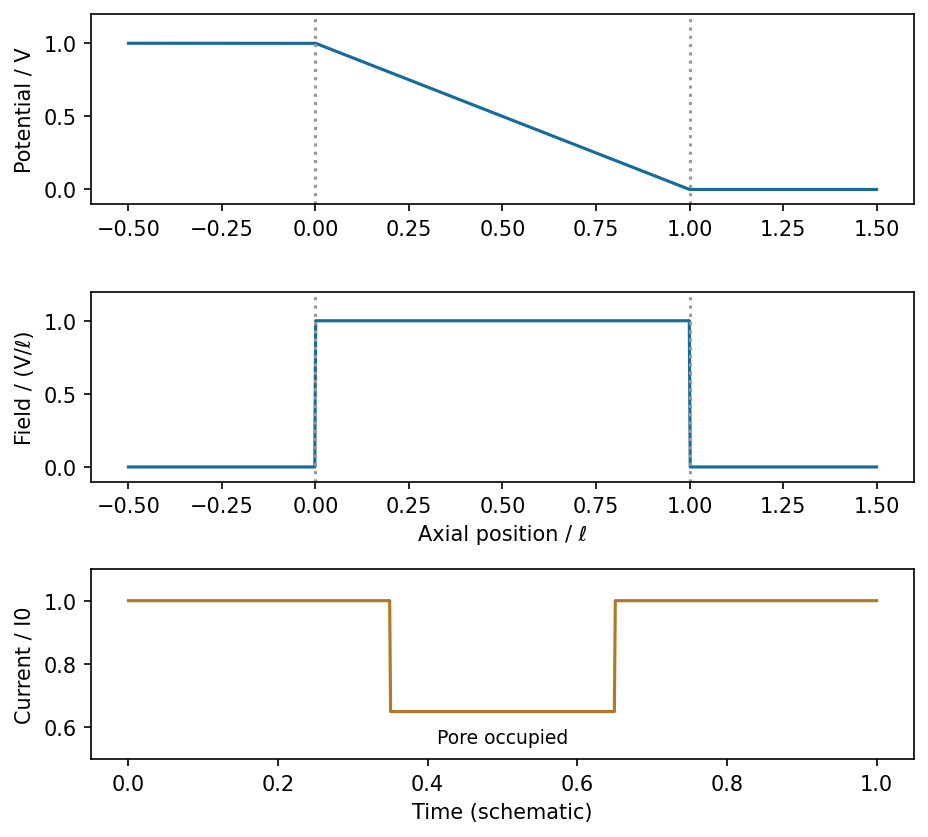
Ideal potential, field and current blockade for a generic insulating particle crossing a uniform pore
. Source. Details. 
For constant-speed passage and an approximately position-independent in-pore obstruction, the current has a rectangular downward pulse from to during occupation. Entry, exit, filtering and nonuniform fields round real pulses. This describes a physical particle signal without inferring any biological identity or charge.
Articles by others on the same topic
There are currently no matching articles.