A liquid crystal flows while retaining partial molecular order. A nematic liquid crystal has long-range orientational order but no crystal-like positional lattice. Its local mean axis is the nematic director , with for an ordinary apolar nematic. Order leads to anisotropic optical and dielectric response and an elastic cost for director distortions.
Nematic order selects an axis, not a common molecular head direction or density-layer stack. The original sketch uses short rods as a coarse-grained orientation map.
Liquid-crystal order, defects, anchoring and cylindrical confinement
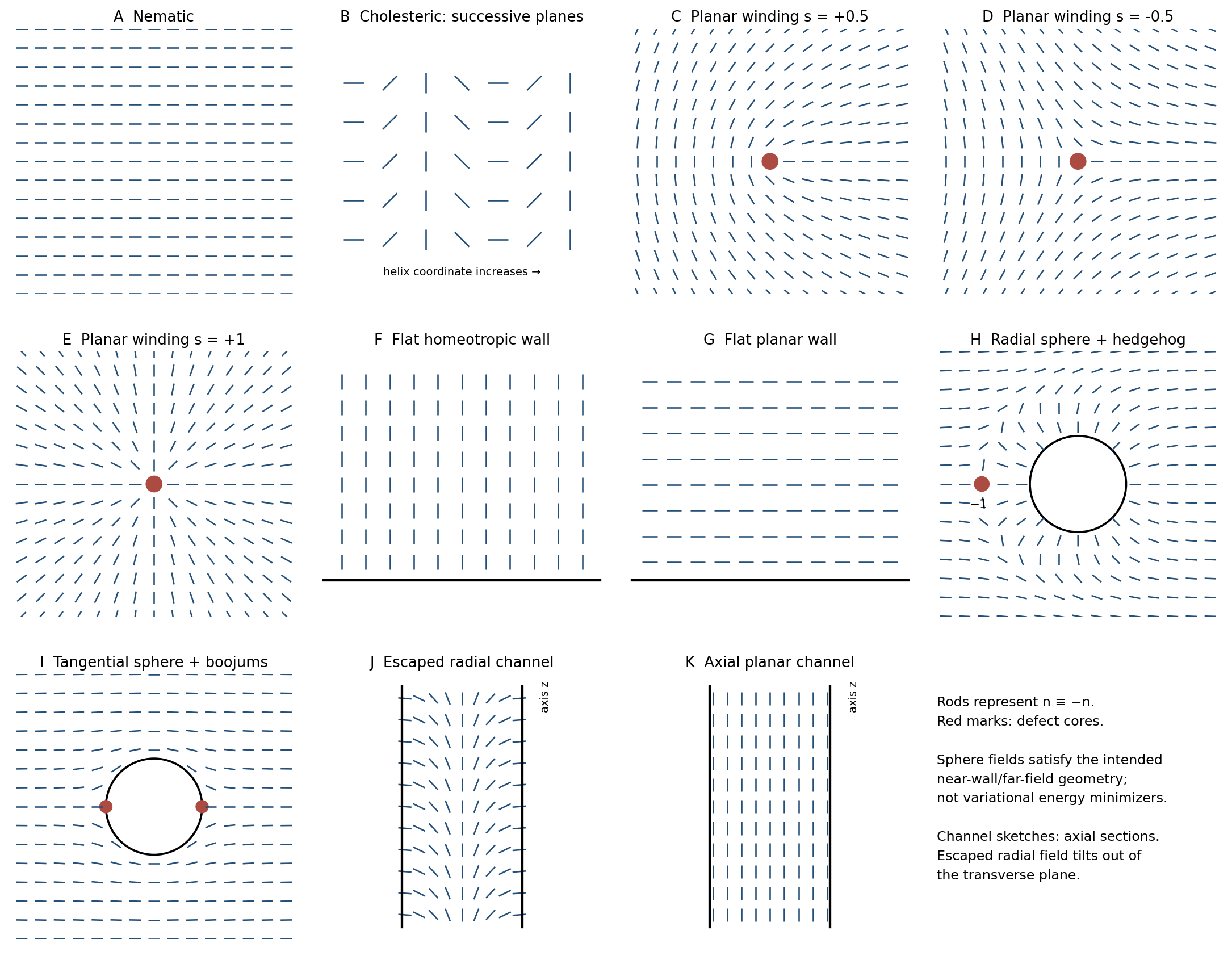
. Original director sketches. Rods have no arrowheads. Sphere profiles are illustrative boundary-compatible fields, not elastic-energy minimizers. Channel panels are axial sections; the homeotropic profile escapes toward the pore axis. Details.
A cholesteric liquid crystal is locally nematic but its nematic director rotates helically, for exampleThe sign of specifies handedness and is the full-turn pitch. The sketch shows rods rotating through transverse planes. This is helical orientational order, not a smectic density-layer lattice. Although an apolar director repeats physically after a half-turn, the conventional pitch denotes a full turn. A pitch comparable to visible wavelengths can give selective reflection.
The blue phases result when strong local chirality favors double twist that cannot fill three-dimensional space everywhere without frustration. Double-twist regions are connected through a network of nematic disclinations.
Blue phase I has body-centered cubic order and blue phase II simple-cubic order in their director/defect structures. The periodicity can cause selective optical reflection. Blue phase III is disordered or amorphous, not another ideal cubic lattice. These are structured fluid phases rather than ordinary crystals with molecules fixed to every lattice site.
Articles by others on the same topic
There are currently no matching articles.