A liquid crystal flows while retaining partial molecular order. A nematic liquid crystal has long-range orientational order but no crystal-like positional lattice. Its local mean axis is the nematic director , with for an ordinary apolar nematic. Order leads to anisotropic optical and dielectric response and an elastic cost for director distortions.
Nematic order selects an axis, not a common molecular head direction or density-layer stack. The original sketch uses short rods as a coarse-grained orientation map.
Liquid-crystal order, defects, anchoring and cylindrical confinement
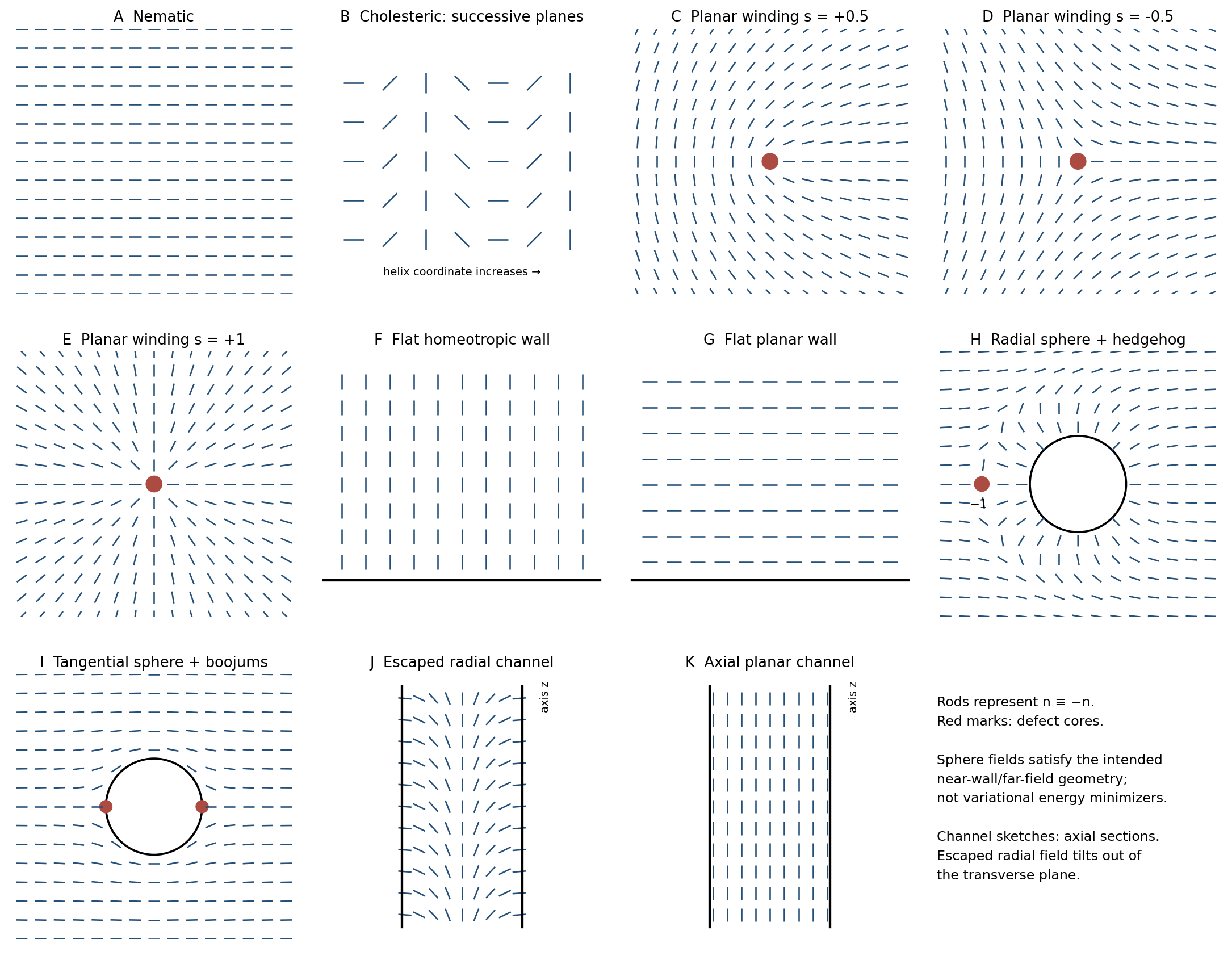
. Original director sketches. Rods have no arrowheads. Sphere profiles are illustrative boundary-compatible fields, not elastic-energy minimizers. Channel panels are axial sections; the homeotropic profile escapes toward the pore axis. Details.
A cholesteric liquid crystal is locally nematic but its nematic director rotates helically, for exampleThe sign of specifies handedness and is the full-turn pitch. The sketch shows rods rotating through transverse planes. This is helical orientational order, not a smectic density-layer lattice. Although an apolar director repeats physically after a half-turn, the conventional pitch denotes a full turn. A pitch comparable to visible wavelengths can give selective reflection.
The blue phases result when strong local chirality favors double twist that cannot fill three-dimensional space everywhere without frustration. Double-twist regions are connected through a network of nematic disclinations.
Blue phase I has body-centered cubic order and blue phase II simple-cubic order in their director/defect structures. The periodicity can cause selective optical reflection. Blue phase III is disordered or amorphous, not another ideal cubic lattice. These are structured fluid phases rather than ordinary crystals with molecules fixed to every lattice site.
A topological defect occurs where the local order cannot be continued smoothly while retaining its surrounding texture. At a nematic disclination core, the director model fails and the orientational order may decrease.
For a planar texture ,Because , half-integer winding strengths are allowed. The original sketches use to show , corresponding to director turns . A radial pattern and an azimuthally rotated version have the same winding.
These are planar labels. In unrestricted three dimensions an integer line texture may escape by tilting out of the plane; half-integer lines have a different classification. A planar disclination strength must not be identified automatically with a three-dimensional hedgehog point charge.
homeotropic anchoring favors the nematic director normal to a surface. For a flat wall at , uniform is a simple compatible profile, shown as perpendicular rods. If a remote wall demands another orientation, elastic bending interpolates between the boundaries.
A common surface energy is , with wall normal and . Its minima have parallel or antiparallel to . The profile is controlled jointly by this preference and Frank elastic energy.
planar anchoring favors the nematic director tangent to a surface. A flat wall at permits uniform , as in the sketch. A rubbed surface can select one in-plane axis; degenerate planar anchoring selects only the tangent plane.
For the degenerate case, has minima at . A remote incompatible boundary produces elastic distortion. Tangency alone does not specify an azimuthal direction within the surface.
Strong homeotropic anchoring requires radial orientation just outside a sphere, while the remote director is uniform. A plausible dipolar texture contains a compensating hyperbolic hedgehog defect on one side. The particle's radial boundary has charge under a consistent convention, balanced by an exterior point defect of charge so the far field is uniform. The original cross-section depicts this configuration.
An alternative has an equatorial Saturn-ring defect. Its local disclination winding is half-integer; that local winding is not itself the net three-dimensional compensating charge. Particle size, elastic constants, confinement and anchoring strength select between configurations. The elastic theory explicitly compares dipolar, Saturn-ring and surface-ring states.[ref]
Director field configurations around a spherical particle in a nematic liquid crystal by Holger Stark. 1999, configuration comparison and dependence on particle/surface parameters
A sphere with degenerate planar anchoring can have a bipolar texture with two surface boojums at opposite poles along the far-field axis. Surface director lines remain tangent, curve between the polar cores and relax toward uniform alignment far away. The original cross-section shows both cores.
A globally regular tangent orientation field cannot cover a sphere; the associated surface winding indices sum to its Euler characteristic, two. These are surface defects, not two arbitrarily placed bulk hedgehogs. Finite anchoring allows deviations near the cores, while an azimuth-selective coating could favor a different texture.
Choose an asymmetric diblock copolymer in a cylinder-forming regime: minority cylinders lie in a continuous majority matrix. Form and anneal a film to develop microphase separation, control substrate and top-surface preferences or apply a suitable field to orient cylinders normal to the film, then selectively remove the minority phase. The retained majority matrix becomes the porous support. Infiltrate the channels with liquid crystal. The majority phase forms the channel walls; removing that continuous matrix would not generally leave a continuous nanoporous membrane.
With homeotropic anchoring, the director is radial at a cylindrical side wall. A strictly transverse radial texture has a line core, but an escaped radial texture can avoid it:The director turns axially at the center and is normal to the wall at radius . The original axial-section sketch shows this three-dimensional escape. End conditions, channel dimensions and anchoring strength determine whether escape or a defect-containing profile is favored.
With planar anchoring on the cylindrical side wall, uniform axial alignment is a simple defect-free profile. The axial direction is tangent at every wall point, so it satisfies the lateral boundary everywhere without elastic distortion.
This assumes degenerate planar anchoring, or an azimuthal preference compatible with axial alignment. End constraints, selected circumferential anchoring or imposed twist can favor another state. planar anchoring alone does not require a circumferential vortex. The original axial-section sketch shows the uniform axial option.
Surface-treated colloids impose boundary conditions on a nematic liquid crystal, producing director distortions and defects. Bringing particles together can reduce total Frank elastic energy by sharing distortion or defect structures. The interactions are directional: particle–hedgehog dipoles can favor chains, while quadrupolar and confined configurations can favor other arrays. The defects provide orientation-selective bonds rather than an isotropic attraction alone.
Prepare a cell with controlled far-field alignment and particle anchoring. Image textures with a polarizing microscope; use optical tweezers to place two particles at selected separations and orientations, then release them and track their trajectories. Repeating over orientations tests anisotropy before increasing concentration to assemble larger arrays. Compare particles with different anchoring and compare with the isotropic phase to distinguish director-mediated binding from ordinary aggregation. Temperature-dependent viscosity and other surface forces must be accounted for in kinetic comparisons.
The reported two-dimensional nematic colloidal crystals used micrometre confinement and defect-mediated interactions to create ordered particle structures. This motivates the mechanism without implying that arbitrary particles will select the same lattice.[ref]
Two-Dimensional Nematic Colloidal Crystals Self-Assembled by Topological Defects by Igor Muševič and others. 2006, pp. 954–958, confined colloidal assembly and defect-mediated binding
Articles by others on the same topic
There are currently no matching articles.