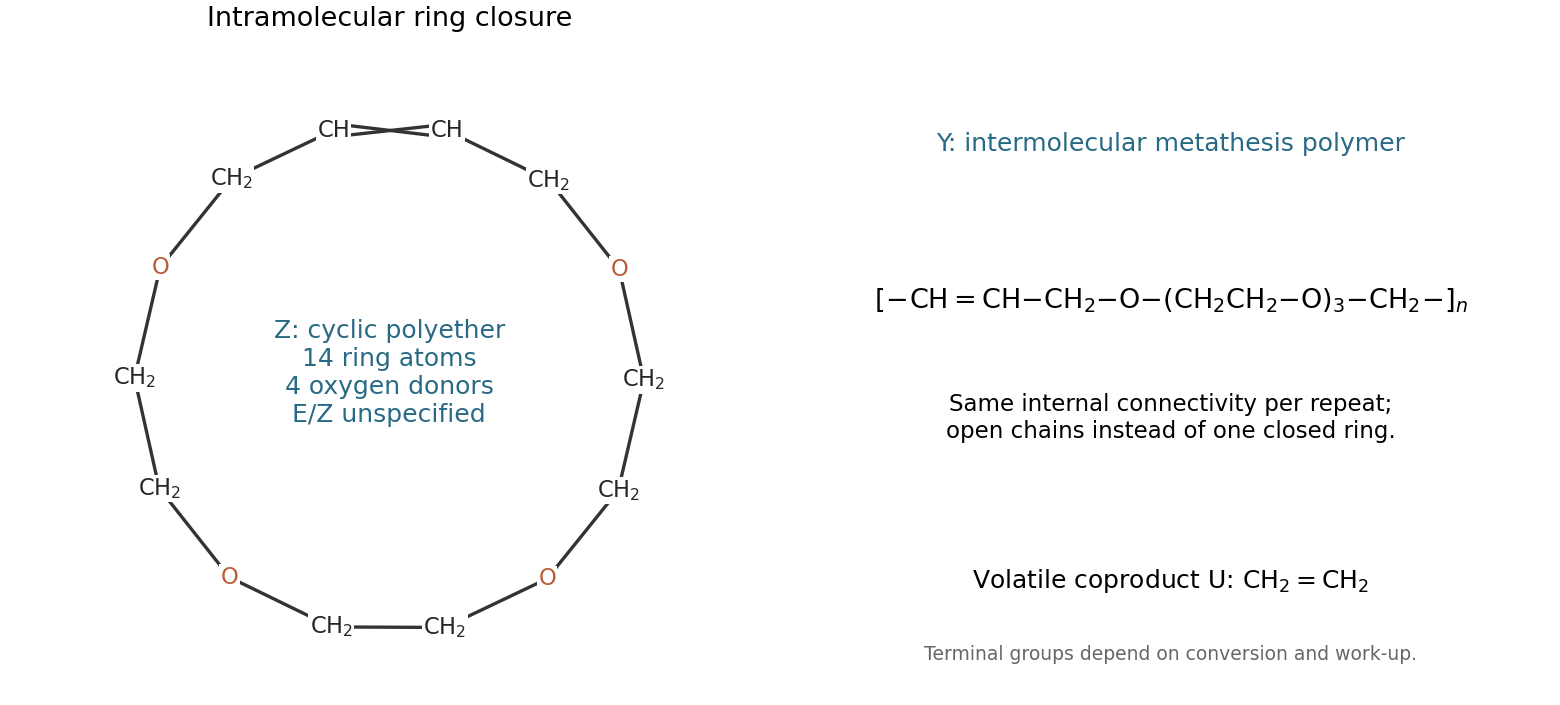
The two terminal alkenes undergo olefin metathesis. Their terminal methylene groups combine to give U = ethene, . Connecting the two internal alkene carbons of the same molecule gives Z, the unsaturated crown ether macrocycle. Following the drawn chain gives four oxygens, six carbons in the three internal ethylene links, two O-adjacent methylenes at the ends and two alkene carbons: a 14-membered ring containing four oxygens.
The ring connectivity is specified completely by the cyclic sequenceThe final methylene reconnects to the first alkene carbon. The examination does not fix alkene stereochemistry, so a single E/Z assignment is not required.
At high concentration, intermolecular encounters compete strongly with ring closure, giving Y, an unsaturated polyether formed by acyclic diene metathesis polymerization. Its repeat connectivity can be writtenFor a finite linear chain, terminal groups depend on conversion and work-up; its internal repeat is the relevant structural answer. Reduced pressure removes ethene and promotes metathesis conversion, while dilution reduces bimolecular chain growth relative to intramolecular closure. These competing routes are documented by the original authors' chemical study.[ref]
Template-Directed Ring-Closing Metathesis by Michael J. Marsella and others. 1997, macrocycle formation and competing unsaturated-polyether formation

Articles by others on the same topic
There are currently no matching articles.