C2 is favoured by kinetic control; C1 is favoured by thermodynamic control. Starting from the central reactant well, the path towards C2 has the smaller activation barrier, so it normally forms faster at low temperature or short reaction time, assuming comparable prefactors. C1 lies lower in energy and is the more stable product on the drawn energy scale.
Raising temperature can make the larger barrier accessible and permit equilibration through reverse reactions. If products interconvert and entropy contributions do not reverse the energy ordering, the equilibrium mixture then favours C1. It would be incorrect to say that high temperature alone guarantees C1: an irreversible reaction may remain kinetically controlled, and the figure does not provide the full temperature-dependent free energies. The useful distinction is rate selection before equilibration versus relative free energy after equilibration.
Remove the gaseous coproduct as it forms, for example by a controlled inert-gas sweep or reduced pressure compatible with the solvent and apparatus. Lowering its partial pressure reduces its chemical potential. For the decomposition equilibrium,so removing G lowers the reaction quotient and drives net conversion towards F until equilibrium is re-established. As D is consumed, reversible conversion from E can replenish it, allowing the coupled network to feed F.
Removing or selectively precipitating F can have a similar effect if feasible. Heating may increase the rate, but its effect on equilibrium requires the reaction enthalpy; a catalyst accelerates equilibration without changing the equilibrium constant. The gas-removal argument works because it changes product activity, not because it changes the identity of the catalyst.
Two neutral carboxylic acids can form a carboxylic acid dimer with two reciprocal O–H···O=C hydrogen bonds. In water, each acid group already makes favourable solvent contacts. Association must displace some of those contacts and loses translational freedom, so the extra stabilization of the dimer may be small. Any ionized carboxylate population also cannot form the same neutral two-donor carboxylic acid dimer.
A nonpolar, weakly hydrogen-bond-accepting solvent such as dry toluene or a compatible hydrocarbon generally favours this dimerization relative to water, provided the acid dissolves. The solvent competes less strongly for the donor and acceptor sites. Dilution still disfavors the dimer because : the dimer fraction depends on concentration even in a favourable solvent. Thus trace dimer in the aqueous sample is not evidence that the acid lacks hydrogen-bonding ability.
Reversible imine formation and disulfide exchange provide two suitable dynamic covalent chemistry reactions.
An aldehyde and a primary amine can reversibly form an imine with loss of water:Multifunctional components can build rings or cages. Acid catalysis, solvent and water activity must permit both formation and hydrolysis or exchange, so that initially incorrect connections can rearrange.
For disulfide exchange, a thiolate attacks a disulfide and substitutes one sulfur-containing fragment:Suitable pH, redox conditions and exchange kinetics let a library of connectivities equilibrate. A template that stabilizes one assembly can shift the library towards it. Reversibility under the actual conditions is essential: calling a covalent reaction “dynamic” does not make a kinetically trapped product mixture equilibrate.
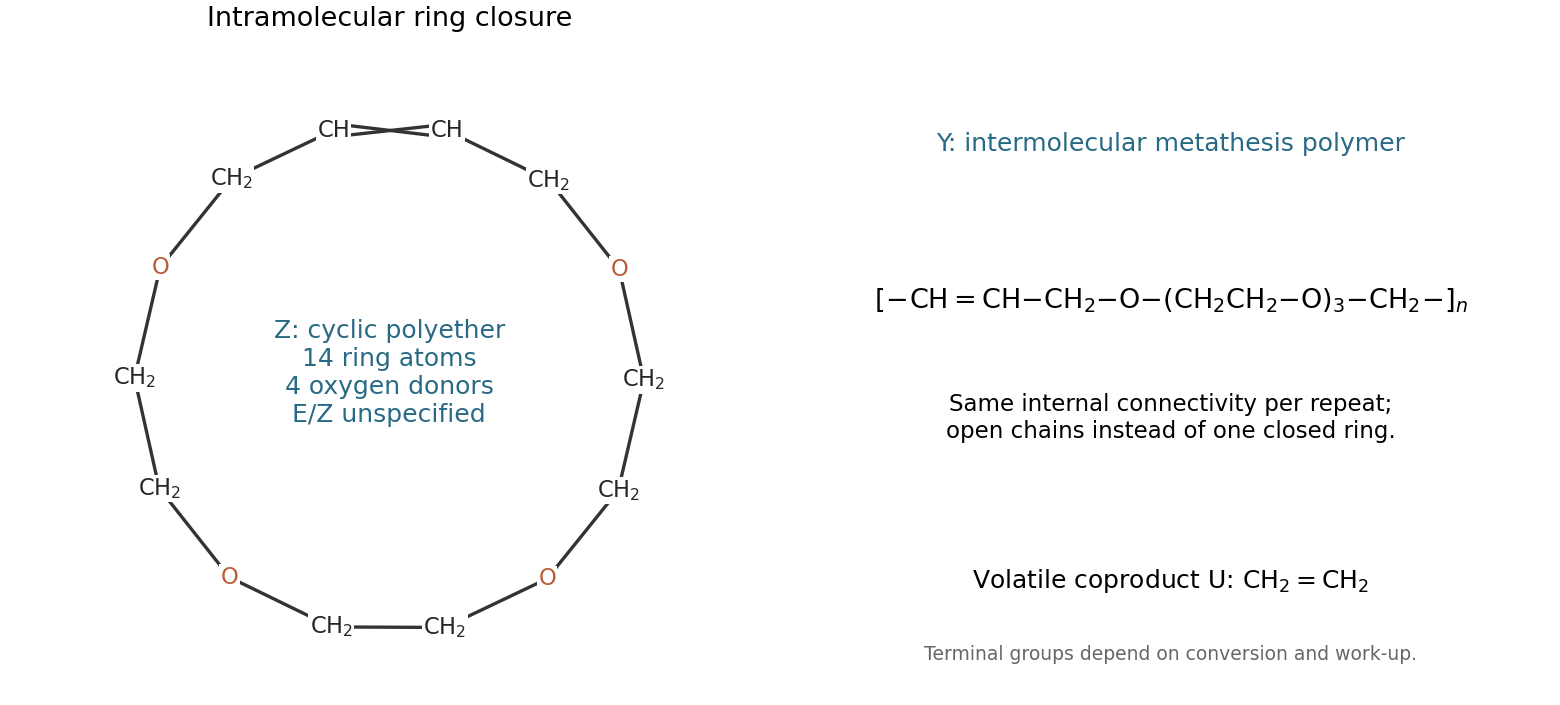
The two terminal alkenes undergo olefin metathesis. Their terminal methylene groups combine to give U = ethene, . Connecting the two internal alkene carbons of the same molecule gives Z, the unsaturated crown ether macrocycle. Following the drawn chain gives four oxygens, six carbons in the three internal ethylene links, two O-adjacent methylenes at the ends and two alkene carbons: a 14-membered ring containing four oxygens.
The ring connectivity is specified completely by the cyclic sequenceThe final methylene reconnects to the first alkene carbon. The examination does not fix alkene stereochemistry, so a single E/Z assignment is not required.
At high concentration, intermolecular encounters compete strongly with ring closure, giving Y, an unsaturated polyether formed by acyclic diene metathesis polymerization. Its repeat connectivity can be writtenFor a finite linear chain, terminal groups depend on conversion and work-up; its internal repeat is the relevant structural answer. Reduced pressure removes ethene and promotes metathesis conversion, while dilution reduces bimolecular chain growth relative to intramolecular closure. These competing routes are documented by the original authors' chemical study.[ref]
Template-Directed Ring-Closing Metathesis by Michael J. Marsella and others. 1997, macrocycle formation and competing unsaturated-polyether formation

The cation acts as a noncovalent template. Coordination to the ether oxygens folds the open chain into conformations with its two alkene ends close together. This increases their effective local concentration and reduces the conformational search needed for ring-closing metathesis. The bound cyclic product is also stabilized relative to unbound alternatives, which can favour it in a reversible reaction network.
A well-matched ion therefore suppresses competing intermolecular connections and increases the isolated or analytical macrocycle yield. It need not become covalently incorporated into Z; it can be removed by changing the binding conditions during work-up. Nor is it necessarily the metathesis catalyst: the ruthenium complex performs bond reorganization, whereas the cation primarily changes preorganization and relative stability. A yield increase alone does not separate a kinetic templating effect from a thermodynamic one, and both can contribute.
The chemically supported assignment isThe four oxygen donors can converge around the small lithium ion to organize the alkene ends efficiently. The larger sodium and potassium ions are less well matched to this particular folded four-oxygen binding environment, with potassium giving the weakest enhancement in the stated comparison. This is a match between donor geometry, solvation and cation size, not a universal rule that lithium templates every crown ether best.
The primary chemical record supports the identity assignment: the inventors' Table 1 reports a strong lithium enhancement for the 14-membered product, with much smaller effects from sodium and potassium. It lists the potassium yield as , whereas this examination gives ; that discrepancy should not be hidden by treating the exam numbers as a verbatim reproduction. The ion assignment follows the structure and the documented templating comparison, rather than the numerical yield alone.[ref]
Template-directed metathesis patent by Robert H. Grubbs and others. US6080826A, Table 1 and discussion of the 14-membered ring: Li, Na and K comparison
Articles by others on the same topic
There are currently no matching articles.