For a uniformly magnetized bilayer that relaxes to one of its easy directions after a saturating in-plane field, the in-plane remanent component isIt is therefore approximately zero when the easy axis is perpendicular at the thin-Co end, and increases towards as the easy axis rotates into the plane. The graph should show an increasing crossover between about and , but the source does not specify its exact shape. A straight line is not a consequence of the two endpoint orientations.
The trend reflects competition between interface-driven perpendicular magnetic anisotropy and volume or demagnetizing contributions favouring in-plane magnetization. An illustrative effective anisotropy is , with sign convention chosen so positive favours the normal. A continuous rotation can require higher-order anisotropy terms; the simple sign change alone need not produce a smooth canting interval.
The relation assumes a well-defined remanent direction and no complete cancellation by domains. A vibrating-sample magnetometer measures total moment: if the result is reported without dividing by magnetic volume, the moment per area additionally scales as .
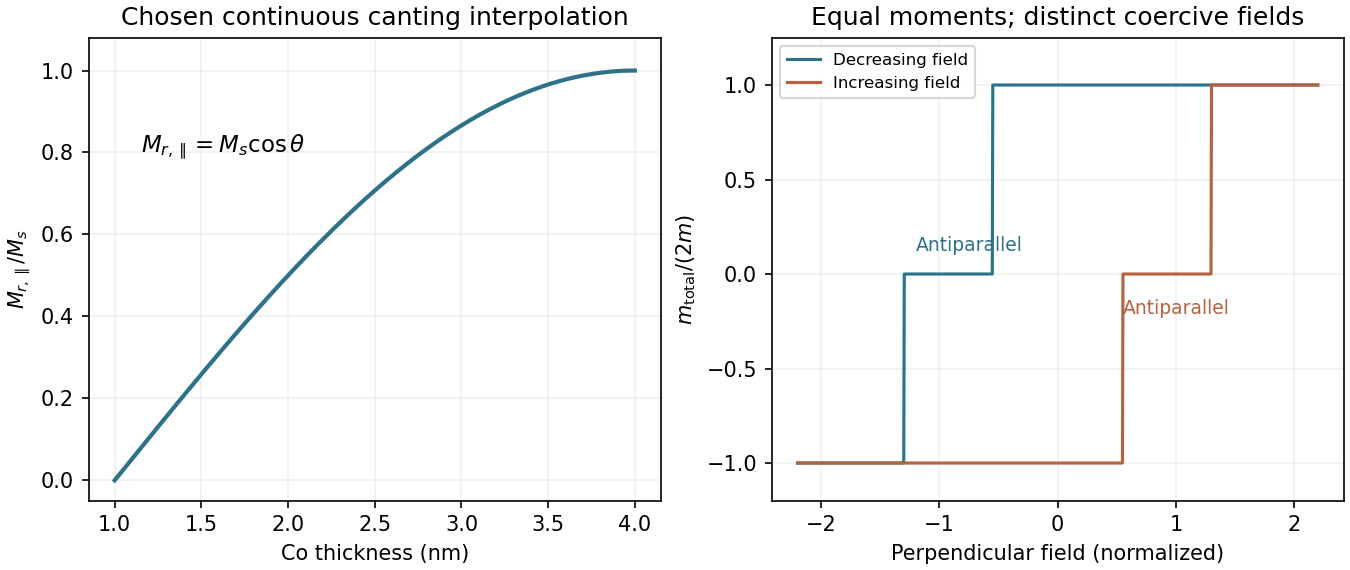
Illustrative remanence crossover and independent two-layer magnetic switching
. The remanence interpolation is a chosen schematic, not fitted data. The hysteresis loop assumes equal magnetic moments, distinct coercivities and independent abrupt reversal. Details.
Let the two layers have equal magnetic moments and coercive-field magnitudes . Assume they are exchange-decoupled, both easy axes are perpendicular, each switches sharply, and dipolar coupling, thermal activation and domain distributions do not smear or offset reversal.
Starting from positive saturation and reducing the perpendicular field, the total moment changes asat and . Between the switches, the moments are antiparallel and cancel. On the return sweep the corresponding transitions occur at and . The plotted normalized loop therefore has two reversal steps and an antiparallel plateau on each sweep, as in the accompanying figure.
Equal magnetization densities do not alone guarantee an exactly zero plateau if the two Co thicknesses or active areas differ: cancellation requires equal moments . The source allows Co thickness variation, so this is an additional assumption worth stating. A real unpatterned millimetre-scale film may reverse by domain processes rather than coherent rotation, producing rounded steps and reduced remanence.
In current-perpendicular-to-plane magnetoresistance, the resistance difference between parallel and antiparallel ferromagnetic layers relies on spin-dependent transmission and retention of spin information. Here, an electron traversing the stack must pass a platinum layer between the two Co films. Strong spin-orbit coupling and associated spin relaxation in Pt, together with spin-memory loss at interfaces, can reduce the polarization reaching the second Co layer and weaken giant magnetoresistance. This is more relevant to the stated perpendicular current than an in-plane shunting explanation.
First, redesign the spacer path so a low-spin-relaxation conductor such as Cu directly separates the two ferromagnets, while retaining perpendicular anisotropy through other interfaces or a different layer sequence. Minimize unnecessary Pt traversal and improve interface sharpness. Merely thinning the Cu layer is not sufficient if it reintroduces magnetic coupling or leaves the Pt spin-relaxation bottleneck unchanged.
Second, replace the metallic spin-transport section with a suitable thin insulating tunnel barrier, for example an engineered MgO-based magnetic tunnel junction, and choose compatible magnetic electrodes. Spin-selective tunnelling can give a much larger resistance contrast, but pinholes, disorder and a poorly matched barrier defeat it. Retaining distinct switching fields and a stable antiparallel configuration remains essential in either design.
Articles by others on the same topic
There are currently no matching articles.