A reference electrode should provide a stable, reproducible potential from a well-defined reversible equilibrium, with fixed relevant activities. It should pass negligible measuring current, resist contamination and drift, and avoid changing the sulfate sample through incompatible ions or reactions.
Silver is suitable when coupled to a sparingly soluble silver salt and a controlled filling electrolyte; a silver sulfate reference electrode avoids introducing chloride into a sulfate system. Mercury is also electrochemically suitable in a mercury/mercurous-sulfate reference system, although its toxicity and handling requirements make silver attractive where practical.
Sodium is unsuitable because it reacts with water rather than maintaining a quiet metal/ion reference equilibrium. Calcium and strontium are likewise too reactive in water. Magnesium is not a dependable reference simply because it sometimes reacts slowly: corrosion, oxide/hydroxide films and mixed potentials make its open-circuit potential dependent on surface history and solution conditions. A relatively inert-looking surface is not equivalent to a reproducible reversible electrode.
Even a suitable reference is not just an arbitrary piece of metal immersed in the sample. The metal, equilibrium salt, controlled electrolyte and liquid junction together define the reference system.
Use a silver wire or strip in contact with excess solid silver sulfate, immersed in a sulfate filling solution of known, stable activity. A porous frit connects the filling solution ionically to the sample while limiting bulk mixing. The reference housing should maintain the salt/electrolyte composition rather than letting the sample directly determine it.
Connect the unknown working electrode to the positive input and the silver reference to the negative input of a high-input-impedance voltmeter. The frit or sulfate-compatible salt bridge completes the ionic circuit. At negligible measuring current,A stable, small junction contribution is desirable. The reference electrode should not carry the counterelectrode current in a driven experiment: a separate counterelectrode is used when current is passed.
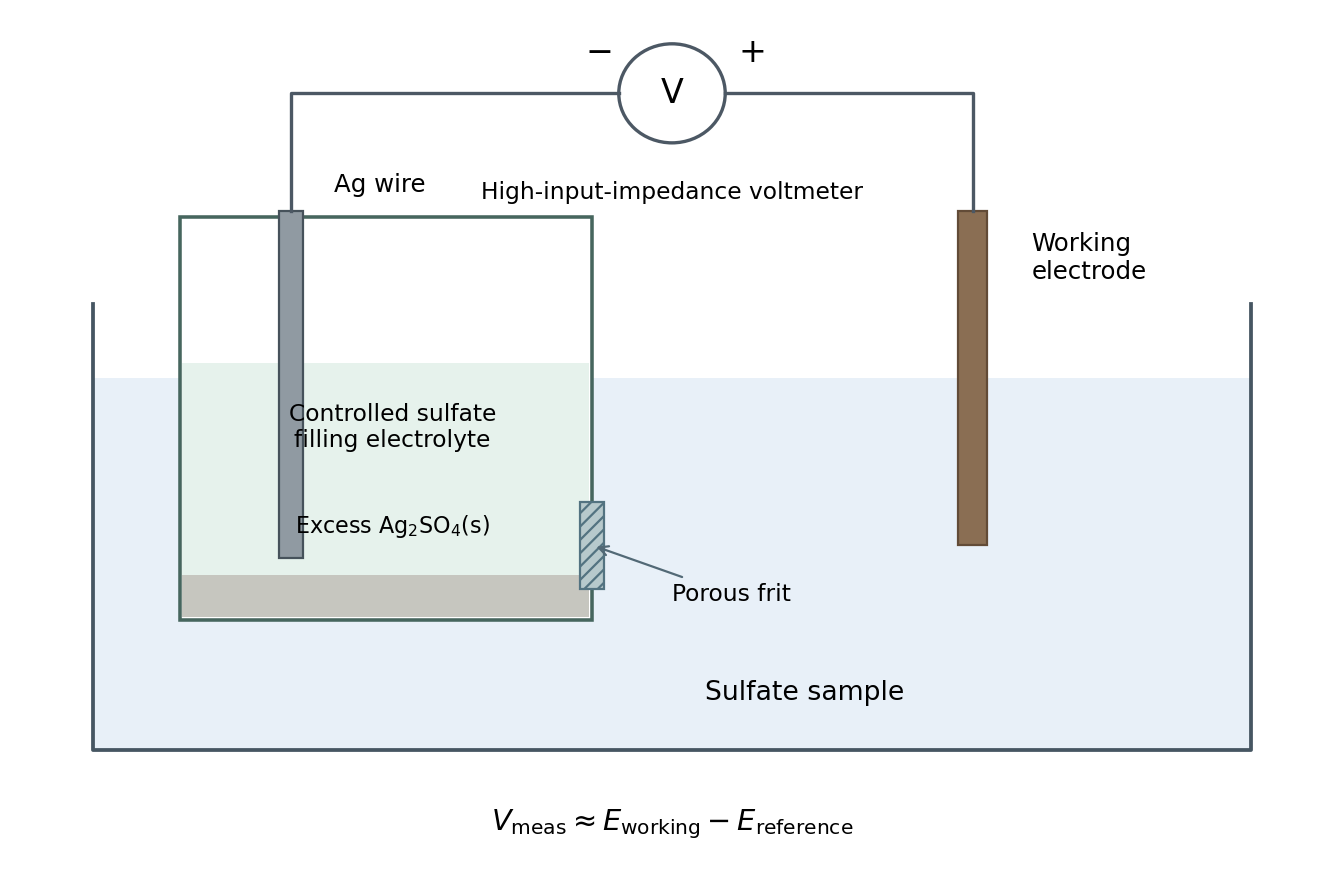

The equilibrium written in the reduction direction isWith pure-solid activities set to one, the Nernst equation givesMaintaining sulfate activity fixes the reference potential; protonation to bisulfate in strongly acidic filling solutions must be included in specifying that activity.
Calibrate against, or use a reliable tabulated potential relative to, the standard hydrogen electrode for the same filling solution and temperature. With the voltmeter sign specified above and a corrected or negligible junction potential,There is no universal numerical offset for every silver reference: silver/silver-chloride, silver/silver-sulfate and different sulfate filling solutions define different potentials.
Articles by others on the same topic
There are currently no matching articles.