Absorption generates electrons and holes in the perovskite. After relaxation toward the band edges, their nonequilibrium populations are described by separate electron and hole quasi-Fermi levels. Selective contacts collect electrons through an electron-transport layer and holes through a hole-transport layer, while suppressing the opposite carriers.
For ideal contacts at open circuit,This quasi-Fermi-level splitting is not the band gap itself or simply the equilibrium built-in voltage. At equilibrium there is one common Fermi level and no extractable photovoltage. Under illumination at open circuit, generation is balanced by recombination while a nonzero population splitting persists.
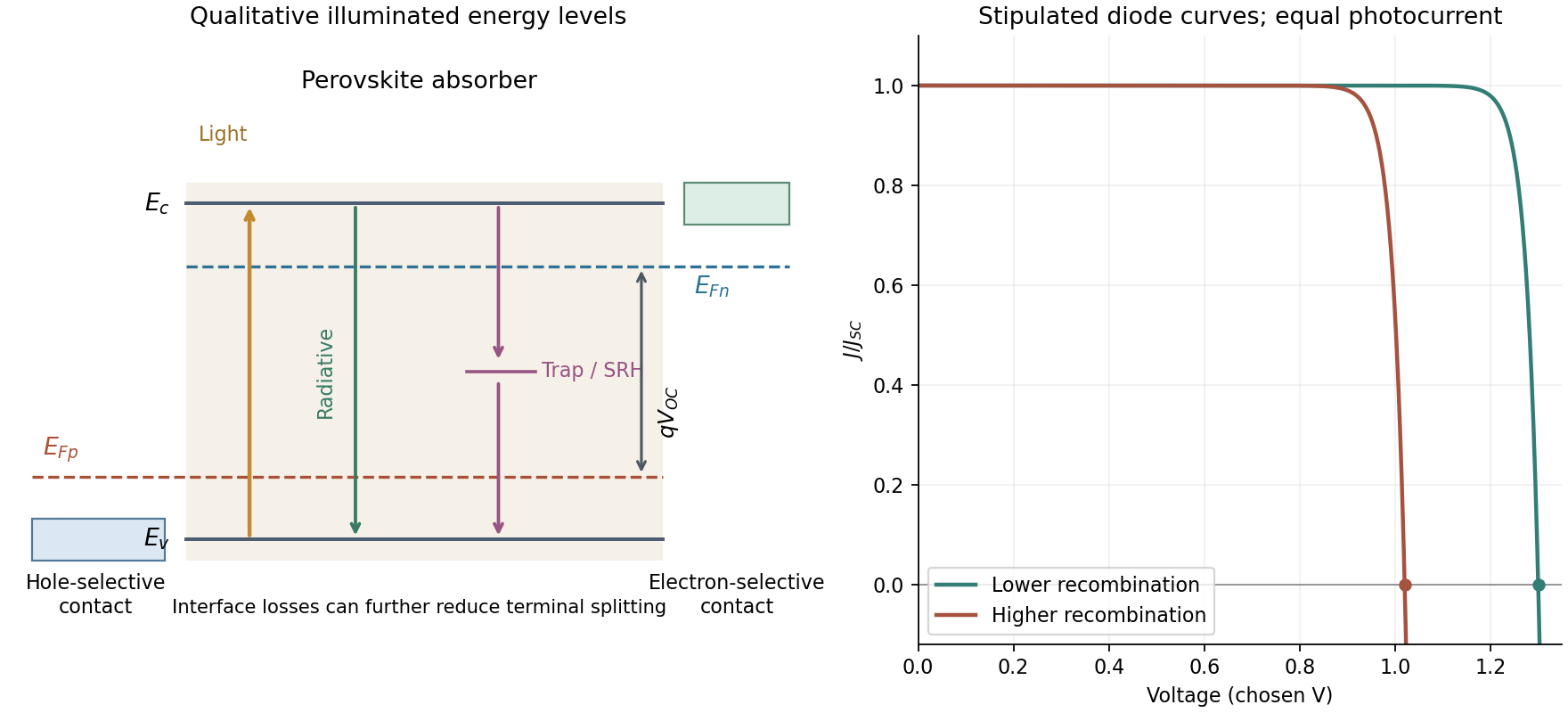
Selective extraction, quasi-Fermi splitting and recombination-limited solar-cell voltage
. Original qualitative energy diagram and stipulated illuminated diode curves. Trap-assisted and interface recombination reduce carrier splitting and open-circuit voltage. Band offsets, energy spacings and current scales are illustrative rather than fitted perovskite data. Details.
Important parasitic paths include trap-assisted Shockley-Read-Hall recombination in the bulk, at grain boundaries and at interfaces, and recombination at poorly selective contacts. They lower the steady carrier populations and their quasi-Fermi splitting. Auger recombination can matter at high carrier densities but need not dominate an ordinary one-sun device. Radiative recombination is an unavoidable detailed-balance contribution, rather than an avoidable defect loss of the same kind.
An approximate illuminated diode relation isIncreased nonradiative recombination generally increases the dark recombination current and reduces ; it can also change ideality and fill factor. Shunts add a leakage path. Series resistance mainly reduces voltage under load and fill factor: its simple drop vanishes at zero terminal current, so it should not be invoked as an automatic direct subtraction from open-circuit voltage.
The Shockley-Queisser limit is a radiative detailed-balance limit for a single-junction photovoltaic device under specified illumination and temperature. Its idealized absorber collects above-gap photons, thermalizes their excess energy and loses carriers only through the radiative processes required by absorptance and emission. Sub-gap photons are not harvested. A favorable gap balances current loss at large gap against voltage loss at small gap.[ref]
Detailed Balance Limit of Efficiency of p-n Junction Solar Cells by William Shockley and Hans J. Queisser. Journal of Applied Physics 32 (1961), pp. 510–519; radiative detailed balance and illumination assumptions
For a step-like absorber,The dark radiative current decreases rapidly with gap, so the qualitative ordering for the supplied absorbers isThe curve rises beneath the diagonal . The deficit reflects finite-temperature carrier statistics and the entropy associated with absorption and emission, including angular dilution of sunlight. Under ordinary unconcentrated illumination it is of order a few tenths of a volt, with a weaker gap dependence than itself. In a fixed blackbody-sun model its absolute value grows modestly with increasing gap, while its fraction of decreases. Above-gap thermalization is an efficiency loss but is not, by itself, the definition of this voltage deficit.
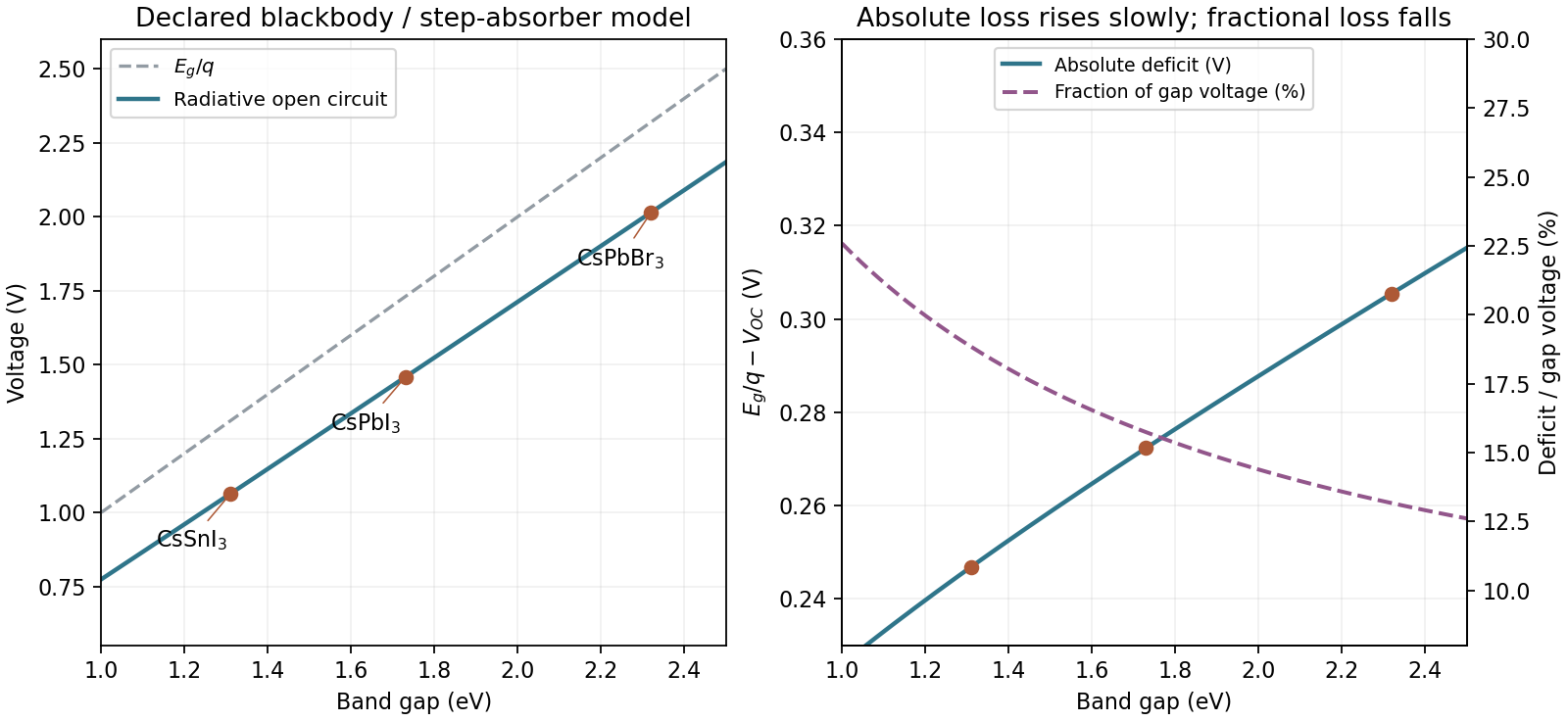

A measured perovskite device can have a larger deficit from nonradiative recombination and contact losses. The gaps alone do not determine those material-specific losses or a unique numerical voltage: solar spectrum, concentration, cell temperature and optical emission geometry must also be specified.
The material figure of merit isLarge thermoelectric power factor supplies electrical output, while low thermal conductivity limits heat leaking without useful conversion. For a constant-property ideal generator, a common approximation isIncreasing the appropriately averaged figure of merit raises efficiency toward, but not beyond, the Carnot limit. Actual devices also incur contact, geometric and heat-transfer losses, and a single peak material ZT does not specify their efficiency.
The supplied trends show the trade-off with carrier density: conductivity rises, the magnitude of the Seebeck coefficient tends to fall, and electronic thermal conductivity rises approximately with conductivity through the Wiedemann-Franz law. Thus neither arbitrarily high doping nor maximization of conductivity alone gives the best ZT; the power factor and thermal terms produce an intermediate optimum.
Two complementary strategies are:
- Reduce lattice thermal conductivity while preserving useful charge transport. Alloy disorder, grain boundaries and suitably designed nanoscale interfaces scatter phonons. Nanostructured bismuth–antimony telluride provides an experimental example in which microstructure and transport measurements supported reduced lattice heat conduction.[ref]High-Thermoelectric Performance of Nanostructured Bismuth Antimony Telluride Bulk Alloys by Bed Poudel and others. Science 320 (2008), pp. 634–638; grain-boundary/defect phonon scattering and enhanced ZT
- Improve the power factor through band engineering and carrier-density optimization. Band convergence increases useful valley degeneracy and can support a larger Seebeck coefficient without sacrificing conductivity as severely as a simple low-density strategy. Composition and doping tuning in lead telluride–selenide alloys demonstrated this route.[ref]Convergence of electronic bands for high performance bulk thermoelectrics by Yanzhong Pei and others. Nature 473 (2011), pp. 66–69; experimentally engineered valley convergence
Both strategies must be checked for mobility penalties and electronic heat transport. Simply suppressing every kind of transport would also suppress electrical output.
Articles by others on the same topic
There are currently no matching articles.