Let be the constant precursor production rate per volume. Here is the precursor yield per nuclear fission, and and are number densities. At a steady state,For fixed homogeneous coefficients and spatial shape, the reactivity contribution of an added absorption coefficient is . Thus the model givesWhen capture removal dominates xenon radioactive decay, , and henceThe limit is independent of the xenon neutron absorption cross section: at high neutron flux, nearly every xenon atom supplied by the precursor ultimately consumes a neutron. The assumptions include constant pre-shutdown neutron flux, sufficient time for precursor and xenon equilibrium, the supplied single-precursor model with no direct xenon fission source, and fixed parameters for translating absorption into reactor reactivity.
The general solution contains both decay of the initial xenon and continued feeding from the initial iodine. Use for removal of the flux, and retain as the pre-shutdown value in the initial conditions. Neglect post-shutdown nuclear fission and neutron capture. ThenMultiply this first-order linear differential equation by the integrating factor and integrate:With the preceding steady initial conditions, and , this isIf , the coefficient of the first exponential term is small compared with the coefficients of the feeding term, yieldingThis approximation neglects the finite initial xenon population and is consequently not a small relative error at , where its value is zero while the exact is positive. The exact expression supplies the initial value and satisfies . For equal nuclear decay constants, the continuous limit of the exact solution is .
The approximate population peaks about after flux removal. Differentiate the preceding difference of exponentials. The stationary condition isso for distinct nuclear decay constants,Using hours consistently,and thereforeThe approximate population is positive for , starts at zero, tends back to zero and has only this one stationary point, so it is a maximum.
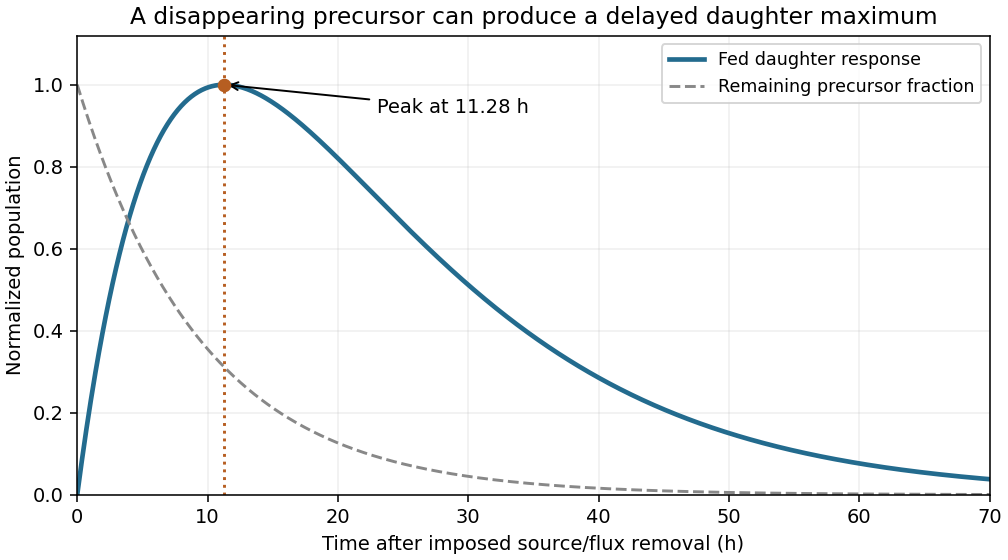

The delayed maximum corresponds to a delayed maximum in the magnitude of the absorber's negative contribution to reactor reactivity, within the fixed model. It does not determine a permissible restart time, which would require information absent here. The estimate also inherits the high-flux initial-population approximation of part (ii); the exact solution can peak at a different time when that approximation is unsuitable.
Articles by others on the same topic
There are currently no matching articles.