Reduce time, increase distance and use radiation-appropriate shielding. At fixed conditions, accumulated absorbed dose is proportional to exposure time. For an approximately isotropic point source, the inverse-square law reduces the uncollided radiation field as distance increases. Confinement of radioactive material prevents contamination; it addresses a different pathway from attenuation of an external field.
For alpha particles, short stopping ranges make light barriers sufficient against external particles, but confinement remains important. For beta particles, a low-atomic number shield such as plastic limits both penetration and secondary bremsstrahlung; high-atomic number material can then attenuate residual photons. For penetrating gamma rays, dense material such as lead, or a thicker bulk shield such as concrete, provides attenuation. One shield material is not equally appropriate for every radiation type.[ref]
Minimize Your Exposure by United States Nuclear Regulatory Commission. Time, distance and shielding; alpha, beta and gamma examples
[ref]Consolidated Guidance About Materials Licenses, Volume 12 by United States Nuclear Regulatory Commission. Appendix I, printed page I-2: low-atomic-number beta shielding and an outer high-atomic-number layer for bremsstrahlung
The cobalt-60 mass is approximately . The nuclear decay constant follows from the half-life, using a -day year:Since radioactive activity is , the parent population at certification isConvert the supplied atomic mass into molar mass, , and use the Avogadro constant:This is about of the specified isotope. It is not the total mass of the pellets or capsule, which can also contain other material.
The idealized external photon estimate is approximately at one metre. First apply radioactive decay to the certified radioactive activity:Treat the source as isotropic and small compared with the observation distance. Neglect photon self-absorption, capsule attenuation and attenuation in air. The metal and capsule stop the primary beta particles, so the direct external contribution is taken to be the two gamma rays; secondary bremsstrahlung is neglected. Their total energy per transformation isThe incident photon energy flow per area at distance is thereforeInterpret the given as the linear energy-absorption coefficient , rather than a total photon-removal coefficient. For an absorbing medium of mass density , a thin volume absorbs energy per time and has mass . Its absorbed dose rate is consequentlyFor the estimate assume a water-like and local deposition of the secondary charged-particle energy. At ,For gamma rays, the radiation weighting factor is one, giving under these assumptions.[ref]
Absorbed, Equivalent, and Effective Dose by International Commission on Radiological Protection. More Details: photon radiation weighting factor one and the distinction between absorbed and equivalent dose
The phrase “equivalent absorbed dose” mixes two quantity names: absorbed dose is measured in gray, while equivalent dose is measured in sievert. Their rates are numerically equal here because the weighting factor is one. The estimate is a physical energy-deposition calculation; the assumed mass density is essential, and the stated inverse-length coefficient must not be used as if it already had area-per-mass units.
In the stated model, the limiting thicknesses are about of lead or of concrete. Use the unshielded equivalent dose rate from part (c), . Let , where is the supplied total linear attenuation coefficient. The stipulated radiation buildup factor gives the requirementThe left side decreases for because its derivative is . Solving the equality gives a unique threshold,Thus, with the source-to-observation distance kept at one metre,For example, rounding upward to of lead or of concrete satisfies the stipulated inequality. Equality at the threshold is not sufficient for the strictly smaller target.
A compact surrounding shield favours lead; concrete trades much greater thickness for a common structural material. The densities permit a useful planar comparison: the threshold areal masses are about and , respectively. The thinner shield is not proportionately lighter per equal projected area. Total enclosure mass also depends on geometry.
The idealized outline is continuous coverage around the source with the required material path length, including the closure; a direct unshielded line through a gap would invalidate this attenuation estimate. The calculation assumes the quoted observation distance, the fixed effective photon coefficients and the prescribed radiation buildup factor. It is not based on the more optimistic uncollided exponential attenuation alone.
One energy group and a nearly isotropic local neutron distribution are the main approximations. The one-group neutron diffusion equation replaces the full energy-dependent transport problem by one scalar neutron flux and averaged coefficients. A single group cannot resolve spectral changes, resonance absorption or differences between rapidly moving and thermal neutrons; its effective parameters depend on the spectrum used for averaging.
The diffusion approximation also replaces angular transport by a current proportional to the negative neutron flux gradient. It works best where repeated scattering makes the angular distribution nearly isotropic over distances comparable to the field's variation length. It is less reliable close to a sharply localized source, a vacuum boundary, a strong absorber or an abrupt material interface, and in weakly scattering regions. Approximate boundary extrapolation does not restore the lost angular information.
Thus an apparently smooth solution of the one-group neutron diffusion equation need not accurately represent a transport field outside the assumptions that produced its coefficients and boundary conditions.
The one-group particle balance with a prescribed external volume source can be writtenHere is scalar neutron flux, is the neutron diffusion coefficient, and are macroscopic cross sections. The terms describe accumulation, current divergence, absorption, nuclear fission production and external input.
For a steady state, set ; source-free means . In a homogeneous medium is spatially constant, so substitution givesThe supplied notation defines as the effective production per absorption, . ThereforeThis identification uses the absorption accounting for the homogeneous model; a fuel-only reproduction factor with other absorbers excluded would not automatically equal this . The derivation assumes one prescribed energy group, constant effective coefficients and the diffusion approximation; all neutron production included here is represented by the steady nuclear fission term.
The fundamental nonnegative mode is . Put the origin at the centre of the cylinder, so . Neglecting extrapolation imposes zero neutron flux at and . WriteFor an axisymmetric field, separation of variables in cylindrical coordinates givesChoose the axial separation constant so . Midplane symmetry and the lowest positive axial mode give , withThe radial equation isThe solution regular on the axis is the zero-order Bessel function of the first kind, ; the independent second-kind solution is singular there. The first radial zero gives . Higher zeros would introduce sign changes and do not describe the fundamental nonnegative neutron flux. Normalize by the central value, using :The printed is a rounded Bessel function zero, rather than an exact root.
Substitute the separated solution into the one-group neutron diffusion equation. The radial and axial Laplacian contributions are and . A nonzero solution therefore requiresThe left side is the geometric buckling; the right side is fixed by the stipulated homogeneous material. Their equality is the model's nuclear criticality condition, expressing the balance of production, absorption and leakage. Both sides have inverse-length-squared units.
The minimum-volume aspect ratio is . Keep the material parameter fixed and positive. Write and . The constraint from part (c) givesThe cylinder volume is consequentlyIts logarithmic derivative isThe denominator is positive. The derivative changes from negative to positive exactly once, and diverges as or . Hence this stationary point is the global minimum:Equivalently . This is an aspect ratio in the supplied idealized boundary value problem; it does not determine an absolute size without a specified material parameter.
Each equation is stored thermal energy changing at the rate “input minus output”. Define the three heat capacities , and introduce the internal heat-transfer ratesIn the fuel balance, is accumulation, is thermal power generation and is transfer to the neutron moderator. In the moderator balance, enters, leaves and is accumulation. In the coolant balance, enters, is accumulation and is net energy carried away by flowing coolant.
The factor two follows the model's arithmetic-mean approximation , since the advective energy removal is . The parameters and are effective thermal resistances, in , for fuel-to-moderator and moderator-to-coolant transfer. They summarize the relevant geometry and heat-transfer mechanisms; they are not heat capacities.
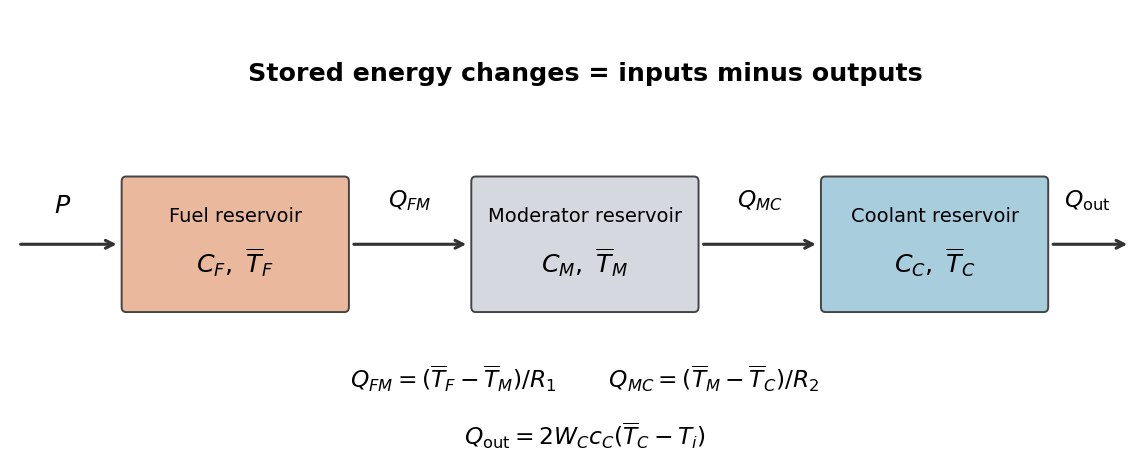
Original three-reservoir energy-balance diagram
. Details. At a steady state, all three accumulation terms vanish. The fuel balance gives , the moderator balance then gives , and the coolant balance equates that input to its advective output. ThereforeEach successive region adds the temperature drop needed to carry the same thermal power through its thermal resistance. Summing the original balances cancels both internal transfers, providing the independent total energy balance .
The coolant mass flow rate is approximately . All thermal power leaves in the steady coolant energy rise:With the stated constant specific heat capacity,The difference equals a difference. Thermal power is used directly; no electrical conversion efficiency enters.
The average moderator temperature is . First the mean coolant temperature in the lumped thermal model isAt a steady state, the same thermal power crosses both thermal resistances. If , thenThusIn particular at the specified state.
Differentiate the family of steady states, keeping , , , and fixed. A quasistatic process uses the temperature responses from part (b):Apply the chain rule to reactor reactivity along that family, weighting each response by its temperature coefficient of reactivity. Collecting terms gives the power coefficient of reactivityIts unit is inverse power. If the thermal resistances, coolant flow or inlet condition varied appreciably with power, their derivatives would contribute additional terms; those changes are excluded by the stipulated constant-parameter model.
The power coefficient is approximately , or . From part (c),Substituting in the power coefficient of reactivity givesThe negative sign means that a slow increase in thermal power produces a decrease in reactor reactivity along this family. This is a restoring thermal feedback control effect despite the positive moderator coefficient. A negative quasistatic slope alone does not prove stability of every transient: the separate heat capacities, transport delays and neutron-population dynamics matter for a time-dependent stability analysis.
Xenon poisoning is neutron removal by xenon-135, which reduces reactor reactivity. Its important precursor is iodine-135. At a long-established constant neutron flux, production through precursor decay is balanced by xenon radioactive decay and neutron capture. A steady model must account for that additional absorber in its neutron balance.
After a rapid removal of the imposed neutron flux, capture removal becomes small immediately, while the existing iodine population continues supplying xenon. The xenon population can therefore rise before eventually falling as the precursor reservoir is exhausted. The resulting extra negative reactor reactivity is a delayed effect, rather than an instantaneous disappearance of the absorber when nuclear fission stops.
An intermediate post-shutdown maximum is possible. This explains why the reactivity associated with a previously operating system can differ substantially from its long-time shutdown value. The population model below quantifies that mechanism; a population maximum is not by itself an operating or restart prescription.
Let be the constant precursor production rate per volume. Here is the precursor yield per nuclear fission, and and are number densities. At a steady state,For fixed homogeneous coefficients and spatial shape, the reactivity contribution of an added absorption coefficient is . Thus the model givesWhen capture removal dominates xenon radioactive decay, , and henceThe limit is independent of the xenon neutron absorption cross section: at high neutron flux, nearly every xenon atom supplied by the precursor ultimately consumes a neutron. The assumptions include constant pre-shutdown neutron flux, sufficient time for precursor and xenon equilibrium, the supplied single-precursor model with no direct xenon fission source, and fixed parameters for translating absorption into reactor reactivity.
The general solution contains both decay of the initial xenon and continued feeding from the initial iodine. Use for removal of the flux, and retain as the pre-shutdown value in the initial conditions. Neglect post-shutdown nuclear fission and neutron capture. ThenMultiply this first-order linear differential equation by the integrating factor and integrate:With the preceding steady initial conditions, and , this isIf , the coefficient of the first exponential term is small compared with the coefficients of the feeding term, yieldingThis approximation neglects the finite initial xenon population and is consequently not a small relative error at , where its value is zero while the exact is positive. The exact expression supplies the initial value and satisfies . For equal nuclear decay constants, the continuous limit of the exact solution is .
The approximate population peaks about after flux removal. Differentiate the preceding difference of exponentials. The stationary condition isso for distinct nuclear decay constants,Using hours consistently,and thereforeThe approximate population is positive for , starts at zero, tends back to zero and has only this one stationary point, so it is a maximum.
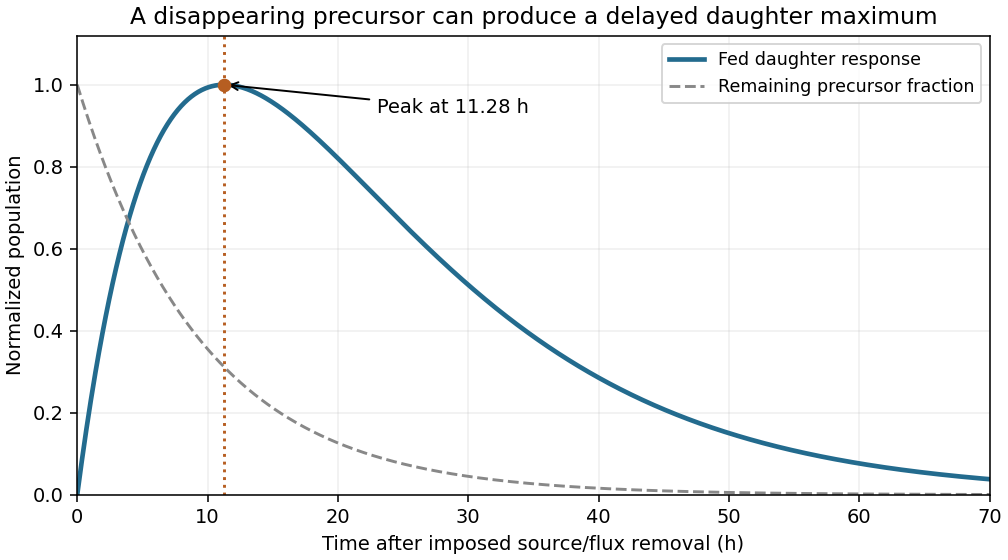


The delayed maximum corresponds to a delayed maximum in the magnitude of the absorber's negative contribution to reactor reactivity, within the fixed model. It does not determine a permissible restart time, which would require information absent here. The estimate also inherits the high-flux initial-population approximation of part (ii); the exact solution can peak at a different time when that approximation is unsuitable.
Articles by others on the same topic
There are currently no matching articles.