The useful mechanism is radioactive decay during retention, not chemical destruction of carbon dioxide. With the time in seconds,Here is a radioactive activity concentration; the supplied units are per volume rather than per mass. The original plot follows this concentration over four hours.
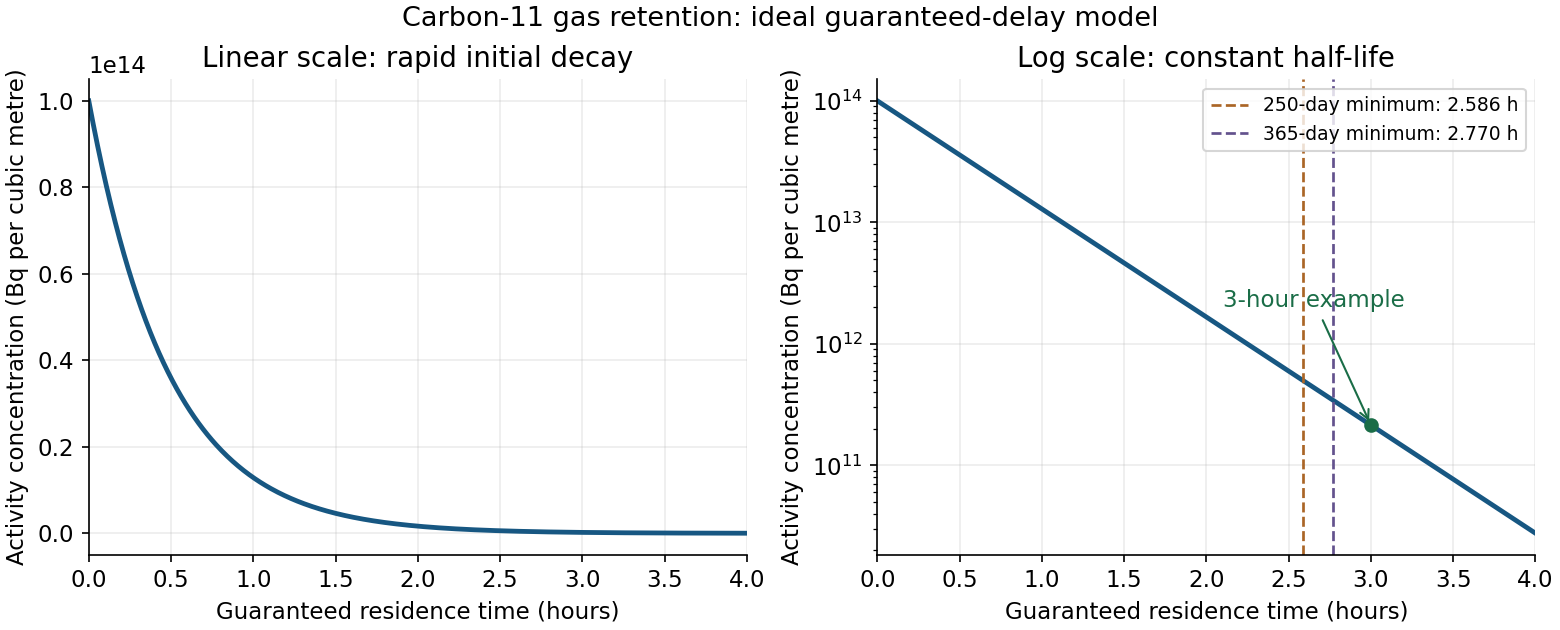

A practical illustrative choice is a three-hour guaranteed residence time, at which , giving about a factor reduction. On a plug-flow basis, the carbon-dioxide-equivalent hold-up volume isUse a contained delay line or a validated retention arrangement that prevents early breakthrough, followed by monitored discharge. A retention bed could instead hold the radioactive carbon dioxide, but its capacity and breakthrough performance would have to be established. Gas retention and monitored discharge are waste-treatment functions, independent of the eventual use of the isotope.[ref]
Predisposal Management of Radioactive Waste from Nuclear Power Plants and Research Reactors by the International Atomic Energy Agency. SSG-40, section 6, gaseous-waste treatment and selection of decay devices
The L result is a flow-delay volume, not a fill-and-immediately-dump tank specification. It credits radioactive decay during the guaranteed transit time and no subsequent storage after discharge from the delay system. Gas entering a filling tank near the end of filling has not aged for the entire filling time. For a literal tank filled for and immediately emptied, the radioactive activity at emptying is insteadThat alternative must not be analysed by multiplying the whole collected inventory by . If “no post filling radioactive decay” is intended to prescribe this literal fill-and-dump arrangement, the three-hour calculation does not establish compliance for it.
The nitrogen fraction is also unspecified. If is the carbon dioxide volume fraction at the stated volume reference conditions, a gas delay line requires , not necessarily L of physical vessel volume. The graph alone does not define a unique optimum: a cost objective, operating calendar and residence-time model are needed. Parts (c) and (d) quantify the discharge constraint for the stated guaranteed-delay design.
Articles by others on the same topic
There are currently no matching articles.