This is an absent-minded decision problem: the two decision nodes belong to the same information set. A behavioural strategy must therefore use the same probability at both visits. Put and ; fresh randomization occurs independently at each visit.
The terminal probabilities are for stopping immediately, for going down once and then right, and for going down twice. Thus the expected payoff isThis expression gives the unique global maximum on :
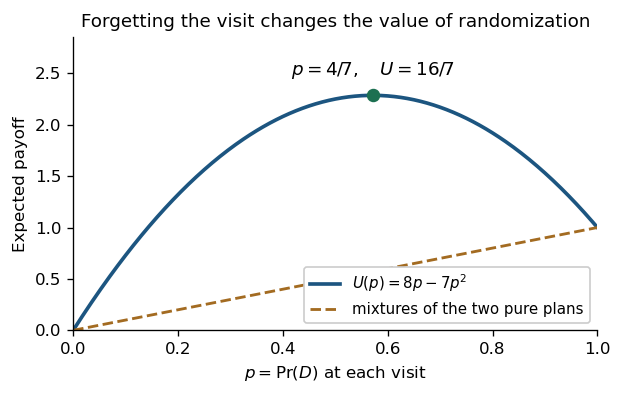
The optimal behavioural strategy improves on either fixed plan
. Details. 
The independence of repeated randomizations is essential. A mixed strategy choosing once between the two deterministic plans “always ” and “always ” gives at most , since their payoffs are and . It cannot arrange “ first, then ” as a deterministic plan respecting this information set. The failure of perfect recall is exactly why mixed strategies and behavioural strategies need not have the same attainable outcome distributions here.
Articles by others on the same topic
There are currently no matching articles.