Solutions to all four questions and all ten marked lettered parts of the University of Oxford examination held on 1 June 2023. Every unlabelled bullet task within those parts is covered. Source release: released examination archive, member 2022/T/a15684w1.pdf; the cover identifies the paper as Trinity Term 2023. Question statements and original diagrams are omitted. Necessary conventions about finite representations, repeated-game payoffs and empty-coalition normalization are stated at the affected parts.
Under the expected utility hypothesis, use positive affine uniqueness of affine preference representations to normalize the extreme outcomes to and . The stated indifference relations then giveThe two lotteries have expected utilitiesHence , with normalized expected utility difference . Equivalently, substitution reduces them to lotteries with probabilities and of the better extreme outcome. The inference uses the independence axiom for lottery preferences; the three displayed outcome comparisons alone would not determine preferences over all compound lotteries without the expected utility hypothesis.
Yes: the stated order has an expected utility representation. For outcomes whose monetary amounts are , respectively, chooseThenSince , this utility function gives exactly the required strict preferences.
The distinction is that the expected utility hypothesis does not by itself require the utility function to increase with monetary amount. This nonmonotone monetary utility ranks the outcome paying 2 below the outcome paying 1. If increasing monetary utility were imposed as an additional assumption, the stated order would fail: requires becauseThat additional monotonicity assumption is not printed in this part.
For the intended finite representation, put . For each , form the mintermA Boolean valuation satisfies exactly when its selected subset is . Therefore the weighted formula utility representationrepresents exactly: at the Boolean valuation for , only that minterm contributes, with weight . This proves completeness and the bound of rules simultaneously. Zero-weight rules may be omitted. The bound counts rules; writing each minterm also requires symbols in Big O notation.
For the computational question, assume rule weights are rational numbers encoded in binary. This makes exact equality of sums a finite computational task. With this conventional encoding, equivalence of weighted formula utility representations is co-NP-complete.
For membership, the complement has a short witness: a Boolean valuation on the variables occurring in either rule base. Evaluate each propositional formula, sum the weights of satisfied rules, and accept the witness if the sums differ. Propositional formula evaluation takes polynomial time. Exact sums of binary rational numbers also have polynomially bounded bit lengths: the product of their denominators has bit length at most the sum of the input denominator lengths. Thus non-equivalence lies in NP, and equivalence lies in co-NP.
For hardness, take a Boolean satisfiability problem instance and constructThe first utility function is one at satisfying Boolean valuations and zero elsewhere, while the second is always zero. ConsequentlyThe unsatisfiable Boolean formula problem is co-NP-complete, as the complement of the NP-complete Boolean satisfiability problem. The construction is a polynomial-time reduction, proving hardness even with the single weight .
Two qualifications matter in the literal wording. First, unrestricted real weights have no specified finite encoding, so a standard bit-complexity classification needs the encoding assumption above. Second, the problem says only that is nonempty. If infinite is allowed while rule bases remain finite, its completeness claim is false. For , take when is infinite and when is finite. A finite rule base mentions only a finite subset of the variables. The Boolean valuations for and agree on all those variables but have different required values. No such rule base represents this . Thus the construction answers the intended finite-set question and identifies the missing hypothesis in the unrestricted statement.
Read the lower-left entry of each cell as player 1's payoff and the upper-right entry as player 2's payoff, as indicated by the source diagram. Against , player 1 strictly prefers because ; against , player 1 strictly prefers because . Against , player 2 strictly prefers because ; against , player 2 strictly prefers because . Thus the pure strategy Nash equilibria are
For a fully mixed strategy Nash equilibrium, write and . Player 1's expected payoffs from the two pure strategies areEquality, required when both pure strategies have positive probability, givesPlayer 2's corresponding expected payoffs areso equality givesBoth probabilities lie strictly between zero and one. Hence the unique fully mixed strategy Nash equilibrium iswith complementary probabilities on and . Its expected payoffs are
These are all three Nash equilibria. There are no equilibria with just one player genuinely mixing: against each opposing pure strategy, the other player's best response is unique, so that player cannot mix. When both players mix, the two linear indifference equations have the unique solution just obtained. This is support enumeration for a bimatrix game with all possible supports checked.
The definition in this part uses a single Boolean valuation, so the relevant Nash equilibria are pure strategy equilibria of a Boolean game. Use its standard convention that the players' control sets form a set partition of the variables.
Membership follows from an existential choice of a strategy profile and a universal check of all unilateral deviations. Assign payoff one to satisfying a player's goal and zero otherwise. A strategy profile is a Nash equilibrium precisely when, for every player and every alternative Boolean valuation of that player's variables,is true: either the goal is already satisfied or no deviation can satisfy it. Thus the requested property isThe strings encoding , and have polynomial length, and evaluating the bracketed propositional formulas takes polynomial time. Invalid encodings of a player index can simply be ignored by the test. This is the existential second level of the polynomial hierarchy, .
For hardness, reduce the canonical complete problem of deciding a two-block quantified Boolean formulaMake a two-player Boolean game: player 1 controls and has goal ; player 2 controls and has goal . Set the query formula to . The construction has size linear in the input formula.
If an assignment satisfies , combine it with any assignment . Player 1 already satisfies its goal, and player 2 cannot satisfy by any unilateral deviation. Thus is a Nash equilibrium satisfying the query.
Conversely, let be a Nash equilibrium satisfying . Player 2 currently has payoff zero. If some alternative made false, that deviation would satisfy player 2's goal and increase its payoff to one. The Nash equilibrium condition therefore implies . This proves the required equivalence and the polynomial-time reduction.
Together, membership and hardness prove -completeness of existential equilibrium checking in a Boolean game. The reduction works with only two players and one constant goal.
Measure all payoffs in millions of dollars, in the order (Ann, Bob). Since both players maximize expected money, those numbers are already their expected utility scale.
In the extensive-form game, Ann moves first. Staying out terminates at . Entering leads to Bob's observed decision between fighting, with terminal payoffs , and acquiescing, with terminal payoffs . Each decision node is its own information set, so this is a perfect-information game.
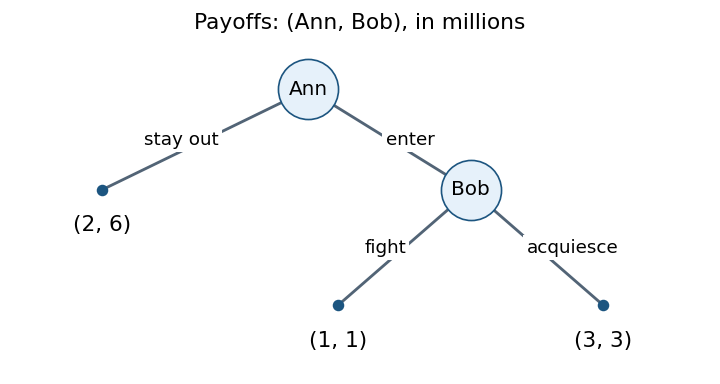

The corresponding normal-form game gives Ann the pure strategies (stay out) and (enter), and Bob the complete contingent pure strategies (fight if entry occurs) and (acquiesce if entry occurs). The payoff matrix isThe pure strategy Nash equilibria are and . Against , Ann prefers ; against , Ann prefers . When Ann stays out, Bob's contingent response does not affect his payoff, so is a best response there.
There is exactly one subgame perfect equilibrium, . In the subgame following entry, Bob strictly prefers to , so backward induction selects acquiescence; Ann then strictly prefers entering for to staying out for . The threat supporting is not optimal in that one-shot subgame.
For infinite repetition, the paper specifies no discount factor. First take the long-run average payoff convention, with all past actions observed. The feasible payoff set is the convex hullAnn can guarantee in every stage by staying out; Bob can guarantee at least in every stage by acquiescing whenever entry occurs. These guarantees are also their minmax payoffs: fighting holds Ann's best possible stage payoff to , and entering holds Bob's best possible stage payoff to .
Therefore the sustainable Nash equilibrium average payoffs are exactly the feasible, weakly individually rational payoffs in a repeated game:This is the closed triangle with vertices .
Here is a direct sufficiency argument for this particular game. Choose a publicly known sequence of stage outcomes whose frequencies give the target point. Before any observed deviation, follow that sequence. After an Ann deviation, Bob fights forever, so Ann can thereafter obtain at most per stage. After a Bob deviation, Ann enters forever, so Bob can thereafter obtain at most per stage. A finite prefix has no effect on long-run average payoff, so no unilateral deviation improves a target with . Rational frequencies can be implemented periodically; arbitrary real frequencies can be implemented by a deterministic sequence with convergent frequencies. Thus even the weak boundary is covered here. In particular, staying out forever and entry followed by acquiescence forever are sustainable; fighting forever is not.
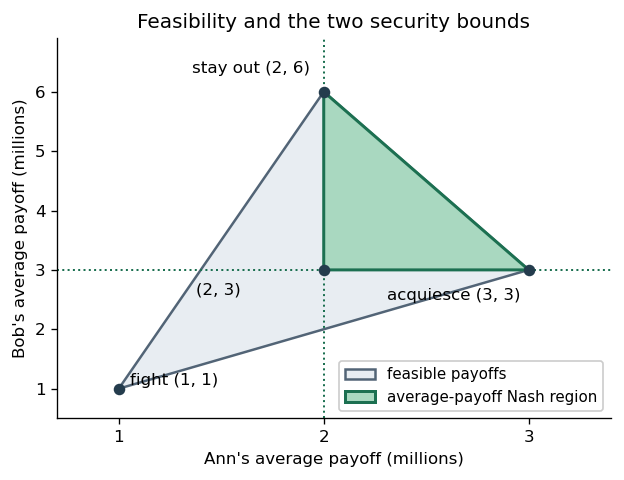
The feasible payoff set and sustainable long-run average payoffs
. Details. 
For discounted payoffs , the folk theorem for repeated games instead gives the usual patience qualification: every feasible point with can be sustained for all sufficiently large . It does not classify the whole region for an unspecified fixed . The two one-shot Nash equilibrium outcomes remain sustainable for every .[ref]
Lecture 15: Repeated Games by Asu Ozdaglar. Slides 19–20 and 24–27: feasibility, minmax bounds, discounted Nash folk theorem and punishment construction
Finally consider the particular history-dependent pair in the paper. Initially Bob has never acquiesced, so Ann stays out. That preserves the same condition forever, giving payoffs . The pair is a Nash equilibrium. Holding Bob's strategy fixed, Ann cannot induce an acquiescence: he fights whenever she enters, and his rule never changes unless he has previously acquiesced. Every entry would give her instead of , so no unilateral deviation helps. Holding Ann's strategy fixed, Bob never reaches a decision node because she stays out; changing his strategy alone cannot create a history in which he actually acquiesces. Hence he also cannot improve.
This direct argument works for both discounted and long-run average payoffs. The outcome gives Ann exactly her minmax payoff and Bob more than his, so it is compatible with the folk theorem for repeated games. A version requiring strict gains above both minmax payoffs is a sufficient condition, and cannot be used to rule out this boundary example.
This is an absent-minded decision problem: the two decision nodes belong to the same information set. A behavioural strategy must therefore use the same probability at both visits. Put and ; fresh randomization occurs independently at each visit.
The terminal probabilities are for stopping immediately, for going down once and then right, and for going down twice. Thus the expected payoff isThis expression gives the unique global maximum on :
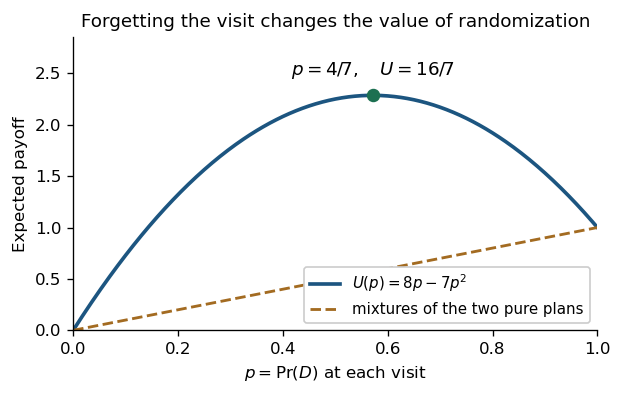
The optimal behavioural strategy improves on either fixed plan
. Details. 
The independence of repeated randomizations is essential. A mixed strategy choosing once between the two deterministic plans “always ” and “always ” gives at most , since their payoffs are and . It cannot arrange “ first, then ” as a deterministic plan respecting this information set. The failure of perfect recall is exactly why mixed strategies and behavioural strategies need not have the same attainable outcome distributions here.
It suffices to take four players. Both two-player coalitions and win, because two is a prime number, while the empty coalition and the four-player coalition lose.
Suppose real weights and quota represented this game. The empty coalition loses, so . The two winning coalitions requireAdding givesso the four-player coalition must win, a contradiction. Hence prime-cardinality games cannot in general be represented as weighted voting games. The same four-player obstruction appears inside every such game with at least four players.
This proof permits negative individual weights, as the printed definition does. An argument based solely on monotonicity would require a nonnegative-weight assumption and would not suffice for that definition.
Let . If the two disjoint winning coalitions exchange players, the aggregate weight is conserved:If both resulting coalitions lost, each weight would be strictly below , making their sum strictly below . This is impossible. Thus every weighted voting game has swap robustness for disjoint winning coalitions, even when the weights or quota are negative.
The converse is false. The four-player prime-cardinality game from part (a) has swap robustness for disjoint winning coalitions: swapping one player each way preserves each coalition's cardinality, so in fact both winning coalitions remain winning. Part (a) proves it is not a weighted voting game.
Even imposing monotonicity would not repair the converse under the printed disjointness restriction. As a stronger counterexample, use five players and declare a coalition winning exactly when it contains player and contains either both or both . This is a simple cooperative game, and all its winning coalitions contain player , so no two are disjoint; the stated swap condition holds vacuously.
Nevertheless and win, while and lose. Both pairs contain every player the same total number of times. A weighted representation would therefore givea contradiction. This is a trade obstruction to weighted voting and pinpoints how weak the disjoint-only swap requirement is.
Use the usual empty-coalition normalization for a transferable utility game. Write , so the proposed payoff is the marginal contributionThe vector is the marginal contribution vector for the natural player order.
First, convex cooperative games have increasing marginal contributions. If and , apply the defining supermodular set function inequality to and :Rearranging gives
The vector is efficient by a telescoping sum:Now fix any coalition . For each , its earlier members are . Increasing marginal contributions therefore giveSum over the members of in increasing order. The right-hand side is another telescoping sum, now along the growing coalition :Efficiency and these inequalities for every coalition are exactly the defining requirements of the core of a cooperative game. Thus belongs to the core. The same proof works for any player ordering, not only the natural order.
The normalization is essential to the literal statement: the printed part does not explicitly state it. Without , take the constant characteristic function of a coalitional game . It satisfies the displayed convex cooperative game inequality with equality, but every proposed is zero, so efficiency fails when is nonempty. Under the standard normalized definition, the proof above establishes the intended result.
Articles by others on the same topic
There are currently no matching articles.