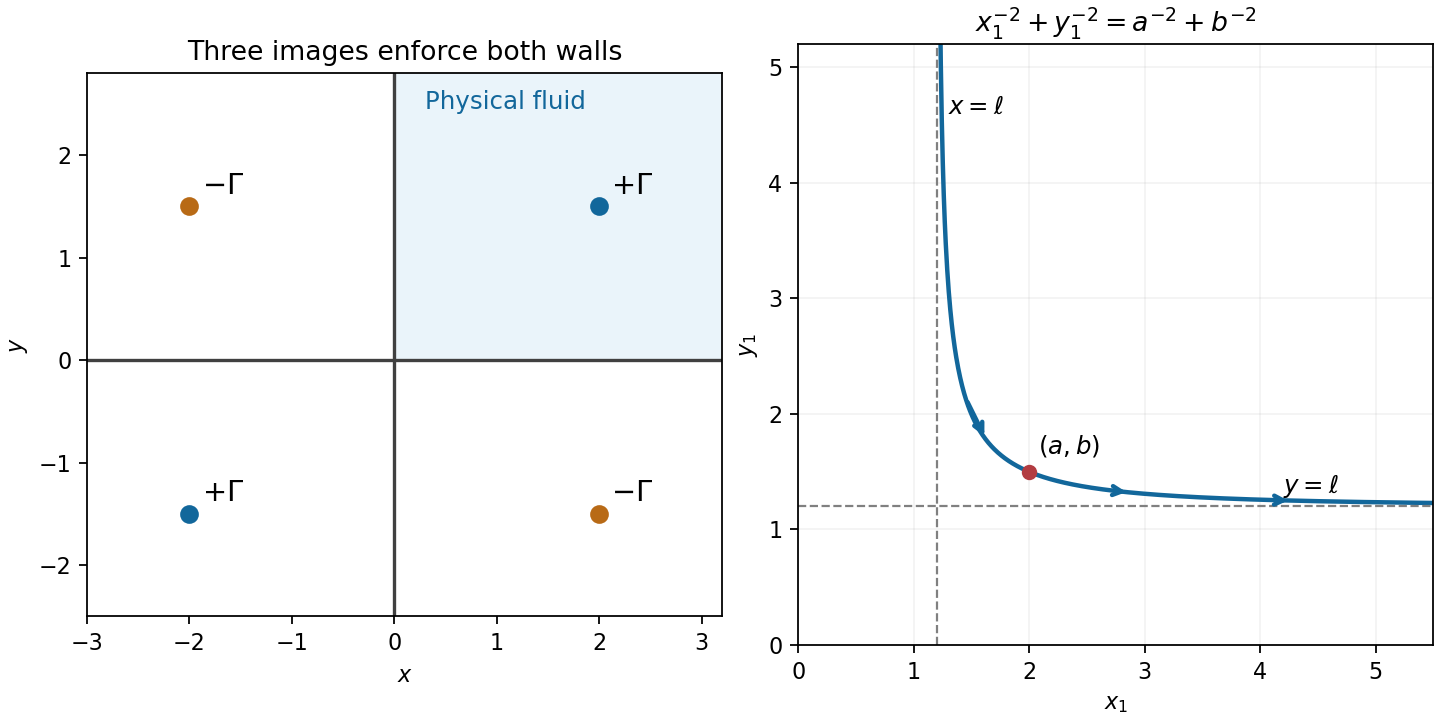
Use the convention that a positive vortex has counterclockwise circulation, with complex potential of a two-dimensional potential flow . To make both coordinate axes streamlines, place images of strength at and , and strength at . The resulting potential isAdditive constants and consistent logarithm branches do not affect velocity. The quotient has unit modulus on either wall, so the streamfunction is constant there and there is no normal flow.
The vortex moves with the regular fluid velocity after removing its own singular field. Since , evaluating the three image contributions at gives exactlyThe overall minus sign and the two reflected-term minus signs here agree with the source scan.
Write , with . Taking real and imaginary parts yieldsDividing gives , which integrates toPut . The first-quadrant branch has vertical and horizontal asymptotes and . Its motion is to the right and downward: from large near the vertical asymptote toward large near the horizontal one. Both coordinates stay strictly positive, so no wall is crossed.

Articles by others on the same topic
There are currently no matching articles.