The covariant derivative differentiates a field while preserving its transformation law under the local electroweak gauge symmetry . Here is the ordinary spacetime derivative and a Lorentz index. The gauge fields , , are the three SU(2) fields; is the U(1) field. The corresponding dimensionless coupling constant is for SU(2) and for U(1).
The are weak isospin generators in the representation of the differentiated field, with on a doublet and on an SU(2) singlet. The repeated index is summed. The generator supplies the field's weak hypercharge in the convention , where is its fractional electric charge. The factor follows the convention of Hermitian generators. The two connection terms compensate the derivatives of spacetime-dependent gauge transformations.
Set and . First expand the charged term using the ladder operators:Substituting the neutral gauge fields as well, the covariant derivative becomesMatching to requiresMatching to requiresFor , elimination yieldsEquivalently, and . The conventional Weinberg angle lies in the first quadrant.
Write . The Pauli matrices give the weak isospin operatorsFor the Higgs doublet with weak hypercharge ,The Higgs field direction, including its vacuum expectation value, is electrically neutral. Consequently the electromagnetic U(1) leaves the vacuum invariant: electroweak symmetry breaking preserves electromagnetism and the photon remains massless. The result concerns this neutral vacuum direction; it does not say that both components of the full Higgs doublet have zero electric charge.
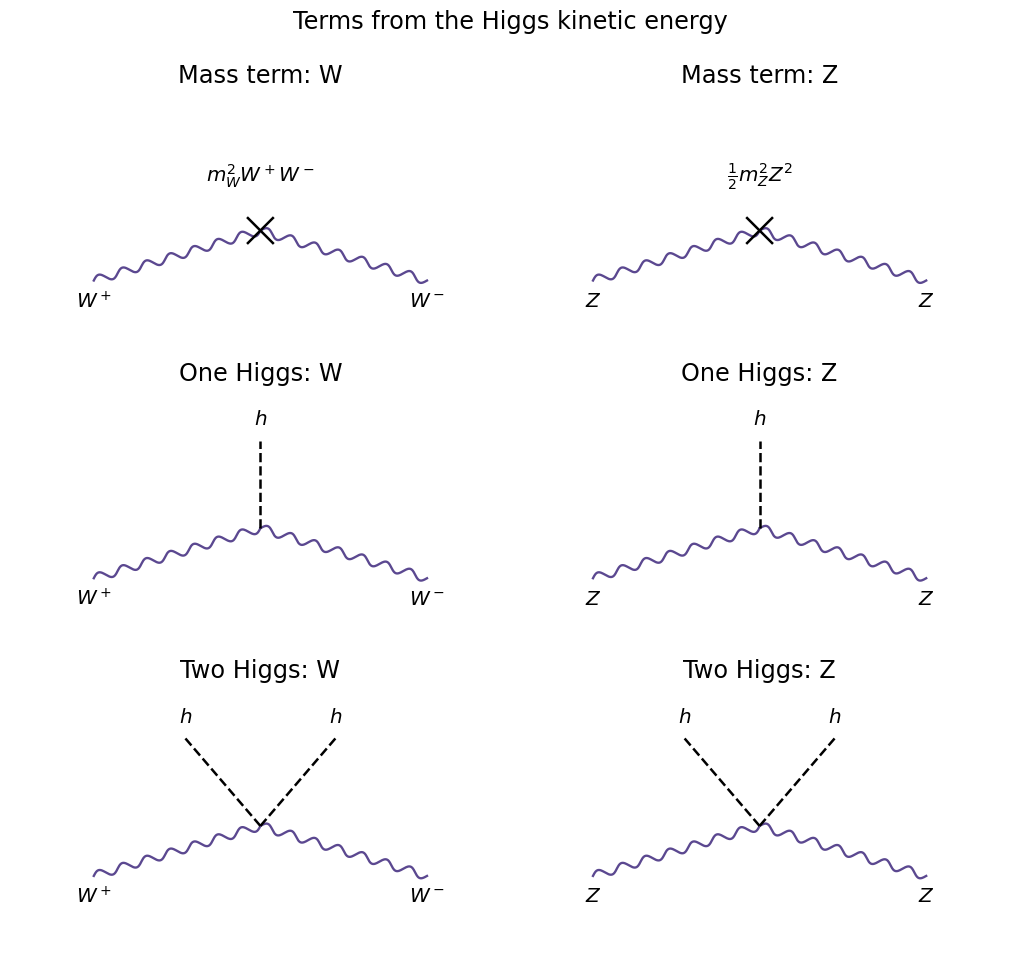
Using c and omitting , the covariant derivative isThe two components are orthogonal, so their squared magnitudes add; . Thus the Higgs field kinetic contribution to the Lagrangian density isThe two terms are gauge boson mass terms. Comparing with gives and . The factor for the real Z boson field is essential.
The two terms are the cubic Higgs boson coupling to W bosons and Higgs boson coupling to Z bosons. They produce the three-leg and Feynman vertices, allowing Higgs decay to two W bosons, Higgs decay to two Z bosons when kinematically available, and the corresponding production mechanisms with virtual gauge bosons. The two terms are quartic and interactions, including vector-boson scattering into a Higgs boson pair. Written in terms of the masses,The corresponding Feynman vertex factors are for one and for two , for , after differentiating with respect to identical fields. These six contributions contain no photon mass or direct interaction because .

Articles by others on the same topic
There are currently no matching articles.