Source bundle pages 31–39. The cover dates this paper to 2022; the attachment filename says 2021. These solutions use natural units , except where units are restored explicitly.
An incoming fermion contributes a Dirac spinor and an outgoing fermion contributes its Dirac adjoint . The label specifies a spin state; is the on-shell four-momentum. Incoming and outgoing antifermions instead contribute and .
The exchanged boson is a virtual photon, represented in the Feynman rules by the photon propagator in Feynman gauge. Its momentum transfer is ; unlike an external real photon, it need not satisfy . Each Feynman vertex contracts a gamma matrix with this propagator and contributes in a conventional QED sign convention. The coupling constant sets the interaction strength, with fine-structure constant . One may reverse the sign of the photon field and both vertex signs without changing the result. The gamma matrices obey , with Minkowski metric .
There is one tree-level Feynman diagram: the distinguishable electron and muon exchange a photon in the channel. There is no identical-particle exchange diagram.
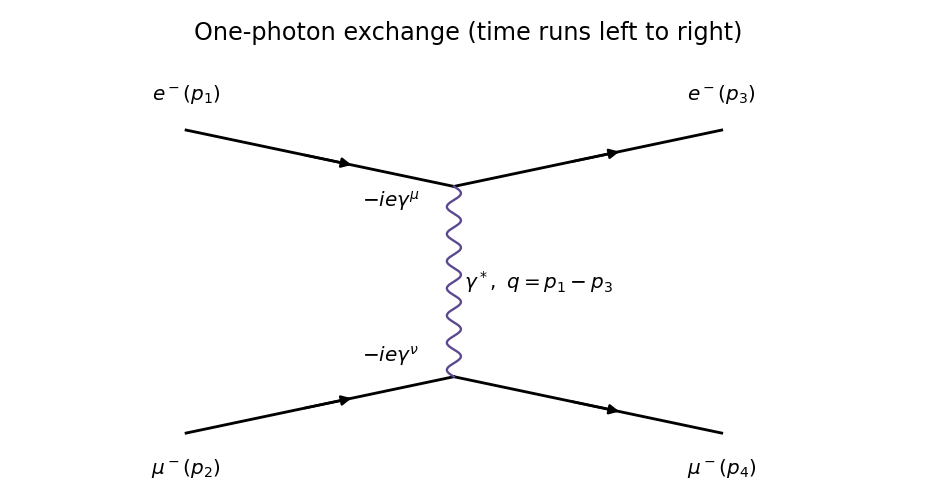
Multiplying the external Dirac spinors, the two Feynman vertices and the photon propagator givesThe overall phase of this scattering amplitude is convention dependent. Four external spin labels with two choices each give possible configurations before taking a limit. For , the vector QED interaction preserves fermion chirality, which becomes helicity for each external particle. Thus the surviving configurations, written as , areHere specify helicity along each particle's own momentum. The other configurations require at least one mass-suppressed flip and vanish in the strictly massless limit.
Define the Mandelstam variables for the scattering labels by , and . Dropping the electron and muon masses givesThese identities follow by expanding the corresponding squared four-momenta, using and four-momentum conservation. Substitution into the supplied spin-averaged matrix element yieldsThe initial spin average is already included in the given expression; no further averaging factor belongs here.
To implement crossing symmetry with the annihilation labels, replace the old scattering four-momenta by . The scattering Mandelstam variables then become , where now , and . ConsequentlyIn the centre-of-momentum frame, take between the incoming electron and outgoing positive muon, . For negligible masses, and . ThereforeDefining using the outgoing negative muon interchanges and and leaves the result unchanged.
The intermediate photon carries spin . In the massless limit, a back-to-back fermion-antifermion pair coupled to its vector current has opposite helicities, so the initial and final projections along their respective axes are . A rotation between these axes contributes the Wigner D-matrix elements . The relevant elements have magnitudes and . Summing the four squared helicity amplitudes gives the angular factorThe common coupling and normalization factors recover the result in d. The terms do not contribute: the massless external vector currents eliminate the corresponding helicity configurations.
The favoured weak charged current transition is followed by . The spectator quark combines with to form the component of the neutral pion, while forms . The product of CKM matrix factors is . The doubly Cabibbo suppressed transition is followed by , with factors ; the final is the neutral antikaon. Both are colour-suppressed internal-emission Feynman diagrams, with the same spectator routing.
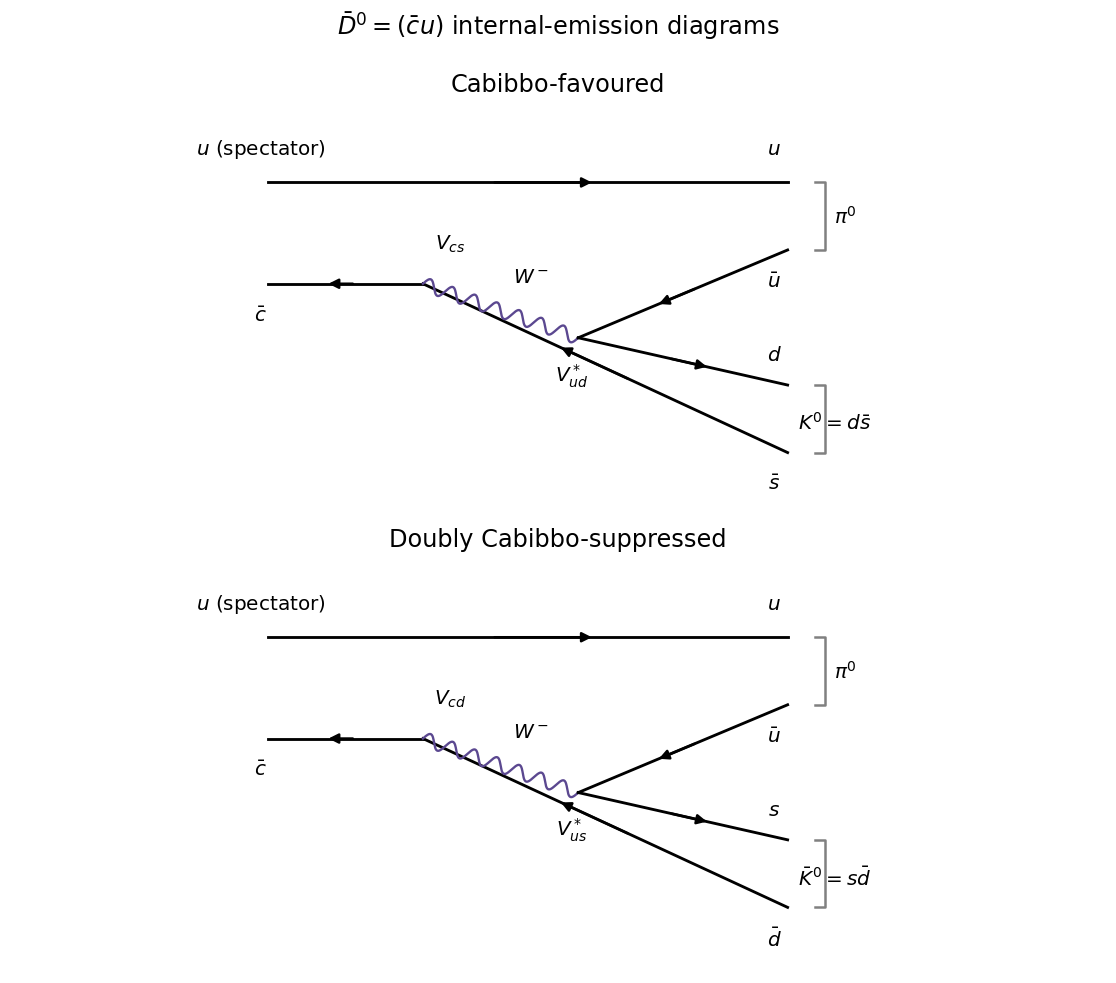
In the two-generation approximation to the CKM matrix, , and . For equal magnitudes of the hadronic matrix elements,The rate ratio is about with the supplied CKM matrix magnitudes. The minus sign of a particular product of CKM matrix elements must be combined with the phases of the hadronic matrix elements and kaon basis states; it is not by itself the observable interference sign.
Choose the exchange-positive CP convention for neutral kaon mixing, . Neglecting CP violation, the kaon CP eigenstates can then be writtenWriting and , projection on these coherent final states givesThis is the convention implicit in the printed sum. Changing the sign convention for the neutral antikaon changes both its coefficient in the kaon CP eigenstates and ; it cannot change either physical decay rate. The extremely small – mass difference can be ignored in the two-body phase space.
Put . Equal two-body phase space gives , so the decay-rate asymmetry is exactlyThe stated magnitude assumption fixes . Retaining the relative strong phase in the convention of b therefore givesA magnitude assumption alone does not determine . For example, has the stipulated magnitude but gives , whereas a real positive gives a positive asymmetry. With the additional aligned-amplitude assumption , conventionally used for this idealised extraction, the intended leading result is . The sign of here refers to the complete amplitude after choosing the kaon phase convention, not to a bare CKM matrix product. A flavour-symmetry relation can supply further information, but is stronger than the printed magnitude assumption.
The long-lived, electrically neutral kaon often traverses the particle detector without decaying into a reconstructable charged final state. Identifying it through a hadronic interaction or missing four-momentum is much less efficient than reconstructing the short-lived kaon through its nearby two-pion decay vertex. The efficiencies must be applied to the observed counts before taking their asymmetry:Using the leading aligned-amplitude approximation from c,The exact aligned formula instead gives , an immaterial correction here. Treating the observed counts as independent Poisson random variables and the efficiencies as known, propagation of uncertainty givesThe separate contributions to are and ; the small sample dominates. Linear propagation of uncertainty yields , although the nonlinear extraction and physical boundary make a symmetric confidence interval a rough summary. Unknown efficiency uncertainties, especially that of , would be additional systematic contributions.
The supplied CKM matrix gives , hence and . The asymmetry difference is only about statistical standard deviations, so the measurement is compatible. Without the phase assumption, these data measure to leading order and do not uniquely measure the Cabibbo angle.
The Delta baryon has electric charge and valence quark content . In its ground state the spatial wavefunction has orbital angular momentum and is symmetric. Its spin is ; the maximal projection state is symmetric in spin, and its quark flavour wavefunction is symmetric as well. Three identical fermions require an antisymmetric total wavefunction by the Pauli exclusion principle. A further internal degree of freedom must therefore supply the antisymmetry.
With three color charges, that factor is the normalized colour singletIt changes sign under exchange of any two quarks. The remaining symmetric factors then give the required antisymmetric total state. This argument motivates color charge independently of the already present quark flavour and spin labels.
For quarks in an -dimensional internal space , complete antisymmetrization of three labels corresponds to a Young diagram with one column of three boxes, the partition . Its representation is the exterior power and has dimensionFor , the column is too tall: . With only two labels at least two of the three coincide, and the Young tableau column antisymmetrizer annihilates the state. For , the filled column spans a one-dimensional determinant representation. It is a colour singlet of SU(3) because every group element has determinant one.
Equivalently, the tensor product of group representations decomposes asThe two mixed-symmetry terms account for dimensions, so the total is . Antisymmetry alone establishes at least three internal states. Exactly three follows in the usual special unitary group model when the observed three-quark baryon must be a colour singlet: for the antisymmetric third exterior power has dimension greater than one and is not a singlet. This extra assumption should be made explicit.
Away from narrow resonances and quark thresholds, the QED annihilation cross section into each accessible quark flavour is its squared fractional electric charge times the muon-pair cross section, multiplied by the number of distinguishable color charges. Thus the inclusive hadronic ratio isWith , the continuum predictions are , and as successive charm quark and bottom quark channels become accessible. The measured normalization and steps support three color charges. At leading order these hadronic events form two back-to-back jets from the quark and antiquark; quantitative comparisons include QCD corrections and avoid the nonperturbative threshold region.
The extra resolved jet is explained by , with gluon radiation from either the quark or antiquark. One possible color charge routing is initial followed by ; the final , and combine to a net colour singlet.
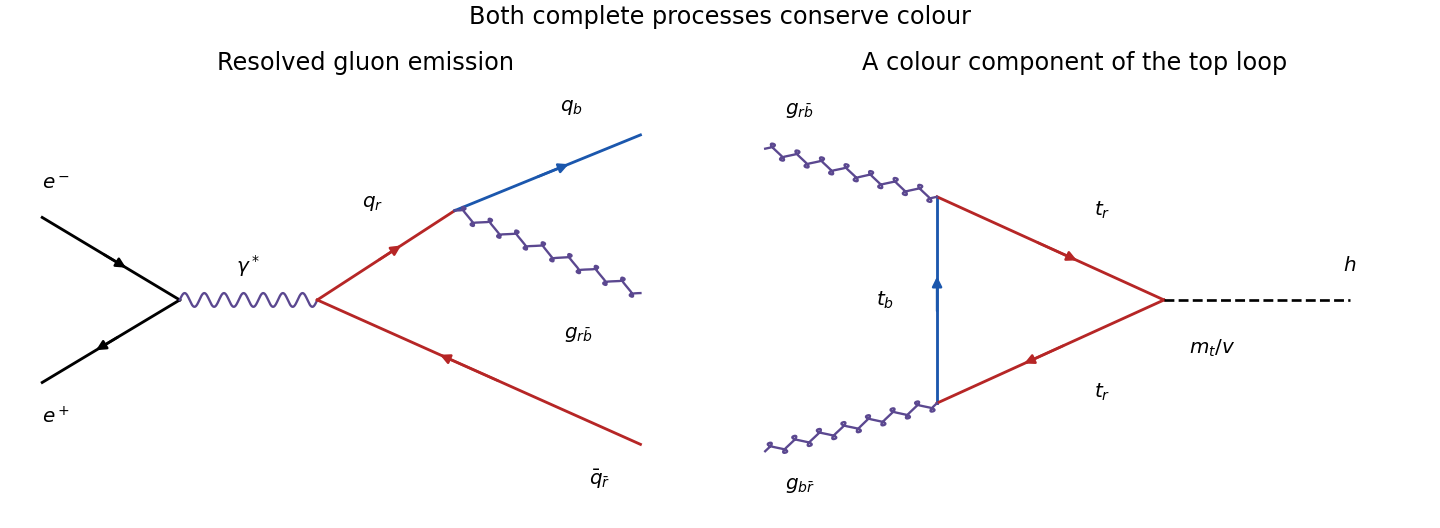
The three-jet cross section contains one additional strong interaction vertex in the amplitude, so its ratio to the two-jet rate is of order times a resolution-dependent kinematic coefficient. A resolved fraction of order is consistent with perturbative QCD and a strong coupling constant much larger than the fine-structure constant. It is not an equality : the jet definition and cuts are needed. Photon radiation has a much smaller electromagnetic rate. The large hadronic third-jet rate supports gluon radiation; identifying the radiated object specifically as a colour-octet gluon also uses the QCD vertex and colour-flow description, not merely the existence of three visible jets.
Represent the color charges by , and . The Gell-Mann matrices satisfyThe physical quark-gluon Feynman vertex contains with ; the off-diagonal combination therefore allows . Color charge conservation assigns the emitted gluon the colour-flow label .
The claimed impossibility of is false. A direct counterexample from the printed matrices isThus both diagonal gluons have nonzero vertex elements, and . They correspond to the traceless combinationsA Gell-Mann matrix is a generator rather than a finite rotation, but exponentiating a diagonal generator also leaves the red basis direction fixed up to a phase. The actual excluded object is the identity generator, proportional to the colour singlet . Adding it would extend SU(3) to unitary group and introduce a ninth singlet vector boson. A colour-preserving vertex among the existing eight gluons does not require that extra boson and does not make the ordinary diagonal gluons colour singlets.
In gluon-fusion Higgs production, two gluons couple to a closed top quark loop, and the Higgs boson couples to that massive quark through its Yukawa interaction. The right panel of the diagram in c shows one explicit colour-flow component: internal at one gluon insertion, then at the other; the colour-neutral Higgs boson insertion preserves the internal color charge. Include both loop orderings. The color charge factor isso the two incoming gluons are projected onto a colour singlet. The Yukawa coupling is , and the vertex has strength . No direct tree-level mass coupling is needed. Integrating out a sufficiently heavy top quark generates an effective interaction proportional to , which is allowed by gauge invariance even though the gluon is massless.
There is also no kinematic obstacle: two massless particles with nonparallel momenta can have nonzero total invariant mass. In particular, head-on gluons have , providing the energy needed for the Higgs boson at the LHC.
The Lorentz force is . Because it is perpendicular to the velocity, it changes the direction of momentum without changing its magnitude. For a charged particle in a uniform magnetic field, the radius of curvature is . Over the short track, the bending angle is . Equivalently, integrate the force for a time while neglecting the small rotation in its direction. The magnitude of the acquired momentum component perpendicular to the incident direction isIts direction follows ; a signed component can therefore be written after fixing an oriented bending axis. Chord length and arc length agree at this order in .
The sagitta is the maximum distance between the circular track and its chord. The perpendicular bisector of a chord of length gives a right triangle with hypotenuse and sides and . HenceAt fixed electric charge, magnetic field and lever arm, , so differentiation and propagation of uncertainty giveThus a fixed spatial measurement uncertainty produces a relative momentum uncertainty growing linearly with . If momentum is expressed in , in tesla, in metres and , restore the usual conversion .
For azimuthally symmetric Rutherford scattering, integrate over the solid angle, . Substituting gives , soThe small lower cutoff dominates when and . Using , the leading total cross section isA nonzero cutoff is essential: the unscreened forward cross section otherwise diverges.
Let . The supplied second moment gives the single-scatter root mean square angleFor independent scatters with uniform azimuth, the small angular-deflection vectors have zero mean. Their cross terms average to zero, so their variances add. After scatters,This is the root mean square magnitude of the two-dimensional angular deflection. Its projection into one specified plane has a variance smaller by a factor of two, hence a root mean square smaller by .
For a thickness with number density of scattering centres, the mean count is . Using the total cross section in i and the variance addition in ii,ThusThe stated assumptions make the prefactor independent of and approximately independent of . The lower-cutoff factors cancel except inside the slowly varying logarithm. Treating as a Poisson random variable rather than a fixed count gives the same result after replacing by its mean.
The magnetic bending angle is . For a momentum estimate based on this angle, propagation of uncertainty gives . Comparing the total Multiple Coulomb scattering angle with the bend therefore gives the commonly intended characteristic estimateIts independence of is the key result for relativistic particles: the scattering angle and magnetic bend both scale as .
A precise standard deviation requires specifying how tracks are measured. If is obtained from independently measured entrance and exit directions and all the material lies between them, the bending-plane projected root mean square is . For that estimator the equality isA three-point sagitta fit weights scatter positions differently again. The paper does not specify these measurement details, so it fixes the scaling and characteristic estimate, but not one universal geometric coefficient for all track fits.
At high momentum, the fixed spatial measurement uncertainty dominates because ii grows as . At lower, still relativistic momentum, Multiple Coulomb scattering dominates the relative uncertainty, which approaches the approximately constant term in iv. Below the relativistic regime the additional velocity dependence of scattering must also be included.
Three complementary improvements are: increase and the tracking lever arm to enlarge the magnetic bend; improve hit-position resolution and alignment to reduce ; and reduce passive material and detector-layer thickness to reduce and hence Multiple Coulomb scattering. For independent contributions one commonly writeswhere is the scattering term for the specified material distribution and track estimator.
The covariant derivative differentiates a field while preserving its transformation law under the local electroweak gauge symmetry . Here is the ordinary spacetime derivative and a Lorentz index. The gauge fields , , are the three SU(2) fields; is the U(1) field. The corresponding dimensionless coupling constant is for SU(2) and for U(1).
The are weak isospin generators in the representation of the differentiated field, with on a doublet and on an SU(2) singlet. The repeated index is summed. The generator supplies the field's weak hypercharge in the convention , where is its fractional electric charge. The factor follows the convention of Hermitian generators. The two connection terms compensate the derivatives of spacetime-dependent gauge transformations.
Set and . First expand the charged term using the ladder operators:Substituting the neutral gauge fields as well, the covariant derivative becomesMatching to requiresMatching to requiresFor , elimination yieldsEquivalently, and . The conventional Weinberg angle lies in the first quadrant.
Write . The Pauli matrices give the weak isospin operatorsFor the Higgs doublet with weak hypercharge ,The Higgs field direction, including its vacuum expectation value, is electrically neutral. Consequently the electromagnetic U(1) leaves the vacuum invariant: electroweak symmetry breaking preserves electromagnetism and the photon remains massless. The result concerns this neutral vacuum direction; it does not say that both components of the full Higgs doublet have zero electric charge.
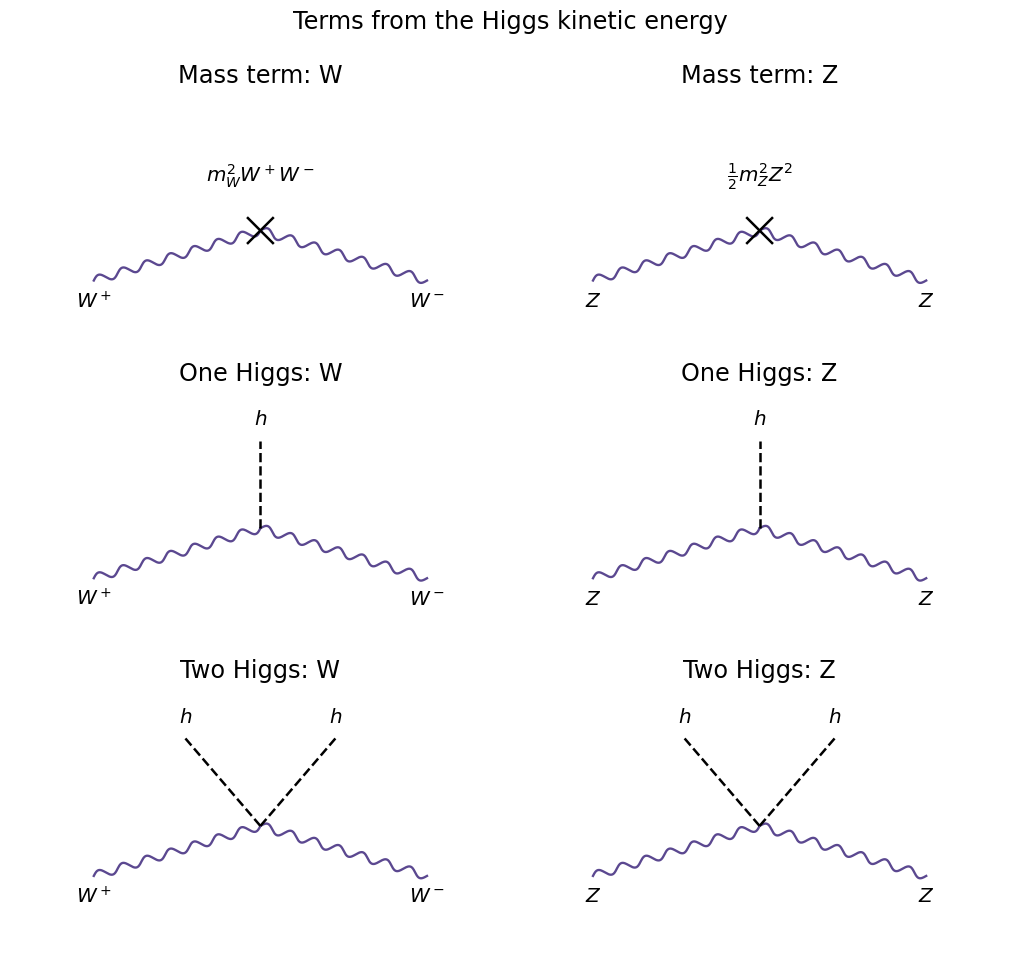
Using c and omitting , the covariant derivative isThe two components are orthogonal, so their squared magnitudes add; . Thus the Higgs field kinetic contribution to the Lagrangian density isThe two terms are gauge boson mass terms. Comparing with gives and . The factor for the real Z boson field is essential.
The two terms are the cubic Higgs boson coupling to W bosons and Higgs boson coupling to Z bosons. They produce the three-leg and Feynman vertices, allowing Higgs decay to two W bosons, Higgs decay to two Z bosons when kinematically available, and the corresponding production mechanisms with virtual gauge bosons. The two terms are quartic and interactions, including vector-boson scattering into a Higgs boson pair. Written in terms of the masses,The corresponding Feynman vertex factors are for one and for two , for , after differentiating with respect to identical fields. These six contributions contain no photon mass or direct interaction because .
The lepton mixing matrix is unitary, so each row has unit norm. Explicitly its electron row obeyswhere and . This is also the normalization needed for unit electron neutrino survival at .
Use and define in natural units. The exact vacuum neutrino oscillation result becomesThe given mass-squared differences satisfy , so the two fast oscillation frequencies are close: . Approximating their phases as equal combines their coefficients intowhile . HenceThe complex CP phase cancels from every . The phase-replacement approximation is uniformly reliable for , especially at short reactor baselines; closeness of the mass-squared differences alone does not guarantee close sine values at arbitrarily large . At medium baselines the distinct fast frequencies can beat, so the exact three-frequency expression is preferable if their detailed pattern matters.
Restoring units in the oscillation phase gives . With , one kilometre is . ThusHere denotes the coefficient in . The familiar applies when is in GeV, not MeV. Strictly, the dimensionless definition keeps once the already include the unit conversion. The intended numerical question concerns the practical coefficient multiplying the numerical values of .
Using the two-frequency approximation in a and in kilometres, the survival probability isThe slow coefficient is ; the fast one is . Since has period , the two individual oscillation periods areThe first broad trough is near km and the second near km; the slow component returns to its crest near km. Small, rapid ripples of depth about sit on the broad envelope. Averaging over unresolved fast oscillations replaces their squared sine by , giving .
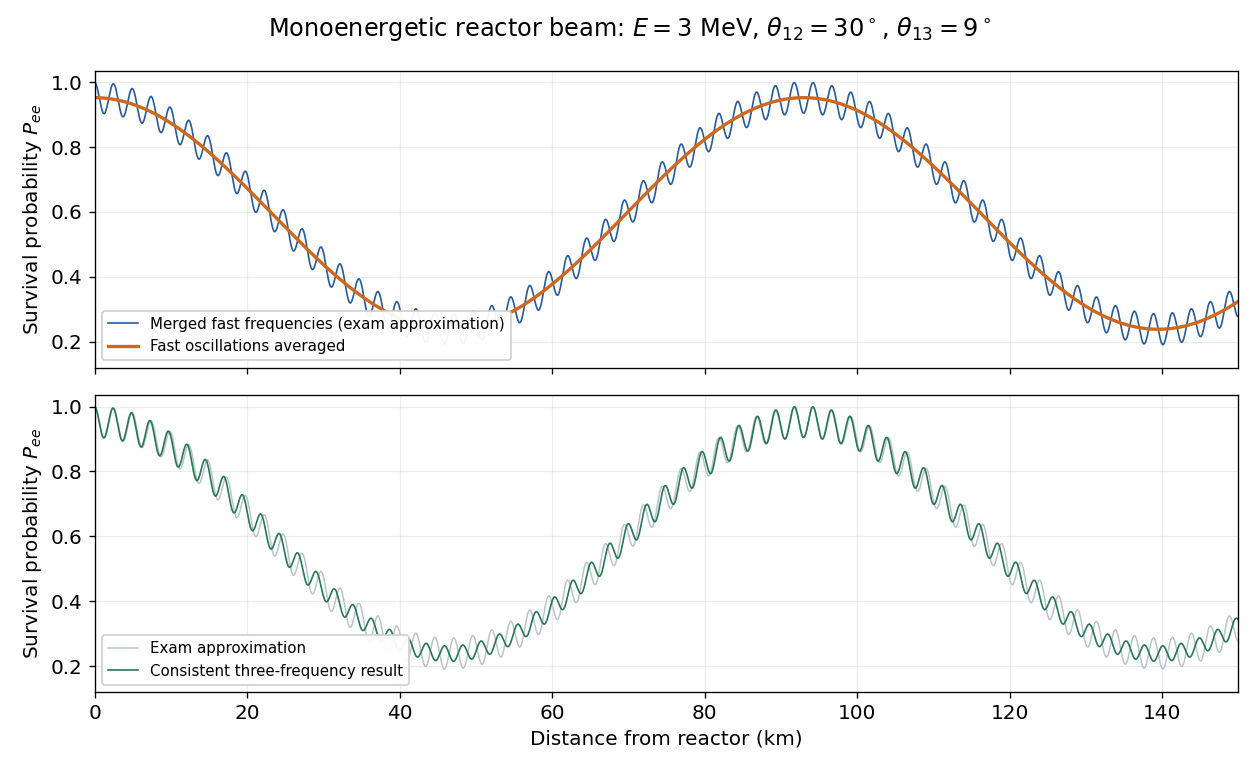
Reactor survival probability and the limits of merging the fast frequencies
. Details. There is no single short period for the combined curve. If the supplied ratio is taken as exact, its mathematical common period is km, outside the plotted range; the approximate physical data do not warrant interpreting that commensurability as exact.
The figure also shows the unmerged expressionFor that comparison take and enforce the identity , with a consistent sign convention. This illustrates the limitation identified in a: the simplified envelope is useful, but its individual fast ripples need not match the three-frequency result over 150 km. The supplied has no effect on vacuum electron-flavour disappearance.
For a rate measurement of the small mixing angle , choose the first fast disappearance maximum,A 47 km baseline instead lies near the slow oscillation maximum associated with . Its much lower flux, approximately falling as , and the many fast oscillations washed out by a reactor's broad energy spectrum make it a poor choice for this simple design. A medium-baseline spectral experiment can still constrain neutrino oscillation parameters if it has enough events and resolution; 47 km is not intrinsically useless, but it is not the optimal short-baseline rate experiment. In a, also affects the slow envelope through , so the sensitivity there is not identically zero.
Matched near and far particle detectors are a good design. A near particle detector, close enough that the fast oscillation phase is small, measures the unoscillated reactor spectrum and normalization. A far particle detector near the first fast maximum measures the disappearance. Their appropriately geometry-corrected ratio cancels much of the uncertain reactor flux and common cross section and detection efficiency. Relative calibration, different backgrounds, multiple reactor distances and any residual near-site oscillation still need treatment. The near site should retain enough shielding to suppress cosmic backgrounds.[ref]
Review of Particle Physics by Particle Data Group (2022). Section 14.6.4, Reactor Antineutrinos: relative near/far measurements of the reactor disappearance signal
A fission reactor supplies predominantly electron antineutrinos, with typical energies of a few MeV. Even if they oscillate to muon antineutrinos, producing a real muon through a charged current requires roughly the muon rest energy, over MeV for a free nucleon target. For example,Thus a muon spectrometer cannot observe this appearance channel from a reactor. Measure electron antineutrino disappearance instead, most commonly through inverse beta decay, , using the prompt Positron and delayed neutron signal.
The radiation length is the characteristic length for high-energy electron energy loss by bremsstrahlung; smaller means more radiative loss for the same traversed thickness. To limit that loss, minimize , choosing less material or a larger , rather than minimizing itself. At reactor Positron energies of a few MeV, ionization and subsequent annihilation matter more than high-energy bremsstrahlung. A sufficiently large scintillation counter measures the deposited energy, so containment of the Positron and annihilation photons, light yield and calibration are the relevant design issues.[ref]
Review of Particle Physics by Particle Data Group (2022). Sections 34.4.1–34.4.4: collision losses, radiation length, bremsstrahlung and critical energy
A Positron signal is correct for the reactor's antineutrinos, through inverse beta decay,A true electron neutrino charged current interaction instead produces an electron, for example . This corrects the source's loose use of “neutrino” for the reactor beam.
After slowing, the Positron annihilates with an electron, generally producing two keV photons. The prompt visible energy includes both the Positron kinetic energy and annihilation energy; neglecting the small neutron recoil,A delayed neutron capture supplies a powerful coincidence tag. Detecting only two annihilation photons discards useful prompt energy and does not uniquely identify the charged current event.
The relevant resolution condition is on the oscillation phase, not solely on which mixing angle is being measured. Since ,At the same medium baseline, the fast -dependent ripples have phases about times larger than the slow component. Resolving those ripples therefore requires a much better fractional energy resolution. At 47 km, ; avoiding substantial phase smearing requires a resolution appreciably better than .
However, a short-baseline experiment near 1.24 km and a experiment near 46.5 km each operate near their relevant first maximum, . Their intrinsic fractional phase-resolution requirements are then comparable. The smaller disappearance amplitude demands careful relative calibration and background control, but it does not by itself impose a universally finer energy resolution. The proposal is conditional on baseline and analysis, rather than a general requirement.
In vacuum the electron-flavour survival probability depends only on and the mass-squared differences. Complex conjugation of the lepton mixing matrix therefore leaves it unchanged:Thus a reactor disappearance measurement cannot search for the intrinsic CP violation phase in the standard three-neutrino model. Sensitivity to that phase calls for suitable appearance channels and, usually, comparison of neutrino and antineutrino beams. Matter can produce differences between propagation of neutrinos and antineutrinos; these are not by themselves intrinsic CP violation, and are small for the proposed short reactor baseline.
The source is on bundle pages 34–41. Its cover gives Trinity Term 2021 despite the attachment's 2020 filename. These solutions use natural units unless a conversion is written explicitly.
In a relativistic two-body decay, four-momentum conservation in the parent's rest frame requires andFor fixed daughter masses, this fixes a unique , independent of direction. In the Lorentz-invariant phase space integral, the Dirac delta distribution enforcing conservation of energy therefore performs the radial momentum integration. Only the solid angle remains to be integrated; the resulting can be taken outside that integral, even if the matrix element depends strongly on direction.
For three or more final particles, four-momentum conservation generally leaves continuously variable daughter energies and momenta, so the decay rate includes integrations over them, or equivalently over independent invariant masses in a Dalitz plot. Integrating over a variable daughter invariant mass is also necessary when an unstable daughter is treated with a finite decay width rather than a fixed mass.
Useful examples with no net quark flavor are the eta c meson and the eta b meson . Examples with nonzero quark flavor are the kaon and the D meson . These are pseudoscalar mesons: in the lowest quark model configuration the constituent spins combine to , the relative orbital angular momentum is , and the total angular momentum and parity are . For the self-conjugate examples, meson parity and charge conjugation also gives . Electrical neutrality alone would not imply zero net quark flavor; for example has strangeness.
Restoring reduced Planck constant, decay width and mean lifetime satisfy . Thus the representative numbers correspond toThe mean lifetimes differ by at least . Hidden-heavy-flavor quarkonium can undergo quark-antiquark annihilation into gluons, followed by hadronization. A color-singlet state can annihilate into two gluons. A lightest open-flavor meson cannot simply annihilate through the strong interaction, which conserves net quark flavor. With no lighter accessible final state carrying that flavor, it must undergo a weak interaction changing a constituent's flavor. The small weak interaction amplitude, CKM matrix factors and available Lorentz-invariant phase space produce a much smaller decay width.
Qualification. A decay width of order tens of MeV is not a universal property of flavor-neutral pseudoscalar mesons. The neutral pion has and decays predominantly by the electromagnetic interaction, a concrete counterexample. Its mass lies below the lightest allowed hadronic final state. The examples above illustrate the intended annihilation-versus-open-flavor comparison; the numerical scale depends on thresholds and selection rules.[ref]
Review of Particle Physics by Particle Data Group (2022). Meson summary tables: neutral-pion width and heavy pseudoscalar properties
Assume the charmonium state annihilates through a virtual photon, with lepton universality and negligible higher-order corrections. For a vector meson of mass , the partial decay width into a charged lepton pair contains both the relativistic two-body decay factor and a vector-current spin factor:[ref]
First Measurement of the Branching Fraction of the Decay psi(2S) to tau pairs by the BES Collaboration. PDF p. 3, Eqs. (1)–(2): vector-current lepton-mass correction
For example, contracting the vector polarization sum with the Dirac trace for the two final fermions gives a factor proportional to , explaining why retaining only is insufficient. Using , and givesThe supplied total decay width also gives and . It cancels from the branching fraction ratio.The decisive change at is crossing the open-charm D meson-pair threshold, approximately . The strong interaction can now create a light quark-antiquark pair and rearrange into , without annihilating the heavy pair. This increases the total decay width from hundreds of keV to tens of MeV. The leptonic decay partial decay width is additionally smaller because is predominantly a state, whereas is predominantly ; the short-distance annihilation overlap is suppressed for nonzero orbital angular momentum. A roughly hundredfold increase in total decay width together with an order-ten reduction in leptonic partial decay width explains the order-thousand reduction in branching fraction. Attributing all three orders of magnitude to the threshold alone would miss the second effect.[ref]
Review of Particle Physics by Particle Data Group (2022). Charmonium listings: total and leptonic widths of psi(2S) and psi(3770)
At an electron-positron collider tuned to the charmonium resonance, select the mixed leptonic tau lepton decaysand their charge conjugates. Require exactly two well-reconstructed oppositely charged tracks, one identified electron and one identified muon, little extra visible activity, visible energy below the beam total, and significant missing momentum pointing into the instrumented region. The multiple neutrinos prevent full reconstruction of each tau lepton, but the known initial four-momentum, lepton spectra and missing energy support a statistical signal extraction. Off-resonance data constrain nonresonant electron-positron annihilation into a tau lepton pair; that continuum is present at both beam energies.[ref]
First Measurement of the Branching Fraction of the Decay psi(2S) to tau pairs by the BES Collaboration. Event selection using mixed electron-muon tau decays and continuum subtraction
A resonant muon pair is one possible detector background: one muon can be misidentified as an electron, while radiation escaping along the beam or a badly measured track produces apparent missing energy. Particle-identification requirements and rejection of almost back-to-back tracks near the beam momentum suppress it. This background needs detector mismeasurement; an ideal measurement would distinguish it.
Above the open-charm threshold, supplies an additional resonant background. Semileptonic decays of the two D mesons can give an electron, a muon and neutrinos; unreconstructed hadrons let some events pass the selection. This on-shell D meson-pair background is kinematically forbidden at .
The three structures are the radiative cascadesIn the quark model, the J/psi meson and are respectively and charmonium states. Thus , , , and meson parity and charge conjugation gives . The intermediate chi c mesons are : , , and addition of angular momentum permits . ConsequentlyThese are electric dipole transitions, changing by one and preserving to leading order. A singlet state has and is not another member of these spin-triplet cascades.
The primary photon energy is , about , and for . The secondary photon remains more energetic even after its boost into the parent rest frame. Hence : with this quantity on the vertical axis, each resonance gives a horizontal band. A finite decay width and detector measurement resolution broaden each band; photon ordering removes the mirrored duplication of an unordered Dalitz plot.
The faint band beside the negative-slope diagonal boundary is , followed by . The neutral pion is predominantly , a pseudoscalar meson with . This production transition violates isospin, accounting for its small rate. To locate the band, set and . Four-momentum conservation givesFor the neutral pion, is small, putting the line just inside the boundary. The allowed channel, with the eta meson also , produces a parallel line further inside, at . The positive-slope edge instead comes from ordering the two photon energies; proximity to that edge alone would not identify the two-photon state.
Use the Minkowski metric and choose the incoming electron along , with the scattered electron in the plane. In natural units, neglecting the electron mass, the four-momenta areThe momentum transfer entering the proton is thereforeThe outgoing hadronic system carries . The energy transfer is , while need not point along the original beam.
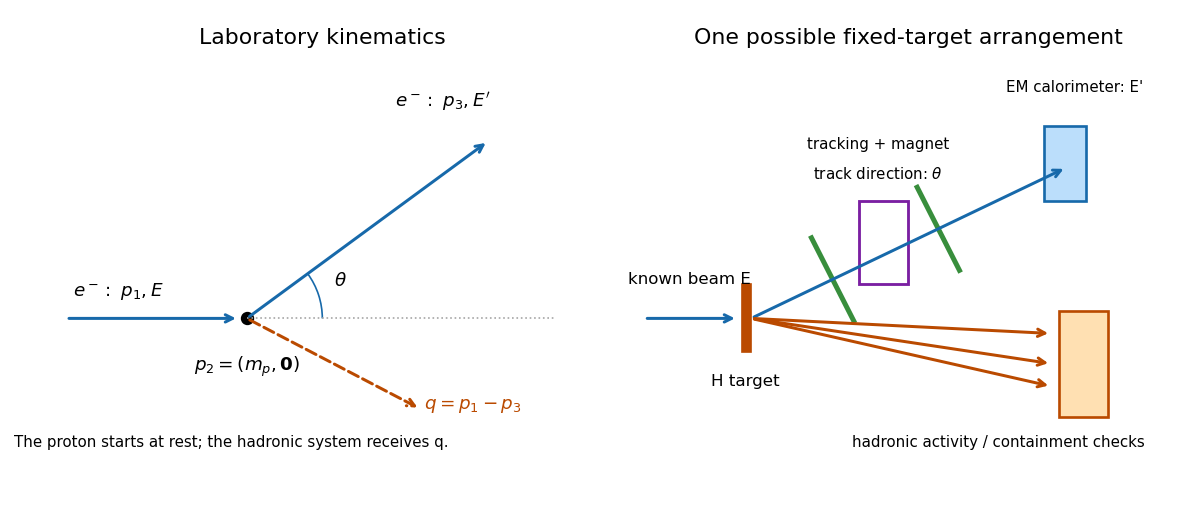
With the four-momenta in a, , , and . Thus the measured beam energy , scattered electron energy and scattering angle determineHere measures the spacelike momentum transfer, is the fractional energy transfer, and the Bjorken scaling variable is the struck parton's longitudinal momentum fraction in the leading collinear description. The hadronic invariant mass satisfies ; large and select deep inelastic scattering.
A beam spectrometer measures before a thin stationary hydrogen target. Tracking layers on both sides of a magnetic spectrometer measure the outgoing electron direction, charge and curvature; an electromagnetic calorimeter measures its energy. Matching the track to its particle shower, with downstream muon rejection where useful, separates the scattered electron from hadronic tracks. A downstream hadronic detector measures the hadronic activity and supports event-quality checks. The sketch in a shows these separate measurements.
The scattered electron provides a clean, single-particle reconstruction. Reconstructing the entire hadronic system requires summing many charged and neutral fragments, correcting unequal particle calorimeter response and losses through beam holes, and sometimes accounting for escaping neutrinos. Thus the leptonic definition is experimentally convenient. It is not a fundamental requirement of Lorentz invariance: exact reconstruction of gives the same , and hadronic or combined reconstructions can be preferable in some kinematic regions.
At leading order in QED, the electron exchanges one spacelike virtual photon with a charged parton inside the proton.
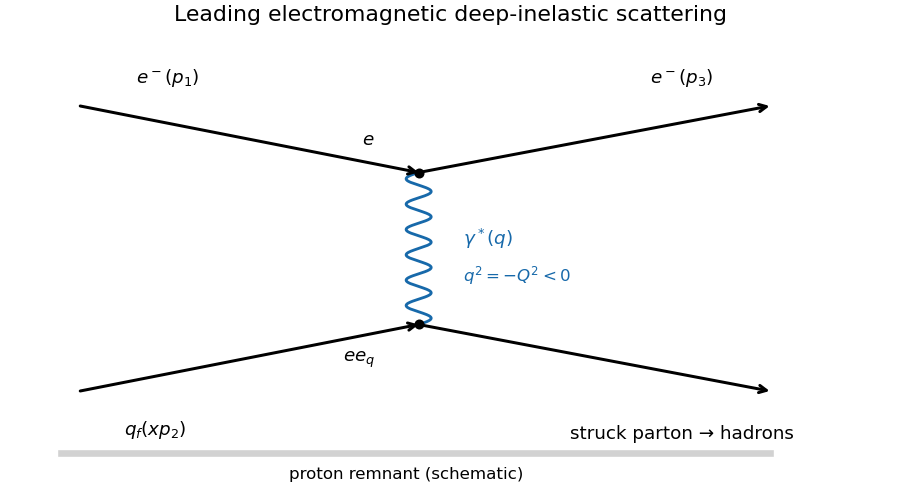


The two Feynman vertices contribute and , while the photon propagator contributes . Hence the scattering amplitude scales as and its squared absolute value as . Since the fine-structure constant is , the electromagnetic coupling dependence is . The numerical in the stated differential scattering cross-section additionally uses the flux, Lorentz-invariant phase space, azimuthal integration and the convention defining the deep-inelastic structure function; it cannot be deduced from the propagator alone.
For each measured bin form the reduced quantityPlot this against at several fixed values, normally using a logarithmic axis. Bjorken scaling predicts an approximately horizontal curve at each , or equivalently collapse of different- data onto one curve. Raw cross sections do not collapse because their explicit kinematic factors vary. QCD predicts logarithmic scaling violations, so exact independence is only the ideal parton model limit. The stated extraction also assumes negligible longitudinal deep-inelastic structure function, as in the leading massless spin-half parton approximation.
Articles were limited to the first 100 out of 503 total.
Articles by others on the same topic
There are currently no matching articles.