The angular separation is . Each star's angular diameter is below , so treating it as a point source is justified at these diffraction scales.
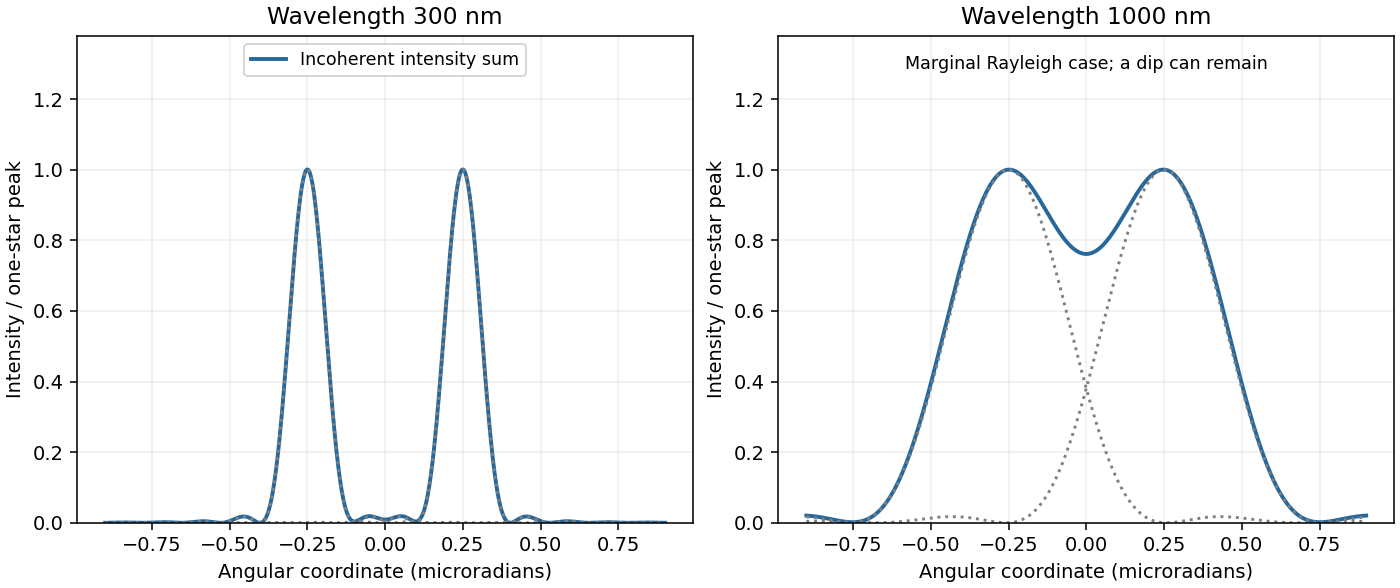
At300nm the Airy disk first-zero radius is . The separation is3.28 times this radius: two well-separated bright peaks occur. The stars are mutually incoherent, so their point spread functions add as intensities, not amplitudes:The value at u=0 is defined by continuity. Faint diffraction rings remain on either side of each principal peak. [ref]
University Physics Volume 3 by Samuel J. Ling and others. §4.5, circular-aperture diffraction and Rayleigh angular scale
Two-star profiles
. Summed Airy intensities for equal incoherent point sources at the two specified wavelengths. Source. Details.
At1000nm the first-zero radius is , slightly larger than the separation. The images therefore overlap strongly and just fail the conventional Rayleigh criterion, rather than forming two clean isolated peaks.
The summed Airy profile can still have a shallow central dip and two local maxima: Rayleigh's criterion is a resolution convention, not the exact condition for a profile to become single-peaked. The two-panel original plot in part(a) shows the correct intensity sums at both wavelengths. [ref]
University Physics Volume 3 by Samuel J. Ling and others. §4.5, resolution criterion for equal point sources
Articles by others on the same topic
There are currently no matching articles.