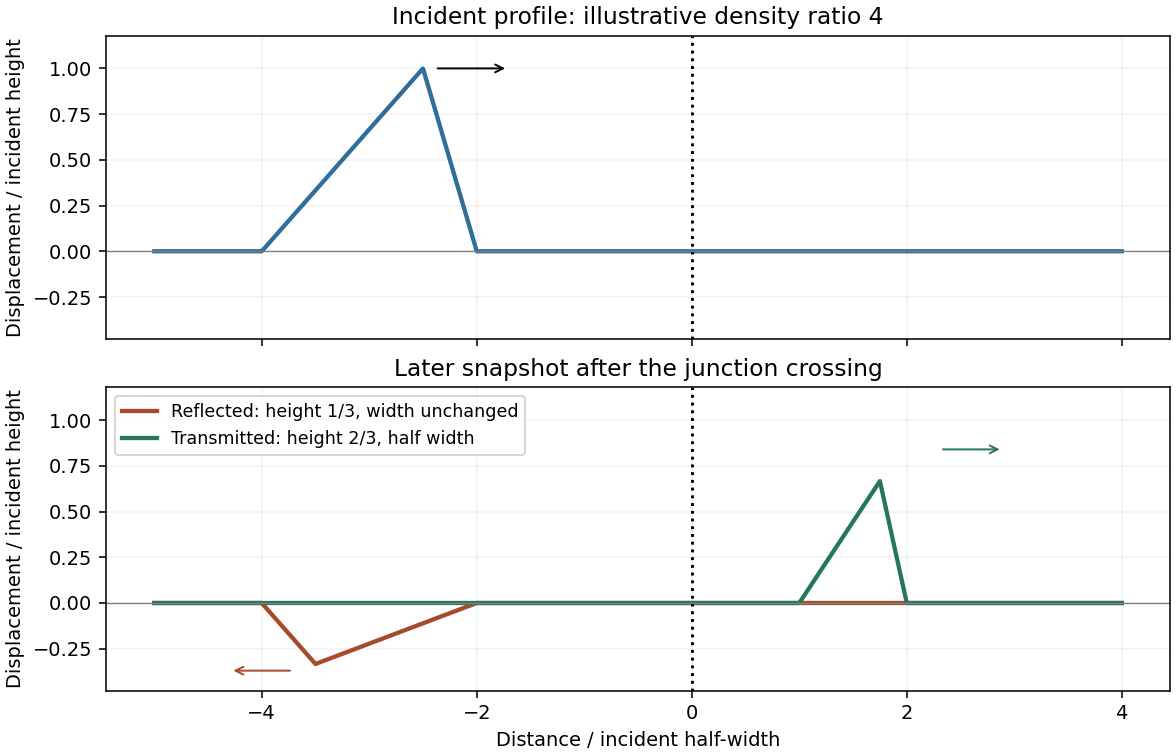
Let the common tension be T, the linear mass densities be and the speeds be , so . Displacement and transverse-force continuity give the displacement coefficients at a string junctionThe reflected triangular pulse is inverted, has smaller height , unchanged spatial width and unchanged speed, and travels left. Its left-to-right asymmetric profile is reversed as well as vertically inverted. The transmitted pulse remains upright, has smaller height tH, travels more slowly, and has width . The string-pulse width mapping at a junction leaves its temporal duration unchanged. The transmitted slopes are steeper by ; the reflected slope magnitudes are smaller by .
The density ratio is unspecified, so only these inequalities are determined. The original plot below illustrates , giving , and half-width transmission; it is not a numerical reading of the examination figure.
Pulse junction
. Illustrative density ratio four; reflection inverts the pulse and transmission compresses its width. Source. Details.
For the adjacent reflected minima of an air-film-air layer in thin-film interference, reflection at the front surface acquires a phase reversal, while reflection at the rear does not. Near normal incidence the reflected minima therefore obey for integral m. A single intermediate maximum means that the two stated minima are consecutive orders:Thus , with orders6 and5, andThe intermediate reflected maximum is at . This assumes negligible dispersion of the supplied refractive index and an air environment on both sides. [ref]
University Physics Volume 3 by Samuel J. Ling and others. §3.4, reflection phase reversals and thin-film interference
The angular separation is . Each star's angular diameter is below , so treating it as a point source is justified at these diffraction scales.
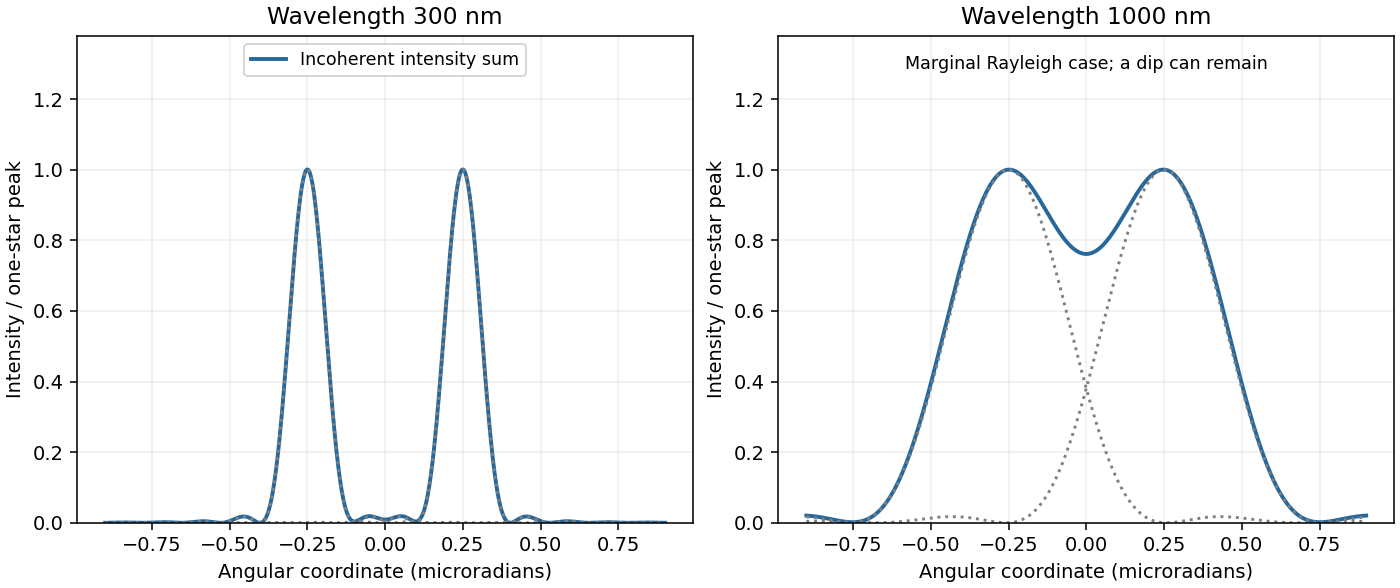
At300nm the Airy disk first-zero radius is . The separation is3.28 times this radius: two well-separated bright peaks occur. The stars are mutually incoherent, so their point spread functions add as intensities, not amplitudes:The value at u=0 is defined by continuity. Faint diffraction rings remain on either side of each principal peak. [ref]
University Physics Volume 3 by Samuel J. Ling and others. §4.5, circular-aperture diffraction and Rayleigh angular scale
Two-star profiles
. Summed Airy intensities for equal incoherent point sources at the two specified wavelengths. Source. Details.
At1000nm the first-zero radius is , slightly larger than the separation. The images therefore overlap strongly and just fail the conventional Rayleigh criterion, rather than forming two clean isolated peaks.
The summed Airy profile can still have a shallow central dip and two local maxima: Rayleigh's criterion is a resolution convention, not the exact condition for a profile to become single-peaked. The two-panel original plot in part(a) shows the correct intensity sums at both wavelengths. [ref]
University Physics Volume 3 by Samuel J. Ling and others. §4.5, resolution criterion for equal point sources
For hard spheres of radius r in a face-centered cubic lattice, contact occurs along a face diagonal: . Four spheres belong to a conventional cell, so the hard-sphere cubic packing fractions giveFor a body-centered cubic lattice, contact occurs along a body diagonal, , and there are two spheres per conventional cell:Their ratio proves that FCC packs more densely. Coordination alone would not establish the occupied volume fraction.
For a classical ideal monatomic gas, and . Treat copper as having one conduction electron per atom. Its degenerate-electron contribution isConsequently the electron-only estimates at5K areThe constant-pressure gas versus electronic metal heat capacity convention makes the second numerator appropriate to a constant-pressure gas measurement. For the solid, the low-temperature difference between and is usually small, but its phonon contribution is not fixed by . In a Debye model,The supplied alone therefore does not determine the ratio to copper's total heat capacity; the electronic-only result is conditional.[ref]
Statistical Physics by David Tong. Chapter3, §3.3.1, Debye lattice heat capacity; printedpp.96–97, distinct electronic-linear and phonon-cubic contributions in copper
An estimate using additional material data is possible: the specific-heat fit in Material Properties: OFHC Copper by National Institute of Standards and Technology gives . Using copper's rounded molar mass gives , and henceThis supplementary estimate includes copper's lattice contribution and retains the ideal-gas approximation for helium. The NIST fit reports a 10% deviation from its source data below 15 K; neither that fit nor the stated pressure alone supplies helium nonideality corrections.[ref]Material Properties: OFHC Copper by National Institute of Standards and Technology. Specific heat: 4–300 K fit, coefficient column a–i, base-ten logarithmic polynomial; stated 10% fit deviation for temperatures below 15 K
Articles by others on the same topic
There are currently no matching articles.