Measure both vertical displacements upward from static equilibrium, so gravity cancels. The spring force changes by , while the damper is attached to a fixed surface and supplies . Newton's second law givesFor sinusoidal steady motion, substitution of gives the spring-base displacement response with a grounded damperA decaying homogeneous transient must be added unless initial conditions already select steady state. At low frequency, and the mass follows the slowly moving support; the first correction is . At high frequency, : inertia suppresses motion and reverses its phase relative to the support. There is no in the numerator because the damper's other end does not move.
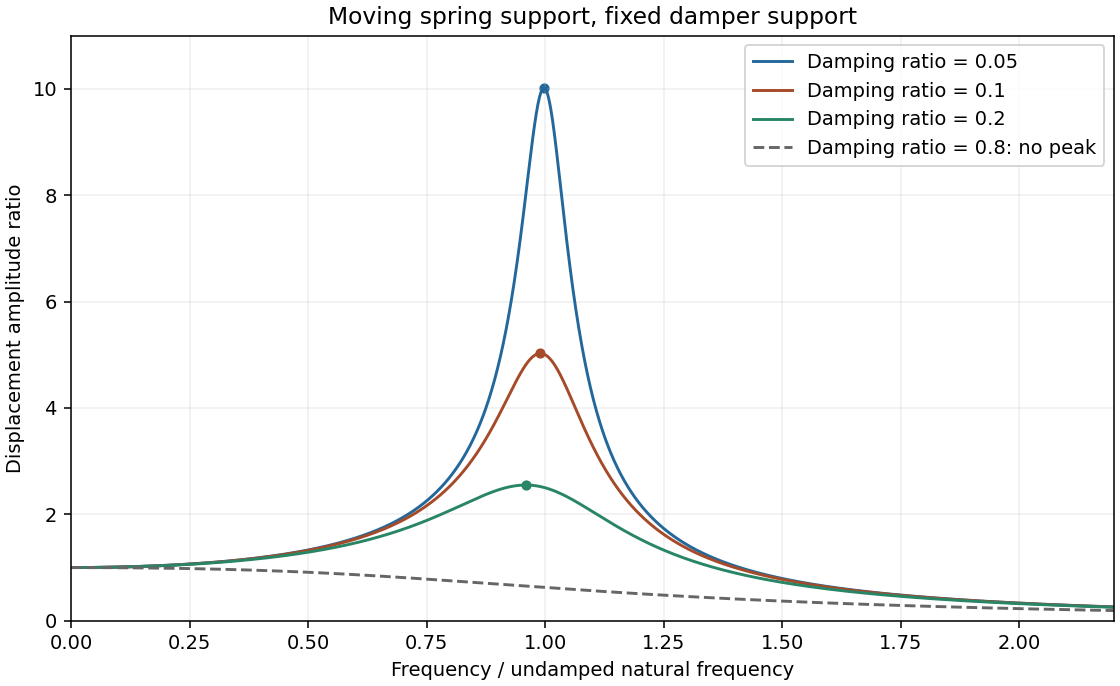
Minimize the squared denominator . Its derivative is , givingWrite and . Then with , and the finite-frequency peak is . Increasing light damping lowers and broadens the peak and shifts it left; the low-frequency limit remains1 and the high-frequency decay remains proportional to .
The resonance versus oscillatory damping thresholds differ. For , the maximum is at zero frequency and the curve decreases monotonically. This threshold is , distinct from the free-oscillation critical damping threshold .

Articles by others on the same topic
There are currently no matching articles.