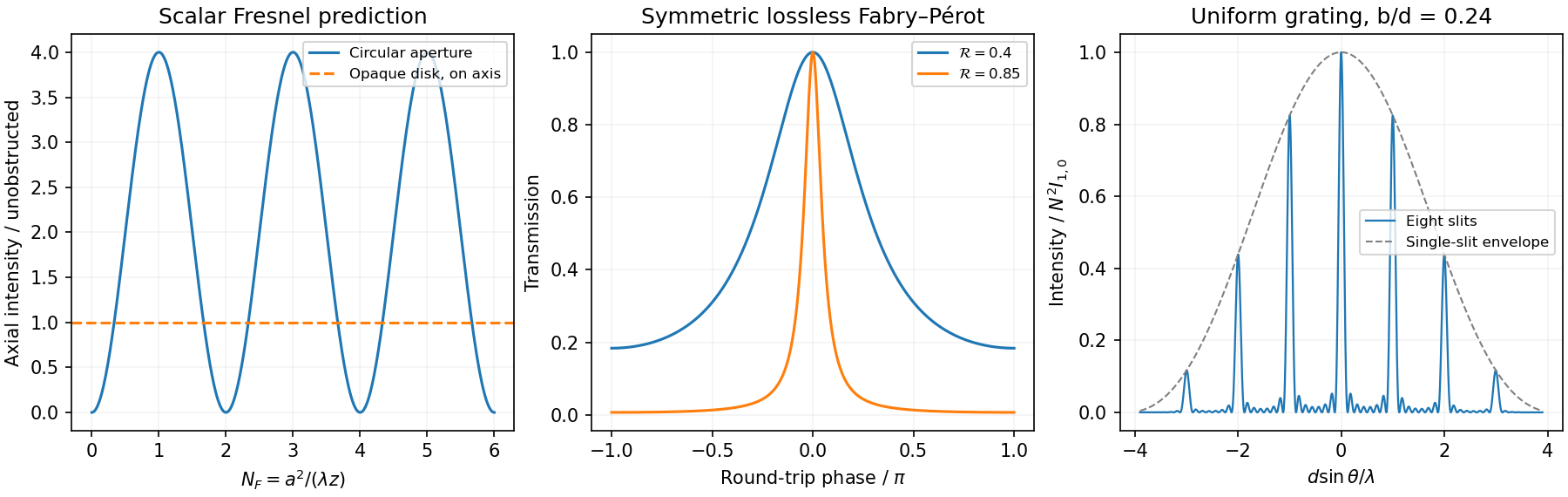
For a circular structure, cylindrical symmetry reduces the scalar Fresnel-Kirchhoff diffraction integral to concentric annuli. With plane-wave illumination, radius and distance , the relevant Fresnel number is . Successive Fresnel half-period zones have radii : their areas are approximately equal while their phases alternate by , causing neighbouring-zone cancellation.
For Fresnel diffraction by a circular aperture, the on-axis field follows directly from the radial integral,Odd zone counts reinforce on axis; even counts cancel in this ideal scalar model. An annular opening gives the difference of the corresponding two edge exponentials. A zone plate alternately blocks or phase-shifts zones so that otherwise cancelling contributions reinforce at a focus, with for its principal focal distance.
Babinet's principle gives for Fresnel diffraction by an opaque disk. Thus its ideal on-axis intensity equals the unobstructed intensity, the Arago spot, even within the geometric shadow. This concerns a narrow axial feature, not the whole shadow. Finite source size, imperfect circularity, bandwidth and alignment reduce its visibility. When , the circular-aperture far-field pattern becomes the Airy disk intensity pattern , with and first minimum near .

Articles by others on the same topic
There are currently no matching articles.