The Debye model replaces the crystal by a harmonic elastic continuum with acoustic dispersion . It counts three polarizations and introduces a cutoff so that the total number of vibrational modes is , where is the atom count. Periodic-box counting givesFor an isotropic average speed, . With cutoff frequency fixed by the mode count,This density of states is quadratic because a three-dimensional shell has volume proportional to and the acoustic dispersion is linear. The cutoff is a mode-counting device; it is not a claim that every actual branch stays linear to the zone boundary.
Each phonon mode has mean thermal energy , using Bose-Einstein statistics with zero phonon chemical potential. The fixed harmonic zero-point contribution has zero temperature derivative. With ,and differentiating at fixed volume givesFor , extend the upper limit to infinity. Expanding gives . integration by parts makes the heat-capacity integral , soOnly modes with are appreciably excited; their number scales as , explaining the power law physically. At high temperature every mode contributes , giving the Dulong-Petit limit .
The model assumes the harmonic approximation, a macroscopic three-dimensional solid and acoustic continuum behaviour for the thermally populated modes. Anisotropic sound speeds change the low-temperature coefficient rather than its cubic power. Real optical branches and nonlinear acoustic dispersion limit the full-temperature approximation; electronic excitations can add a linear term in a metal, and anharmonicity produces thermal expansion and distinctions between and . At temperatures below the lowest finite-sample mode, the bulk continuum law also fails. Thus the result is the low-temperature lattice contribution, not a universal total heat capacity for every solid.
For a circular structure, cylindrical symmetry reduces the scalar Fresnel-Kirchhoff diffraction integral to concentric annuli. With plane-wave illumination, radius and distance , the relevant Fresnel number is . Successive Fresnel half-period zones have radii : their areas are approximately equal while their phases alternate by , causing neighbouring-zone cancellation.
For Fresnel diffraction by a circular aperture, the on-axis field follows directly from the radial integral,Odd zone counts reinforce on axis; even counts cancel in this ideal scalar model. An annular opening gives the difference of the corresponding two edge exponentials. A zone plate alternately blocks or phase-shifts zones so that otherwise cancelling contributions reinforce at a focus, with for its principal focal distance.
Babinet's principle gives for Fresnel diffraction by an opaque disk. Thus its ideal on-axis intensity equals the unobstructed intensity, the Arago spot, even within the geometric shadow. This concerns a narrow axial feature, not the whole shadow. Finite source size, imperfect circularity, bandwidth and alignment reduce its visibility. When , the circular-aperture far-field pattern becomes the Airy disk intensity pattern , with and first minimum near .
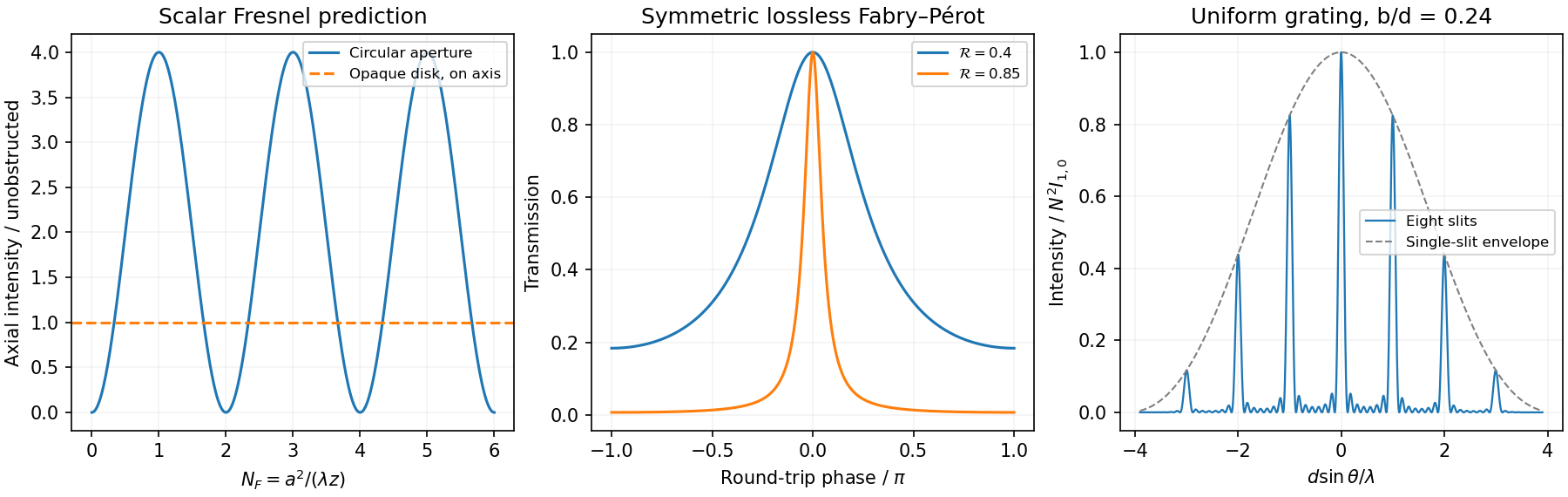
Original calculated circular Fresnel, Fabry–Pérot and finite-grating intensity patterns under their stated idealizations
. Details. 
Two parallel partially reflecting surfaces in a Fabry–Pérot interferometer produce a sequence of coherent transmitted beams. For equal lossless mirror intensity reflectance and round-trip phase , summing the geometric series of amplitudes givesresonances have and unit peak transmission in this symmetric lossless model. Varying angle gives concentric equal-inclination rings; changing spacing scans the resonance wavelengths.
At normal incidence with negligible dispersion, the free spectral range is . For high reflectance, the peak full width gives finesse and resolving powerThe coefficient in the transmission formula and the finesse are different quantities. Multiple round trips sharpen a peak, allowing high-resolution spectroscopy, frequency selection and cavity measurements. Absorption, mirror mismatch, finite angular spread, imperfect parallelism and surface errors reduce usable transmission or finesse. Adjacent orders can overlap in a broadband measurement, requiring order selection or prior spectral information.
For uniformly illuminated identical slits of a diffraction grating, with width and period , the far-field amplitude is a single-slit transform times a finite phasor sum. At normal incidence, write . ThenPrincipal maxima obey and have times the single-slit intensity at that angle. Nearby first minima are separated from a principal maximum by , so more illuminated slits sharpen each order. The broad single-slit envelope suppresses high angles; an order is missing if its principal maximum coincides with an envelope zero.
Differentiating the grating equation gives angular dispersion . Comparing the separation of nearby wavelengths with the first-minimum width yields the Rayleigh resolving powerOnly propagating orders with exist. Different spectral orders can overlap, and finite source-slit width, limited coherence, aberrations and grating errors worsen ideal resolution. A spectrometer therefore collimates light from an entrance slit and focuses each diffracted direction onto a detector; the slit image width and illuminated grating width must both support the desired spectral separation.
Articles by others on the same topic
There are currently no matching articles.