Fresnel diffraction retains quadratic aperture-dependent propagation phases and generally depends on both aperture and screen distance. Fraunhofer diffraction neglects those phases and gives the Fourier transform of the aperture in angle space, either sufficiently far away or in a suitable lens's focal plane.
The calculations below use the Fraunhofer, paraxial approximation. For an overall aperture scale , free propagation requires . The printed alone only makes the separation small relative to distance; it is not by itself the full far-field condition.
The relative slit-centre phase is . Near the optical axis, , so adjacent interference maxima have spacingSlow diffraction-envelope variation can slightly shift the exact local maxima.
A slit of width has its first zeros at . Thus the full central-envelope widths areThe narrower envelope determines the overlap, so it spansThis is the usual approximate “50 fringes” count. If counting nominal bright fringe centres strictly inside both first zeros, they have indices , giving 49 centres. The endpoints lie at the wider slit's first zeros, where two-slit visibility vanishes; they should not be counted as fully interfering bright centres.
At the centre, equal illumination gives slit amplitudes proportional to widths, so . The local interference extrema are and , givingThese are the central-envelope extrema as relative phase varies, or equivalently the near-centre fringe limits where the envelope is nearly constant.
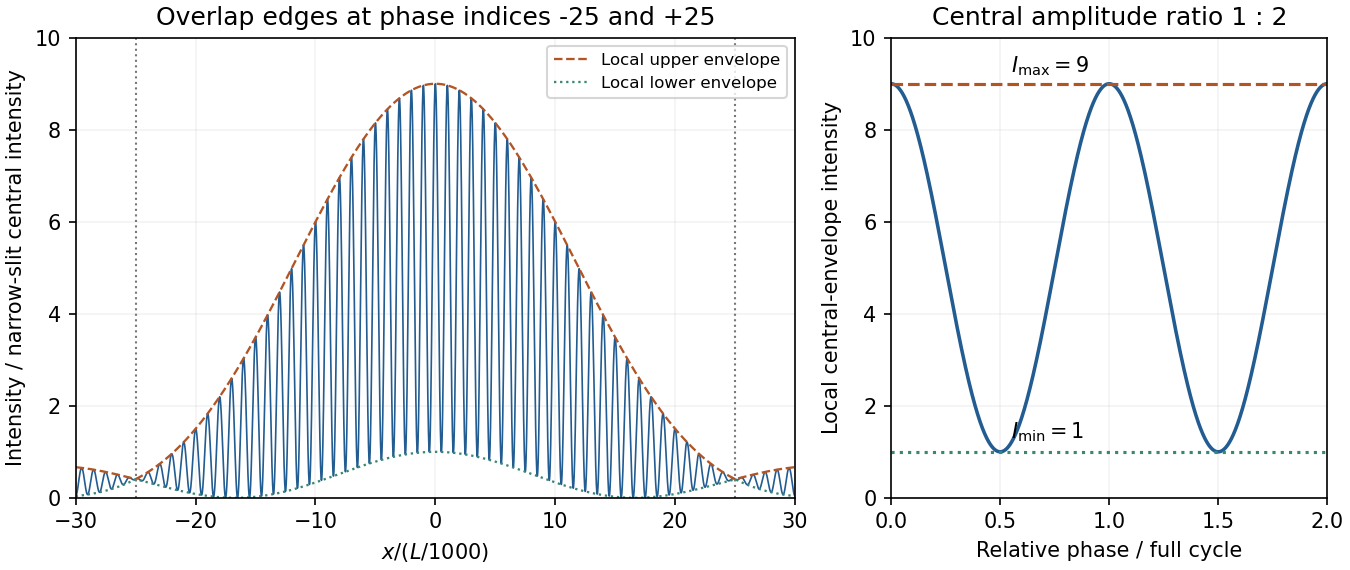
Original unequal-slit Fraunhofer intensity and its envelopes, with central-overlap edges and local nine-to-one intensity contrast
. Details. 
Treat the transparent plate as a phase plate at normal incidence. Its extra optical path is . An unchanged interference pattern requires an integer number of full phase cycles:For full-cycle phase-plate invisibility in an ordinary nontrivial material with , the two smallest are and . If the optically null case is admitted, the first two nondecreasing- values are and . A different allowed range of refractive indices would need to be specified before calling these the absolute smallest possibilities.
Articles by others on the same topic
There are currently no matching articles.