2016 paper: Public original PDF, physical page 768. Student-answer availability for this paper remains unverified.
The Stefan–Boltzmann law gives the radiated luminosityFor radiative mass loss at fixed luminosity, using mass-energy equivalence, the mass-loss magnitude and one-percent time areThe numerical constants are the external CODATA 2014 and ; years here mean 365.25 days.[ref]
CODATA recommended values of the fundamental physical constants 2014 by National Institute of Standards and Technology. Stefan-Boltzmann constant and vacuum light speed
This estimates radiative mass loss with the supplied radius and temperature held constant. It does not predict a real stellar lifetime or include solar-wind mass loss.For this molecular escape-speed temperature estimate, . Equating this to the surface escape-speed square givesThis evaluation keeps the paper's and , and uses externally documented , and .[ref]
Earth Fact Sheet by National Aeronautics and Space Administration. Bulk parameters: gravitational parameter GM
[ref]CODATA recommended values of the fundamental physical constants 2014 by National Institute of Standards and Technology. Atomic mass constant and Boltzmann constant
The corresponding escape speed is about .This is the requested speed-scale comparison. Atmospheric escape can occur from the high-speed tail at lower temperature; molecular dissociation and ionization also prevent treating an actual gas at this temperature as unchanged neutral nitrogen molecules.
For the potential of an inverse-radius spherical charge density, assume there is no additional point charge at the origin and choose . The enclosed charge is for , and outside. Gauss's law then givesIntegrating the field inward from infinity,The potential and its first radial derivative are continuous at , since there is no surface charge there. The integrable density singularity has a finite potential limit .
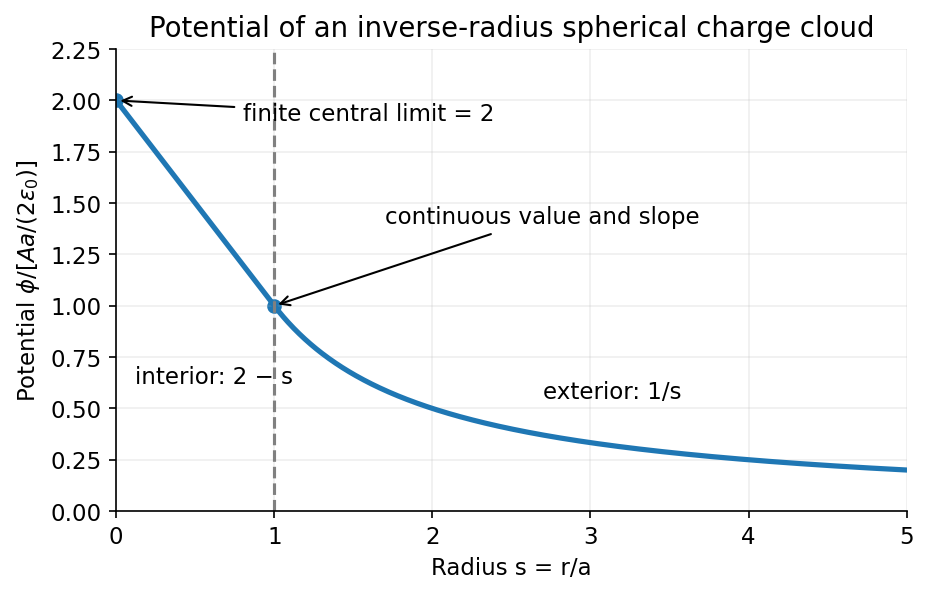
The potential falls linearly inside the inverse-radius charge cloud and joins a reciprocal-radius exterior tail
. Source. Details. For the ultrarelativistic magnetic bending radius, the Lorentz force supplies the transverse momentum change, so . At this energy the proton is ultrarelativistic, giving andThe electronvolt-to-joule conversion cancels the elementary-charge factor numerically. This uses external CODATA light speed and charge definitions.[ref]
CODATA recommended values of the fundamental physical constants 2014 by National Institute of Standards and Technology. Vacuum light speed and electronvolt conversion
If the stated beam energy means total energy, ; if it means kinetic energy, . Either interpretation gives the quoted radius at the precision of the supplied numbers.For contact loss on a smooth sphere, let be the angle from the upward vertical. In the limit of an infinitesimal initial displacement, conservation of energy gives . The inward radial equation isContact is lost at , so and . The distance travelled along the sphere is thereforeThe vertical drop is instead ; it is not the requested arc length. Exact rest at the unstable top would persist in the ideal mathematical solution, so the infinitesimal-displacement limit in the question is essential.
For the focal length of a rotating liquid mirror, consider steady rigid rotation at angular frequency . The free surface is an equipotential of . HenceA paraboloidal mirror has , givingThe numerical estimate uses the conventional standard acceleration , rather than an asserted local measurement or a recovered handbook entry.[ref]
NIST Guide to the SI, Footnotes by National Institute of Standards and Technology. Footnote 23: conventional standard acceleration of free fall
The mercury density cancels; the ideal surface shape follows from gravity and rotation.The first ideal linear polarizer transmits half of an unpolarized beam. Each subsequent polarizer is from the preceding transmitted polarization, so Malus's law givesIntensities, rather than coherent field amplitudes for different input polarization components, are averaged for the unpolarized beam. The output is polarized along the last polarizer's axis.
The wave numbers before and after the drop are and . Continuity of and at the finite step givesThus the reflected probability flux fraction isThe transmission probability is , rather than simply . Reflection is possible at a downward potential step even though both sides are classically allowed.
For hyperfine coupling for a spin-one nucleus, let the electron spin be and the nuclear spin . First couple , giving , then , giving .
| Allowed | ||
|---|---|---|
For each , the projection is ; electron projections similarly satisfy . Summing gives 18 states for and 30 for , agreeing with .
Notation qualification: if the printed leading “2” denotes the principal quantum number, a hydrogenic bound state does not exist because ; a physical state needs . If a doublet term symbol or was intended, its leading 2 instead means , and the angular-momentum table applies without fixing . The answers above use the explicitly specified values, while retaining this ambiguity.[ref]
Quantum Mechanics by David Tong. Three-dimensional angular momentum and hydrogenic quantum-number restrictions
The fastest clearly resolved late oscillations occupy roughly – per cycle when compared with the major-tick spacing. Thus is of order – and the Nyquist–Shannon sampling theorem requiresA sampling rate of order is the estimated lower boundary for the plotted signal bandwidth; practical acquisition needs anti-alias filtering and margin. This is not a determination of LIGO's actual acquisition rate.[ref]
What the Nyquist Criterion Means to Your Sampled Data System Design by Walt Kester. MT-002: bandwidth-limited sampling and anti-alias filtering
The bit-depth requirements for waveform digitization need a specified precision. The numerical bit depth is underdetermined by the figure. If the digitizer covers a full-scale range and the required quantization step is at most , thenFor a uniform quantizer its ideal quantization-noise rms is approximately . No permitted quantization error, noise criterion or calibrated digitizer range is specified. The plotted reconstruction band does not itself define one. Therefore no unique finite bit count, or exact lossless digitization of an arbitrary real-valued waveform, follows from the supplied data.
In the paper's convention is measured in units of , and is dimensionless. For , the magnetic moment and its Zeeman energy areIf instead denotes dimensional angular momentum, its coefficient must contain . This resolves the units of the printed moment formula.
Write . Summing the Boltzmann factors gives the one-atom partition functionSince , the Brillouin magnetization formula isHere is the total magnetic moment used by the question; the magnetization per unit volume is . For independent distinguishable atoms, , with no indistinguishability factor.
Putting yieldsThe apparent singularities of the hyperbolic cotangents at cancel; the finite sum makes the zero-field limit explicit.[ref]
Statistical Physics by David Tong. Chapter 1: canonical partition functions and independent two-state systems
For , at fixed selects , so all moments align with the field:This is magnetic saturation. The Curie response of an arbitrary independent spin follows at weak field: givesThis is the Curie law of independent moments with paramagnetism. Thermal populations are symmetric at zero field, so the model has no spontaneous magnetization. Both limits hold at fixed positive temperature; taking first is a different limiting procedure.
The Van der Waals equation replaces the freely available volume by to represent short-range repulsion and excluded volume. The attractive mean field reduces the pressure by : particles near the boundary are pulled back into the gas, lowering their momentum transfer to the walls. Both are effective corrections, rather than an exact microscopic interaction law.
The total internal energy and particle number are conserved. The outer container is rigid and isolated, so there is no external work or heat transfer. Its total volume stays , while the volume accessible to the gas increases from to . Neither the gas temperature nor its entropy is generally conserved: this is an irreversible free expansion, with increasing entropy.
At fixed particle number, . The stated Maxwell relation givesFor the intended classical monatomic Van der Waals gas, equipartition supplies : the attractive mean-field term is temperature independent and there are three translational quadratic degrees of freedom. Consequently,The caloric closure of the van der Waals equation is essential. Caloric assumption: the pressure equation alone determines the volume dependence, but not the function . The monatomic kinetic-energy model is the additional assumption behind the claimed formula.[ref]
Statistical Physics by David Tong. Chapter 2: classical monatomic gases and the van der Waals mean-field interaction
Equating the initial and final internal energies, with the same additive constant,soThis is cooling in free expansion of a van der Waals gas. The gas cools because separating attractive particles raises their potential energy at the expense of kinetic energy. The excluded-volume coefficient cancels from this caloric model. The result assumes a homogeneous equilibrium gas with and positive ; a two-phase final state would require a coexistence calculation rather than this homogeneous formula. The ideal-gas limit has no temperature change.
For a fixed contour, Faraday's law of induction isThe second equation is the differential Maxwell equation, related to the first by Stokes theorem. For a moving wire, the relevant motional electromotive force is . Thus a static magnetic field can induce current in a moving circuit even when .
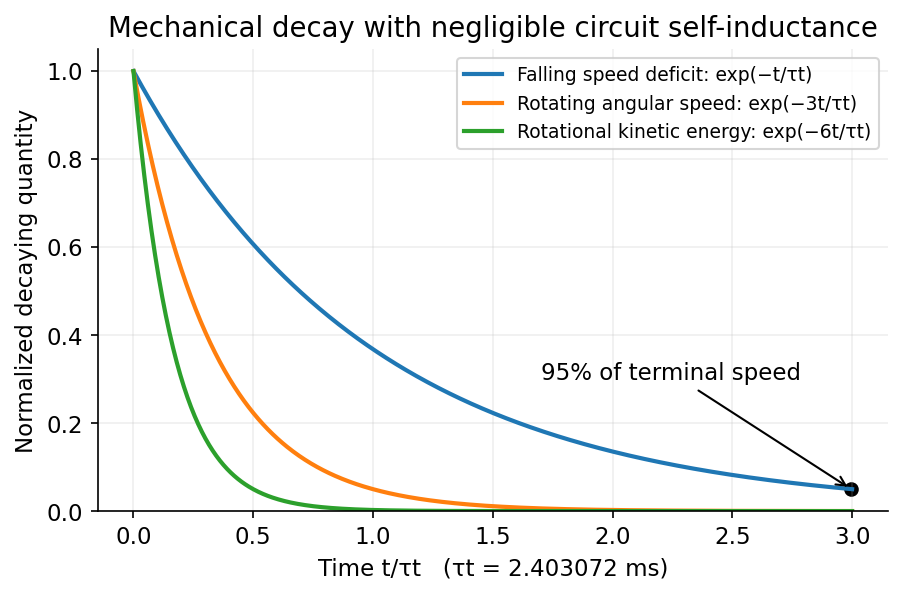
For translational magnetic damping of a square wire loop, while the upper horizontal leg remains in the field, a downward speed reduces the flux at rate . Hence , , and the upward magnetic braking force is . With negligible electrical self-inductance,Let the wire cross-sectional area be , mass density , and resistivity . Since and ,These use the printed copper values and . The wire dimensions cancel. The terminal-speed approximation is restricted to the interval before the upper leg leaves the field, as assumed in the question.
For rotational magnetic damping of a square wire loop, consider rotation about the central axis in a uniform field, the flux is . The induced current produces torque . A thin square loop has moment of inertia : the two legs parallel to contribute , and the other two . Averaging over a rotation givesIf “decay time” means rotational kinetic energy rather than angular speed, gives . This distinction, and the assumed separation between rotation period and slow decay, are essential. The electrical and mechanical time scales in magnetic braking must be separated: electrical self-inductance is neglected in both calculations.
For the normal modes of two spring-coupled equal pendulums, a normal mode has every coordinate oscillating at the same frequency with a fixed displacement ratio. The linearized equations here areTheir normalized displacement patterns and angular frequencies areThe spring is unstretched in the in-phase mode, and stretched or compressed in the opposite-phase mode. The numerical ratio follows from .
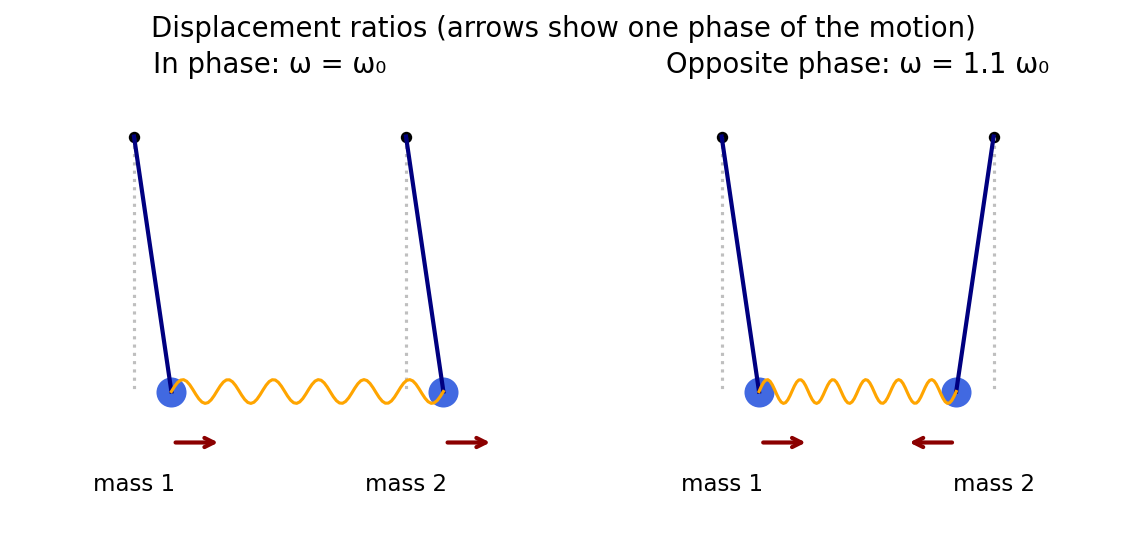
The initial displacement is the equal sum of the two mode patterns, and the initial velocities vanish. ThereforeWith the printed this is , with in seconds. The fast oscillation has frequency and the amplitude is bounded by . The first complete displacement transfer is at , when , and both velocities vanish; the original state returns at . Distinguishing absolute and signed beat envelopes, the absolute beat envelope repeats every , although its signed sine factor has period .
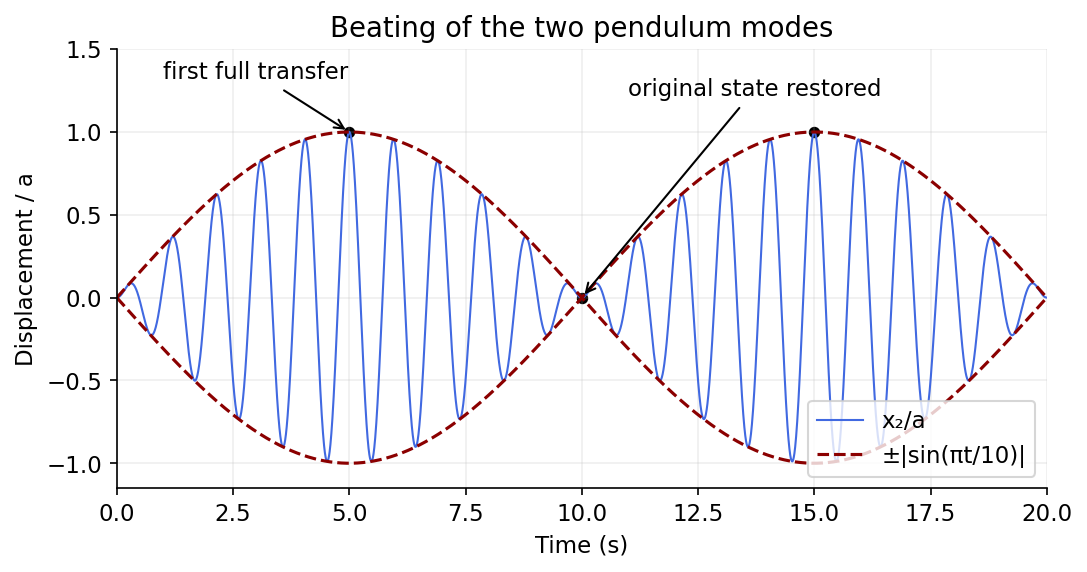
The second pendulum oscillates inside a ten-second beat envelope and first receives the full displacement at five seconds
. Source. Details. Nonrelativistic momentum conservation gives , while an elastic collision conserves kinetic energy, . Squaring the momentum equation yields . The two nonzero outgoing velocities are perpendicular. In the degenerate case where one outgoing particle is at rest, its direction is undefined.
For relativistic collisions conserve total four-momentum, with , and . Rest energies must be included; for photons .
For the symmetric relativistic equal-mass scattering angle, the incident momentum is . Energy conservation gives each final particle , hence . Transverse momenta cancel and , givingThe nonrelativistic limit has , so the outgoing angle is as above.
For the symmetric two-photon annihilation angle in the specified electron-positron annihilation, each photon has energy . Momentum conservation gives , soAs the two photons become back-to-back, transverse to the limiting incident direction; as they are forward collimated. Equal photon energies follow from the specified equal angles, and are not a general property of annihilation in a moving laboratory frame.
Two applications of optical interferometry are precision displacement or strain measurement, and Fourier transform spectroscopy, which recovers a spectrum from an interferogram.
For the round-trip phase in a Michelson interferometer, take a lossless 50:50 beam splitter with and , and mirror reflection amplitude . At the depicted detector, each returning path has one beam-splitter transmission and one reflection. Their amplitudes are and . Consequently,The factor 2 in the phase is the return journey: the labelled is a one-way arm-length difference. The other output port has the complementary intensity. The printed cannot be an intensity: it becomes negative, and does not match the depicted path difference. No choice of normalization fixes that negative minimum. The expression above is the physically consistent result for the drawn output port.
For mutually incoherent spectral components with incident power density ,The plot labels are and ; these printed centres are used here. In the narrow-line, equal-power limit, each line has incident intensity andThere are rapid carrier fringes with approximately mirror-displacement spacing and a slowly varying Interferometric visibility envelope. The first visibility zero is at , and successive visibility revivals are separated byFor the unequal-line visibility in a spectral doublet, with incident line powers , replace the intensity by . The visibility becomesThe visibility minima rise from zero to . The finite widths drawn in the spectrum also make coherence decay with path difference. For example, Gaussian lines of common wave-number standard deviation multiply the oscillatory term by ; the actual linewidth is not specified numerically. Thus the narrow-line plot gives the beat positions, while the true long-delay oscillations die away.[ref]
Interference and Coherence by Sander Konijnenberg, Aurèle J.L. Adam and H. Paul Urbach. Temporal coherence and interference of incoherent spectral components
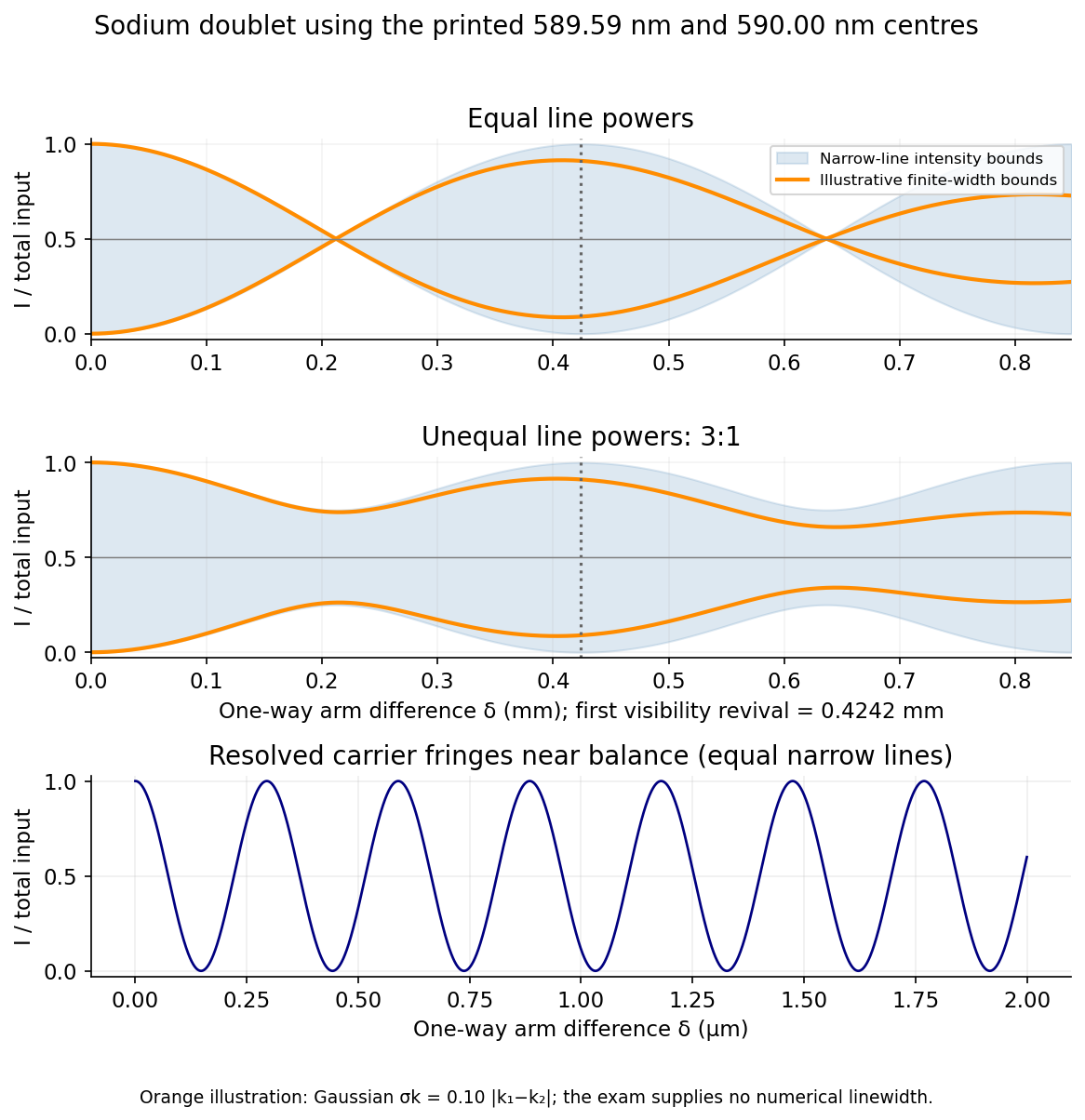
Doublet interferograms: unequal line powers prevent complete loss of visibility; finite linewidth damps the revival envelope
. Source. Details. The common-arm phase cancellation in a balanced interferometer means there is no smallest positive common mirror distance in a balanced interferometer. With the common factor cancels from every intensity, and both paths interfere constructively at this detector for every . Their infimum is zero. The beat length describes changes of arm difference, not of the common arm length. It therefore cannot answer the final request as printed.
The classical minimum is , attained at . The quantum oscillator has , its zero-point energy; simultaneous zero position and momentum uncertainties are forbidden.
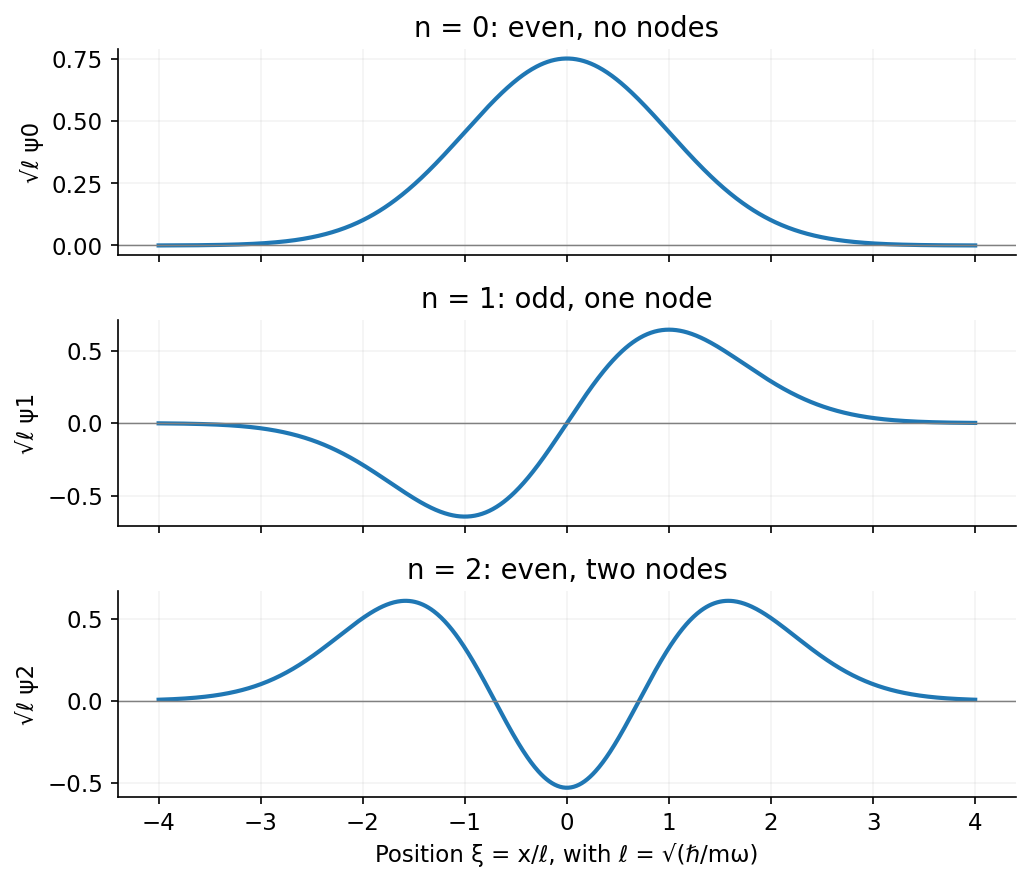
Let and . The first three normalized harmonic oscillator eigenfunctions areThey have respectively zero, one and two nodes, with even, odd and even parity. Their phases may be reversed without changing the state.[ref]
Invert the given ladder operators:Because the Energy eigenstate are orthonormal, : each operator changes the state to one orthogonal to . HenceThe result also follows from the definite parity of every oscillator energy eigenfunction, but here it follows directly from the specified operators.
Orthogonality gives , while the ladder coefficients give and . Squaring the expressions for and therefore givesThusTheir equality is the harmonic-potential case of the quantum virial theorem, and their sum is the oscillator energy .
For the uncertainty product of oscillator number states, the two means vanish, so the standard deviations are the square roots of the second moments:Consequently,Only the ground state saturates the Heisenberg uncertainty principle in this sequence of energy eigenstates; the excited number states have a larger uncertainty product.
In the position representation, the momentum operators are and . Thereforesince at fixed radius. Solving the eigenvalue equation on the circle and imposing periodicity givesTheir normalization uses the angular measure on .
For the half-ring sine-squared angular state, write . The stated wavefunction is normalized because . It and its first derivative match continuously to zero at the boundaries, so the integrations by parts have no boundary contributions. The angular momentum expectation and second moment areHence . The jumps in the second derivative do not invalidate this result: the periodic wavefunction has a square-integrable second derivative and a continuous first derivative.
The probability of is the squared projection onto :The odd sine term gives the imaginary overlap; a real wavefunction need not have zero probability of nonzero angular momentum. Its positive and negative angular-momentum probabilities are equal.[ref]
Quantum Mechanics by David Tong. Chapters 3–4: operator expectation values, angular momentum and eigenstate projections
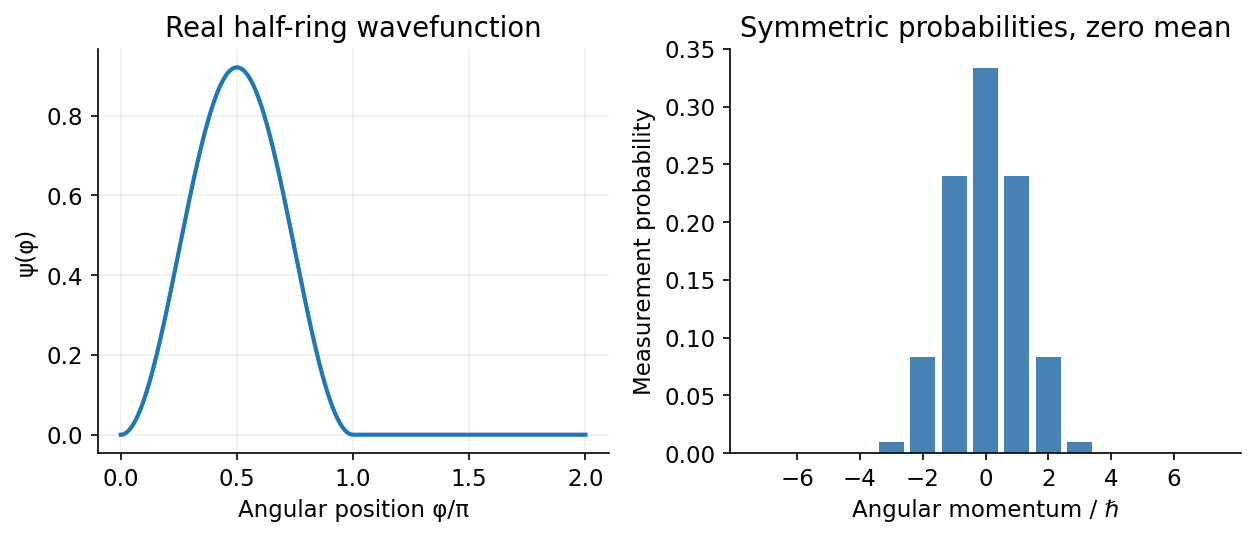
A real state confined to half a ring has zero mean angular momentum and symmetric nonzero measurement probabilities
. Source. Details. Original public paper: Physical PDF pages 689–699. All questions and alternatives are answered. Idealizations and phase conventions are stated where they affect the answer.
For an infinite cubic potential well of side , the one-particle energy eigenvalues are , where and each quantum number is a positive integer. The lowest spatial orbital is , with energy and orbital degeneracy one. The next energy is , with three orbitals given by permutations of .
Spin-zero identical particles are bosons. Both can occupy the lowest orbital, so the two-boson ground state is nondegenerate. The first excited total energy is : one particle occupies the lowest orbital and one an excited orbital. Symmetrizing the two-particle wavefunction gives one state for each of the three excited orbitals, so the first-excited degeneracy is three.
Spin-half identical particles are fermions, so the total state must be antisymmetric. Two particles in the same lowest orbital have a symmetric spatial wavefunction and must form the unique spin singlet state. Thus the fermion ground state is also nondegenerate. At the first excited energy, each choice of excited spatial orbital permits a symmetric spatial state with a singlet state, or an antisymmetric spatial state with a three-dimensional triplet state. ThereforeThe spin multiplicity is essential: counting only the three orbital choices would omit allowed triplet states. The result assumes ordinary spin-statistics, an unsplit spin degeneracy and the hard-wall cube model.
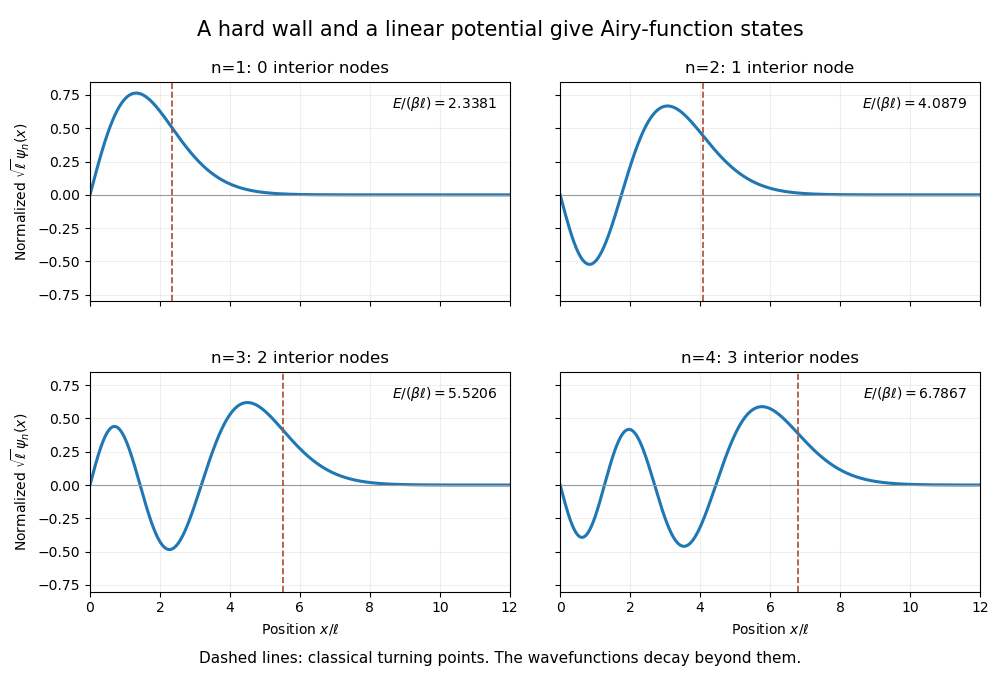
The hard wall imposes , while the increasing linear potential requires decay as . SetThe stationary Schrödinger equation becomes . The growing Airy function solution is excluded, leavingThis is the quantum bouncer. For the first four states, . Their interior node counts are respectively zero, one, two and three. Each wavefunction starts at zero at the wall, oscillates in the classically allowed interval, and crosses smoothly into an exponentially decaying tail beyond the turning point . The turning point is not an extra hard wall: the wavefunction generally remains nonzero there and beyond it.
In the sudden approximation, the nuclear charge changes before the electronic wavefunction has time to evolve. Immediately afterward the state is still the original hydrogenic 1s wavefunction, now expanded in the eigenstates of the new Coulomb Hamiltonian. The final-ground-state probability is the squared overlap, rather than one minus an energy change.
For initial and final charges , the normalized 1s overlap isUsing givesThe remaining probability includes higher bound states and the -wave ionization continuum. In this central, instantaneous model the initial orbital has , and angular orthogonality excludes states with . The electronic spin is unchanged. Nuclear recoil and interactions with the emitted decay particles are outside this leading sudden-charge-change approximation.
For a homogeneous ideal gas in a two-dimensional box of area , with dispersion and one internal state, the density of states is . The excited-particle density at temperature isAs , this diverges. Hence at every fixed positive temperature the excited states can accommodate any finite areal density with ; they never saturate at a finite critical density. There is no finite-temperature Bose-Einstein condensation in the homogeneous two-dimensional ideal gas thermodynamic limit.
The low-energy logarithmic divergence is the reason, not merely the small number of spatial dimensions. A finite box has a low-energy cutoff and a crossover; a trap changes the density of states and can change the conclusion. Condensation at zero temperature and an interacting gas's Berezinskii–Kosterlitz–Thouless transition are separate issues. The proof assumes the uniform quadratic-dispersion model, rather than every conceivable two-dimensional trapping potential.
A spin-half gas has two spin states. Filling the Fermi sphere at zero temperature gives , soWith , the number density is and . ThusThe associated Fermi temperature isFermionic degeneracy matters on cooling to a few kelvin or below in this model, and is pronounced for . Liquid helium-3 is interacting; its quasiparticle effective mass and thermodynamics need not equal the bare-mass free-gas predictions. The requested calculation is the ideal Fermi-gas scale.
For total relativistic energy , the speed is . Both beam energies are enormously greater than the rest energy, so expanding the square root avoids obscuring the small difference:With all energies in GeV, , and , givingThe deficits below the speed of light are about and . The large energy increase therefore produces only a small speed increase; the energy mainly changes the Lorentz factor. These numbers use the quoted beam energies as total energies. Interpreting them as kinetic energies requires adding the rest energy, with only a tiny correction at these scales.
Let be the cylinder centre's small displacement away from the wall. Rolling without slipping gives rotation angle of magnitude . The material point initially at the top moves horizontally by another relative to the centre to first order, so the spring extension is , not . Its small vertical displacement affects the extension only at higher order.
The kinetic and potential energies areThe linearized equation is , givingStatic friction enforces the rolling constraint and does no work at the instantaneous contact point. Omitting rotational kinetic energy, or attaching the spring to the centre instead of the top material point, would change the result.
An element at carries charge . Its field at the origin points opposite its radial position. By Coulomb's law,ConsequentlyFor the particle starts along ; for the opposite sign it starts along . Reflection symmetries make the axis invariant for motion released there from rest. The ring has zero net charge but a nonzero dipole moment, so zero total charge does not imply zero field at its centre.
Assume independent arrivals at constant rate , so the count follows a Poisson distribution. In its mean is . ThereforeOver observation time , the rate estimate is and its standard deviation is . Thus the fractional one-standard-error uncertainty is . To make this strictly less than ten per cent requiresThe mean current magnitude is . The accuracy statement needs a confidence convention: the boxed time uses one standard error, not a guaranteed bound on every realization. A Gaussian 95-percent relative interval would instead require approximately events, or . Dead time and correlated arrivals would need another count model; the mean rate alone does not establish Poisson statistics.
Normalize the central slit amplitude to one. The two outer amplitudes are each, not , because the specified attenuation concerns amplitude. For centre spacing , adjacent slits have phase difference . The far-field amplitude and intensity are thereforewhere is the central slit's intensity alone in the same narrow-slit approximation. Principal maxima have and height ; between them, zeros occur at . Only values in are physical. The endpoints are grazing-direction limits of this ideal angular model.
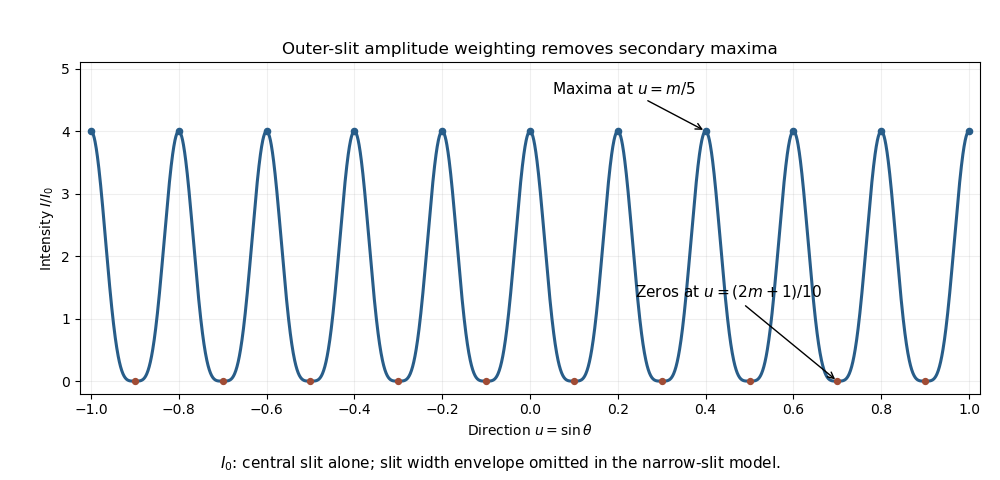
The amplitude weights form a binomial pattern. They remove the secondary maxima that an equal-amplitude three-slit array would have between its principal peaks. No phase shift is needed: changing the coherent weights already changes the interference structure.
For a finite step in a one-dimensional potential and constant mass, the stationary Schrödinger equation requires continuity of the wavefunction and its first derivative. A discontinuous derivative would introduce a delta-function term in its second derivative, unsupported by a merely finite step. A discontinuous wavefunction is still more singular. A delta-function potential has a different derivative jump condition; an infinite wall instead imposes zero wavefunction and does not require matching to an exterior zero derivative.
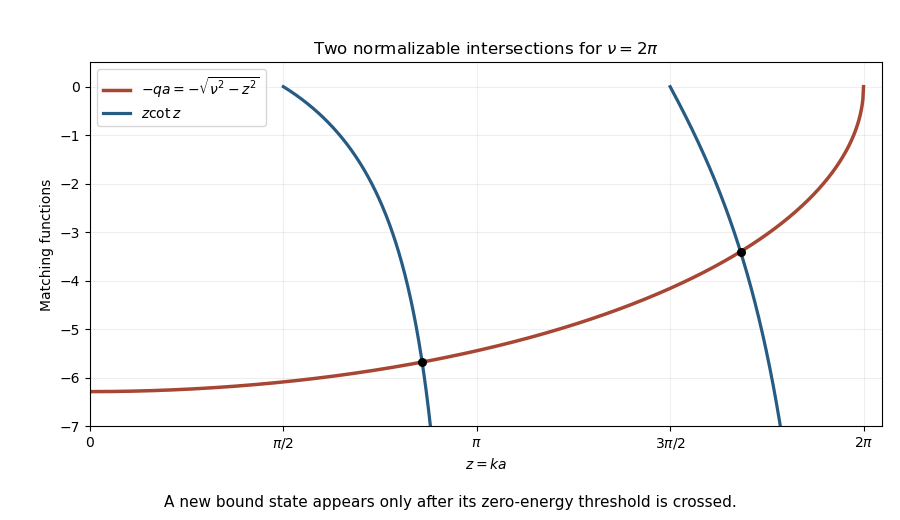
For a bound state of the half-well, . The wall at zero excludes a cosine term, and square integrability excludes exponential growth outside. WriteContinuity at gives and . HencePut , , and . Matching becomes with , . The negative branches of occur on . There is one bound-state intersection in the th interval exactly whenAt equality the new level has , so its outside tail is constant and not normalizable: it is a threshold state, not a bound state. Thus no bound state exists for , including the strict inequality asked in the question.
Exactly two negative-energy bound states require the second threshold to have been crossed and the third not crossed:The lower endpoint is excluded and the upper endpoint included precisely because a zero-energy threshold state does not count as bound. This half-line finite-well bound-state count differs from an unrestricted symmetric one-dimensional well, which has no hard wall at its centre.
Black-body radiation is the equilibrium electromagnetic radiation associated with a perfect absorber, whose spectrum is fixed by its temperature and the available modes. Photons can be emitted and absorbed, so their equilibrium chemical potential is zero. The model here retains two transverse polarizations in an effectively one-dimensional cavity; the resulting pressure is a one-dimensional mechanical force, not a three-dimensional pressure in pascals.
Standing-wave wave numbers are , with one positive mode index and two polarizations. Since , the continuum density of states isThe factor two counts polarizations; counting independent positive and negative traveling momenta in addition would double count standing modes. The thermal energy isThus the one-dimensional photon-gas thermodynamics givesReplacing the mode sum by an integral requires the stated temperature to be large compared with the level-spacing scale. This is thermal energy above the vacuum contribution; a separate boundary-dependent vacuum energy is not included.
Differentiating at fixed length gives the heat capacityThe linear temperature dependence reflects the constant one-dimensional mode density, in contrast to the cubic dependence of a three-dimensional photon gas.
Write , so . At fixed length, , giving with the entropy constant fixed by the unique photon vacuum. The thermal Helmholtz free energy and generalized pressure follow:The entropy constant can also be checked from the exact discrete photon partition function; the continuum approximation should not be extrapolated blindly below its level-spacing regime. In one dimension , whereas the isotropic three-dimensional relation is . Both follow from the number of spatial directions carrying momentum flux.
The quasistatic pressure-volume work done on the body is . If its volume remains constant throughout the process, every vanishes, so the work is zero. Equal initial and final volumes alone would not suffice: an expansion and compression cycle can have nonzero work. Other work modes are excluded by this simple elastic-volume model.
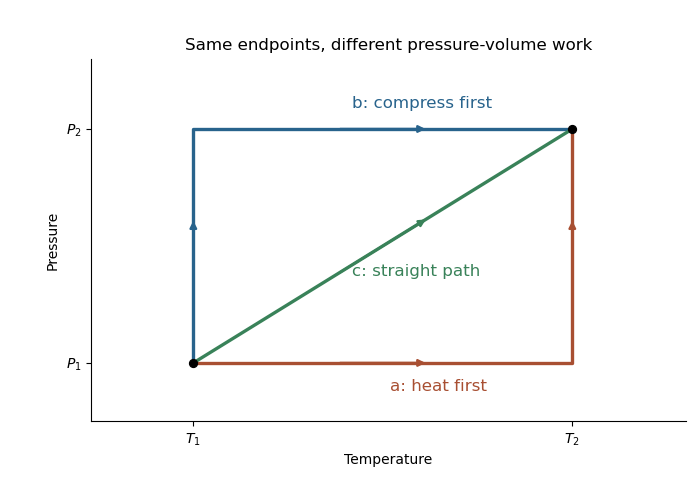
Within the stated small-volume-change approximation, treat in the differential constitutive law as constants. ThenPath (a) first changes temperature at pressure , then changes pressure at fixed temperature . The two contributions are and . ThereforeWork is path dependent even though the endpoints and approximate total volume change are the same.
Path (b) changes pressure before temperature. Its pressure integral is unchanged, but the thermal expansion occurs at :Along the straight path (c), . Thus , while depends only on the pressure endpoints. ConsequentlyThis pressure-temperature path-work identity is a consequence of the linearized volume law and the straight interpolation. It need not hold for strongly varying compressibility or expansion coefficient.


Articles were limited to the first 100 out of 212 total.
Articles by others on the same topic
There are currently no matching articles.