For put , with , and write the discriminant asThe second factor is positive for every , since . The first changes sign at the positive solution of , . Numerically , so . The growing branch exists for , givingEquality is neutral, so this is an infimum wavelength, rather than an attained shortest growing mode.
In the unstable interval,Both phase-speed branches have the same real part there; the imaginary parts have opposite signs. At and beyond the short-wave cutoff the growth rate is zero and the two real speeds areThey split continuously from and approach the boundary-flow speeds zero and at large . As , , so linearly with , despite a finite limiting . A zonally uniform disturbance has no exponential growth from this mechanism.
The maximum growth minimizes . Its derivative isThe positive interior minimum is at , yieldingThe supplied phase-speed formula therefore predicts fastest growth at a wavelength of order four deformation lengths, not at the short-wave cutoff.
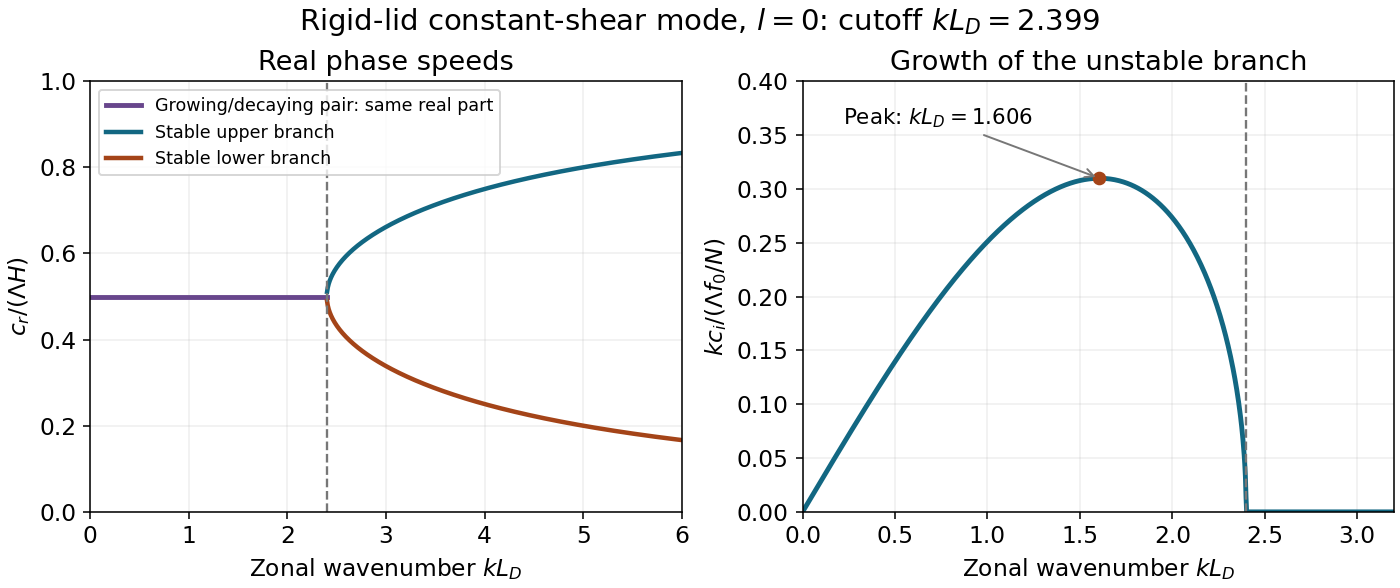
Phase speeds and growth rate of the rigid-lid constant-shear baroclinic mode; cutoff and fastest-growing wavelengths follow from the supplied discriminant
. Details. 
Articles by others on the same topic
There are currently no matching articles.