Let denote buoyancy in a stably stratified Boussinesq approximation. Geostrophic balance and hydrostatic balance imply the thermal wind relation . Consequently the specified vertical shear requiresFor northern-hemisphere and , the mean potential temperature decreases northward and increases upward: , . The corresponding mean isentropes slope upward toward the north, with . Stable potential-temperature stratification does not require the actual temperature to increase upward; the dry adiabatic lapse also enters that comparison.
In the rigid-lid constant-shear baroclinic model, perturbation quasi-geostrophic potential vorticity isThe mean interior potential-vorticity gradient vanishes on this constant-, constant-, linear-shear basic state. Linear advection of that perturbation therefore becomes , the supplied interior equation. It retains slow balanced motion and omits friction, planetary-vorticity gradients and nonlinear disturbance advection.
Substitution of givesA possible branch has zero interior perturbation potential vorticity, soBoth supplied applications have , so this equals the source's expression. For an unstable mode the nonzero imaginary part of the phase speed prevents a real critical level ; for real speeds the displayed solution remains a valid zero-interior-PV branch away from, and smoothly through, any critical level. Taking the real part gives the physical disturbance.
The rigid lids enforce . Linearized adiabatic buoyancy conservation isUse the geostrophic conventions and . At a lid this gives , henceThese are the no-normal-flow condition expressed through boundary buoyancy advection, not conditions of zero horizontal velocity. Boundary temperature anomalies can interact even though this solution has no interior perturbation PV, allowing baroclinic instability to extract mean available potential energy.
For put , with , and write the discriminant asThe second factor is positive for every , since . The first changes sign at the positive solution of , . Numerically , so . The growing branch exists for , givingEquality is neutral, so this is an infimum wavelength, rather than an attained shortest growing mode.
In the unstable interval,Both phase-speed branches have the same real part there; the imaginary parts have opposite signs. At and beyond the short-wave cutoff the growth rate is zero and the two real speeds areThey split continuously from and approach the boundary-flow speeds zero and at large . As , , so linearly with , despite a finite limiting . A zonally uniform disturbance has no exponential growth from this mechanism.
The maximum growth minimizes . Its derivative isThe positive interior minimum is at , yieldingThe supplied phase-speed formula therefore predicts fastest growth at a wavelength of order four deformation lengths, not at the short-wave cutoff.
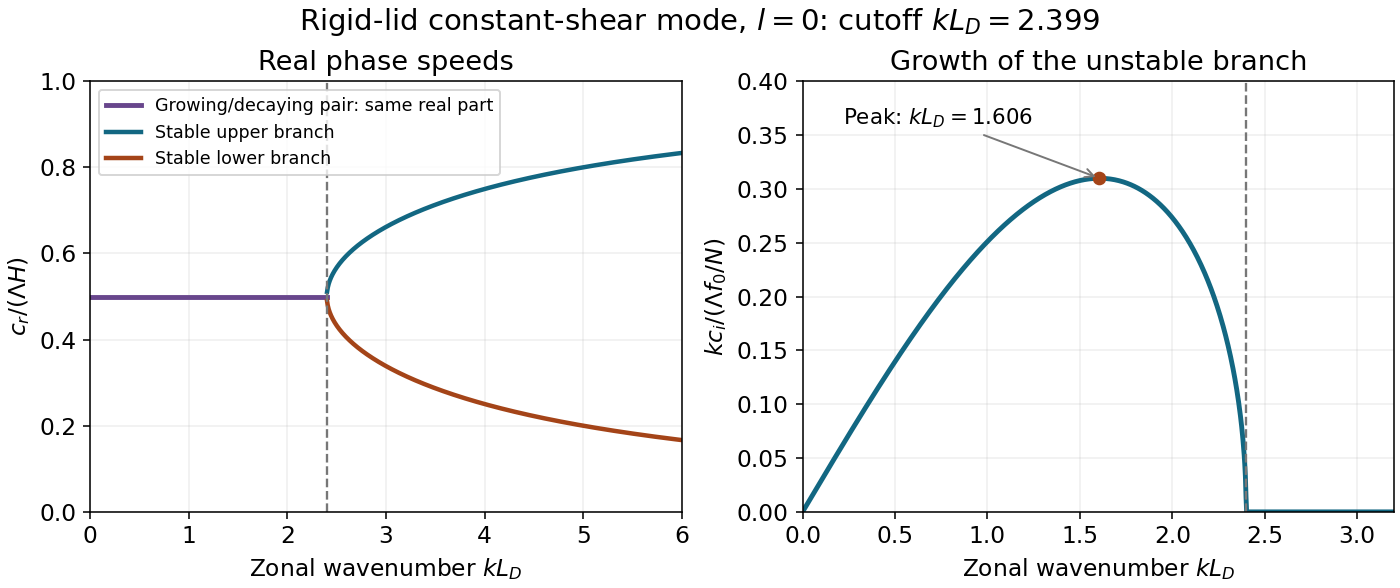
Phase speeds and growth rate of the rigid-lid constant-shear baroclinic mode; cutoff and fastest-growing wavelengths follow from the supplied discriminant
. Details. 
Write the vertical complex amplitude as . A constant streamfunction phase has , hence . For , westward tilt with height implies . With and , a zonal average over the wave givesfor the northern-hemisphere conventions used here. This is the westward tilt and poleward eddy heat flux relation. Warm anomalies move northward and cold anomalies southward, transporting heat down the mean gradient . The tilt describes the relative phases needed for a nonzero flux, not the literal trajectories of fluid particles along a tilted streamfunction crest.
The flux reduces the mean meridional temperature contrast and converts mean available potential energy into eddy available potential energy. In the perturbation buoyancy-variance budget its production term is . Correlated rising warm anomalies and sinking cold anomalies have positive , converting that eddy potential energy into kinetic energy. The flow is therefore energized by the baroclinic reservoir associated with tilted density/potential-temperature surfaces. It is not simply a claim that the disturbance amplifies while leaving the basic state's thermal structure unchanged.
For nonzero meridional wavenumber,At least one growing zonally varying mode can exist only ifThe upper value is a supremum approached as , where the growth itself tends to zero. Thus not every permitted meridional wavenumber has the same fastest-growing zonal scale; nonzero restricts the available band of and weakens the growth factor at fixed .
Using , not the tabulated squared value itself, givesThe planetary radii put these into angular context: is about 280 for Earth and 149 for Jupiter, corresponding to minimum meridional angular wavelengths about and , respectively. They are reciprocal-length wave numbers; the dimensionless angular counts should not be substituted for in the Cartesian dispersion relation. If a channel admits a half-wave across its width, the corresponding minimum width is rather than a full wavelength.
The oceanic scale is mesoscale, while the much larger deformation length makes the Jovian modes thousands of kilometres across. Both are small fractions of the planetary radius, consistent with using a local patch as a first approximation. Real boundaries, planetary-vorticity gradients, varying stratification and jets can change these limits; this simple model alone does not predict the complete observed flow pattern.
Finally, the source's phrase must be interpreted in the mean-flow frame. The actual criterion is , or . In the original frame has nonzero real part, so is generally complex, not an ordered negative real number. For example, at and , and . This is an unstable wave even though the literal printed inequality is inapplicable.
Articles by others on the same topic
There are currently no matching articles.